


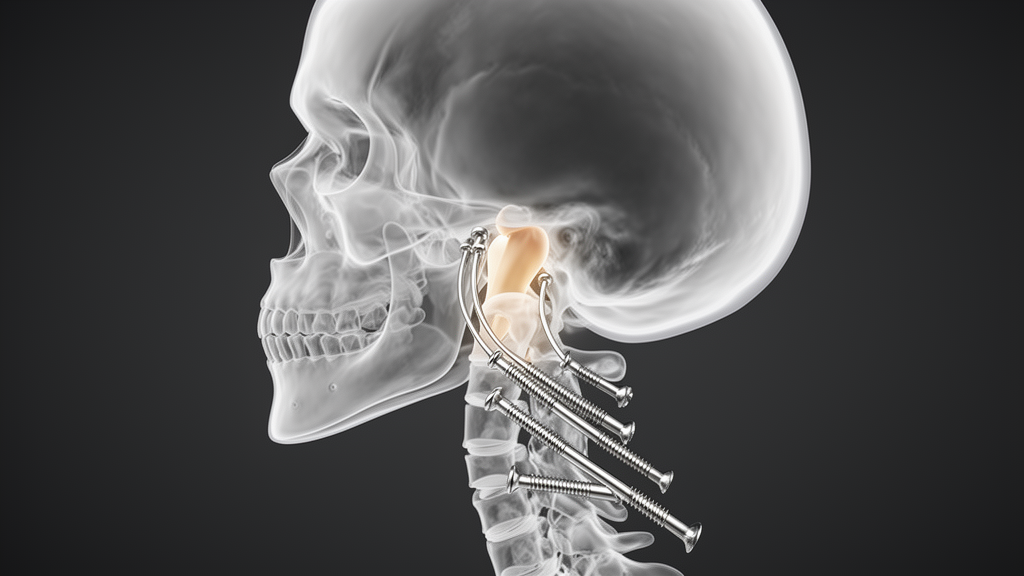
Basilar invagination, a rare but serious malformation at the junction of the skull and spine, forces surgeons to rethink the geometry of one of the most delicate operations in the body. A new computed tomography study of 150 patients with the condition and 150 asymptomatic controls shows that the anatomical distortions caused by the anomaly systematically change the parameters that guide anterior atlantoaxial screw placement, meaning the standard trajectories used in healthy necks cannot simply be transferred to these patients.
The research, published in the European Journal of Medical Research, simulated four anterior fixation configurations on CT scans from each participant: C1 anterior lateral mass screws, C2 anterior pedicular screws, C2 anterior transarticular screws, and C2 vertebral screws. For every simulated screw, the team measured trajectory length, coronal inclination angle, sagittal inclination angle, and the articular surface angle, then compared the values between the basilar invagination group and the controls.
The comparisons revealed consistent, statistically significant differences. In the patient group, the coronal inclination angle for C1 anterior lateral mass screws increased. For C2 anterior pedicular screws and C2 anterior transarticular screws, both the sagittal inclination angle and the articular surface angle rose by roughly five to eight degrees. The two C2-based approaches diverged in another respect: the pedicular screws showed a three-degree reduction in coronal inclination, while the transarticular screws showed a four-degree increase.
Perhaps the most consequential finding concerned screw length. Every screw trajectory simulated in the basilar invagination group was shorter than its counterpart in the controls, with shortening exceeding ten percent, equivalent to two to three millimeters. In a region where millimeters separate a secure screw from injury to the vertebral artery or spinal cord, that margin matters. The authors conclude that surgeons must adapt both screw length and insertion angles to the altered anatomy rather than relying on measurements derived from normal populations.
Subgroup analyses within the patient cohort added further layers of detail. In cases where basilar invagination was accompanied by atlantooccipital assimilation, a congenital fusion of the atlas to the skull base, the C1 anterior lateral mass screws showed both reduced trajectory length and a reduced coronal inclination angle. When the anomaly coexisted with C2-3 fusion, the C2 anterior pedicular screws displayed a decreased coronal inclination angle but an increased sagittal inclination angle.
The severity classification of the malformation also influenced the measurements. The articular surface angle of the C2 anterior pedicular screws was greater in patients classified as Type A basilar invagination than in those with Type B disease. Taken together, the subgroup results indicate that the degree of variability in screw length and inclination angles grows substantially when the condition is complicated by atlantooccipital assimilation, C2-3 fusion, or atlantoaxial dislocation.
The clinical logic behind the study is straightforward. Anterior atlantoaxial fixation is an established and effective surgical treatment for basilar invagination, but the anomaly is associated with a wide range of complex anatomical variations that fundamentally alter the critical parameters of screw trajectories. Because few prior studies had addressed this problem directly, the researchers used CT-based simulation as a way to quantify the differences before patients reach the operating table.
The study’s scope deserves emphasis. All measurements came from simulated screw placement on imaging, not from actual operations, so the findings describe planning geometry rather than surgical outcomes. The cohort spanned scans collected from June 2013 to December 2024, and the analysis was limited to the four anterior configurations tested. Posterior approaches, patient-specific instrumentation, and long-term clinical results remain outside what this dataset can address.
Even so, the message for surgical planning is concrete. When a patient presents with basilar invagination, the preoperative CT should be treated as the primary source of trajectory data, with screw lengths expected to run two to three millimeters shorter than standard and inclination angles shifted by several degrees depending on the specific configuration and on whether assimilation, segmental fusion, or dislocation is present. The study’s authors frame this as a matter of safety: adapting to the measured anatomy, rather than assuming normal anatomy, is what allows screws to be placed securely in one of the most crowded corridors in spinal surgery.
Subject of Research: Computed tomography analysis of how basilar invagination alters anterior atlantoaxial screw trajectory parameters compared with healthy controls
Article Title: Impact of anatomical variations in basilar invagination on anterior atlantoaxial fixation: a computed tomography-based analysis of screw trajectories
Article References: Cai, M., Chen, Z., Chen, J., Ma, R., Wu, Y., Huang, X., Ma, X., & Zou, X. (2026). Impact of anatomical variations in basilar invagination on anterior atlantoaxial fixation: a computed tomography-based analysis of screw trajectories. European Journal of Medical Research. https://doi.org/10.1186/s40001-026-05314-8
Image Credits: AI Generated
DOI: 10.1186/s40001-026-05314-8
Keywords: basilar invagination, atlantoaxial fixation, computed tomography, screw trajectory, craniovertebral junction, spinal surgery, atlantooccipital assimilation, C2 pedicular screws, surgical planning, anatomical variations, Impact, anatomical
News Source: Ophelia Keating. (October 30, 2026). CT scans reveal basilar invagination reshapes screw paths in neck surgery. Scienmag.



