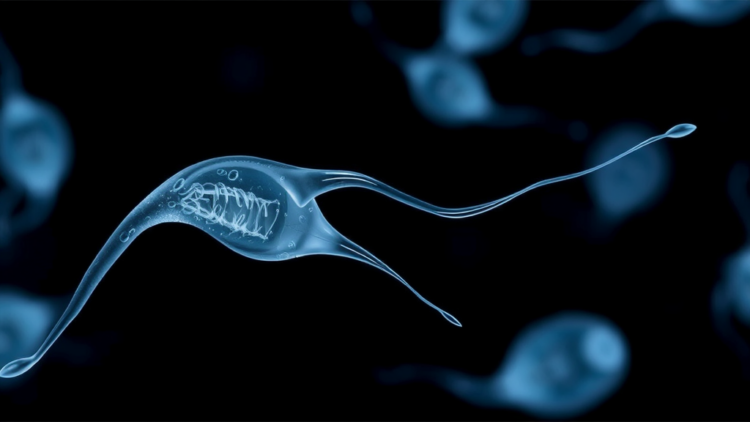
A new study comparing the two main ways of freezing human sperm has found that even when samples look equally healthy under the microscope, the proteins inside them tell a strikingly different story. Researchers led by Guruprasad Kalthur of Manipal Academy of Higher Education, working with proteomics specialists at Yenepoya University and other Indian institutions, froze donated semen samples using both a conventional rapid freezing method and a vitrification technique that avoids penetrating cryoprotectants, the toxic chemicals normally added to protect cells from ice damage. Their findings, published in Reproductive Sciences, show that vitrification preserved visible features such as sperm head shape better than rapid freezing, yet it triggered roughly twice as many changes in the sperm proteome. The work raises important questions about whether standard laboratory assessments of frozen sperm are sufficient to guarantee that the cells retain their full fertilizing potential.
The motivation for the study lies in a long-standing tension in reproductive medicine. Sperm cryopreservation is a cornerstone of fertility treatment, preserving samples for cancer patients before chemotherapy, for men undergoing vasectomy, and for countless assisted reproduction cycles. Yet the process is inherently damaging. Ice crystal formation, osmotic shock, and exposure to cryoprotective agents all conspire to injure the delicate sperm cell. Conventional approaches add penetrating agents such as glycerol, which cross cell membranes to limit ice formation but can themselves disrupt membranes, the cytoskeleton, and mitochondrial function. Vitrification offers an alternative: by cooling cells so rapidly that water solidifies into a glassy state rather than crystalline ice, it can, in principle, protect sperm without any penetrating chemicals at all. Cryoprotectant-free vitrification has already produced healthy births in humans, but whether it is truly gentler on sperm biology has remained contentious.
To address the question at a molecular level, the team collected leftover ejaculates from 71 men attending an andrology laboratory for routine semen analysis. Each liquefied sample was split and preserved in parallel using both rapid freezing and penetrating cryoprotectant-free vitrification, then stored for at least seven days before thawing. This paired design is powerful because it allows direct comparison within each donor, minimizing the noise created by natural variation between men. After thawing, the researchers measured the classic functional benchmarks used in andrology clinics: post-thaw motility, mitochondrial function, DNA integrity, and acrosomal integrity, the intactness of the enzyme-filled cap on the sperm head that is essential for penetrating an egg.
The functional results were, on the surface, reassuring. Motility, mitochondrial performance, DNA damage, and acrosomal status were statistically similar between the two preservation methods, suggesting that the penetrating-cryoprotectant-free vitrification medium performs no worse than the established rapid freezing protocol. There was even one clear advantage: sperm head morphology, the shape and structural appearance of the cell’s DNA-containing compartment, was better preserved in vitrified samples. Since head morphology is closely tied to chromatin packaging and overall sperm quality, this observation alone would be encouraging news for clinics considering vitrification as a standard option.
But the deeper story emerged only when the researchers turned to mass spectrometry-based proteomics. Using data-independent acquisition, a high-throughput approach that enables deep and reproducible profiling of complex protein mixtures, the team identified a total of 4,378 proteins in the sperm samples. Compared with fresh, unfrozen spermatozoa, rapid freezing significantly altered the abundance of 760 proteins. Vitrification, remarkably, altered 1,661 proteins, more than twice as many. In other words, two methods that produced functionally indistinguishable sperm by conventional assays left profoundly different molecular fingerprints on the cells.
Gene Ontology analysis, a bioinformatics technique that maps altered proteins onto known biological functions, revealed considerable overlap between the two methods. Both preservation approaches disrupted proteins involved in cytoskeletal organization, the internal scaffolding that maintains sperm shape and powers flagellar beating. Both changed the abundance of proteins governing oxidative stress responses, reflecting the burst of reactive oxygen species that accompanies freezing and thawing. Both shifted proteins tied to energy metabolism, the mitochondrial machinery that fuels movement, and both affected proteins implicated in fertilization itself, including molecules involved in sperm-egg recognition and membrane fusion. The shared patterns confirm that the fundamental stress of cryopreservation, whatever the method, strikes the same core biological systems.
Yet within these shared categories, the details diverged. The magnitude and composition of the altered protein sets differed between the vitrified and rapidly frozen groups, indicating that each method imposes its own distinct molecular burden. Proteins associated with the acrosome, the mitochondrial sheath, and the flagellar axoneme showed method-specific changes in abundance. Some of these proteins, such as heat shock proteins, annexins, and fertilization factors like IZUMO1-family molecules, are well-established players in sperm function and have been linked to fertility outcomes in both human and animal studies. Their differential perturbation suggests that the two freezing routes may not be biologically equivalent even when they pass the same clinical tests.
The authors are careful not to overstate the implications. Sperm are transcriptionally silent cells, stripped of most internal organelles and reliant on pre-existing proteins, so protein abundance changes are among the most direct readouts of cryodamage available. But whether the proteomic shifts observed here translate into reduced fertilizing capacity, altered embryo development, or any long-term consequence for offspring remains unknown. Functional assays such as motility and DNA fragmentation tests capture only part of sperm biology, and this study demonstrates precisely how much can escape them. The researchers explicitly call for further investigation to establish possible differences in fertilizing potential, long-term safety, and reproductive outcomes between the two preservation strategies.
The study also carries practical weight for the fertility clinic. Penetrating cryoprotectants, while effective, are known to be toxic, and their removal from the preservation workflow has obvious appeal, particularly for samples with low sperm counts where recovery of every viable cell matters, such as in surgical sperm extraction for men with obstructive azoospermia. The finding that vitrification better preserves head morphology adds to its credentials. At the same time, the doubled proteomic disruption observed here is a caution against assuming that eliminating chemicals eliminates harm. Ultra-rapid cooling creates its own stresses, and the cell’s protein complement records them all. The raw proteomic data have been deposited in the PRIDE repository, making the resource available to other researchers seeking biomarkers of cryotolerance.
Ultimately, this work exemplifies a broader shift in reproductive science: the recognition that a sperm cell’s clinical performance cannot be fully inferred from how it moves or looks. Deep molecular profiling is revealing layers of damage and resilience that conventional diagnostics never touch. For the thousands of couples whose treatment depends on frozen sperm each year, the message is nuanced but important. Both rapid freezing and cryoprotectant-free vitrification deliver functionally comparable samples by today’s standards, and vitrification may offer structural advantages. But the frozen sperm that fertilizes an egg is more than its motility score, and science is only beginning to read the full molecular ledger that cryopreservation writes into every cell.
Subject of Research: Proteomic and functional comparison of human sperm cryopreserved by cryoprotectant-free vitrification versus conventional rapid freezing
Article Title: Cryopreservation of Human Spermatozoa Using Penetrating Cryoprotectant-Free Vitrification Medium Exhibits an Altered Proteomic Profile Compared to the Conventional Rapid Freezing Method
Article References: Padmar, S., Agrawal, S., Narayana, V. K., Rai, A. B., Poojary, P. S., James, A. M., Poojary, K. K., Kumari, S., Dutta, R., Khan, N. G., Kabekkodu, S. P., Kulkarni, S. D., Acharya, K. K., Adiga, S. K., Subrahmanya Keshava Prasad, T., & Kalthur, G. (2026). Cryopreservation of Human Spermatozoa Using Penetrating Cryoprotectant-Free Vitrification Medium Exhibits an Altered Proteomic Profile Compared to the Conventional Rapid Freezing Method. Reproductive Sciences. https://doi.org/10.1007/s43032-026-02195-4
Image Credits: AI Generated
DOI: 10.1007/s43032-026-02195-4
Keywords: sperm cryopreservation, vitrification, proteomics, male fertility, rapid freezing, sperm motility, DNA damage, mitochondria, acrosome, oxidative stress, assisted reproduction, mass spectrometry
Cite Scienmag News
APA MLA Chicago
Ophelia Keating. (September 12, 2026). Cryoprotectant-Free Vitrification Leaves Hidden Molecular Marks on Human Sperm. Scienmag. https://scienmag.com/cryoprotectant-free-vitrification-leaves-hidden-molecular-marks-on-human-sperm/
Ophelia Keating. “Cryoprotectant-Free Vitrification Leaves Hidden Molecular Marks on Human Sperm.” Scienmag, 12 September 2026, https://scienmag.com/cryoprotectant-free-vitrification-leaves-hidden-molecular-marks-on-human-sperm/. Accessed 12 September 2026.
Ophelia Keating. “Cryoprotectant-Free Vitrification Leaves Hidden Molecular Marks on Human Sperm.” Scienmag. September 12, 2026. https://scienmag.com/cryoprotectant-free-vitrification-leaves-hidden-molecular-marks-on-human-sperm/
Copy citation Download RIS
Tags: acrosomeand molecular compositionassisted reproductionDNA damagehighlighting the need for improved cryopreservation techniquesMale Fertilitymass spectrometrymitochondriaOxidative stressProteomicsrapid freezingsperm cell integritysperm cryopreservationsperm motilityviabilityvitrification