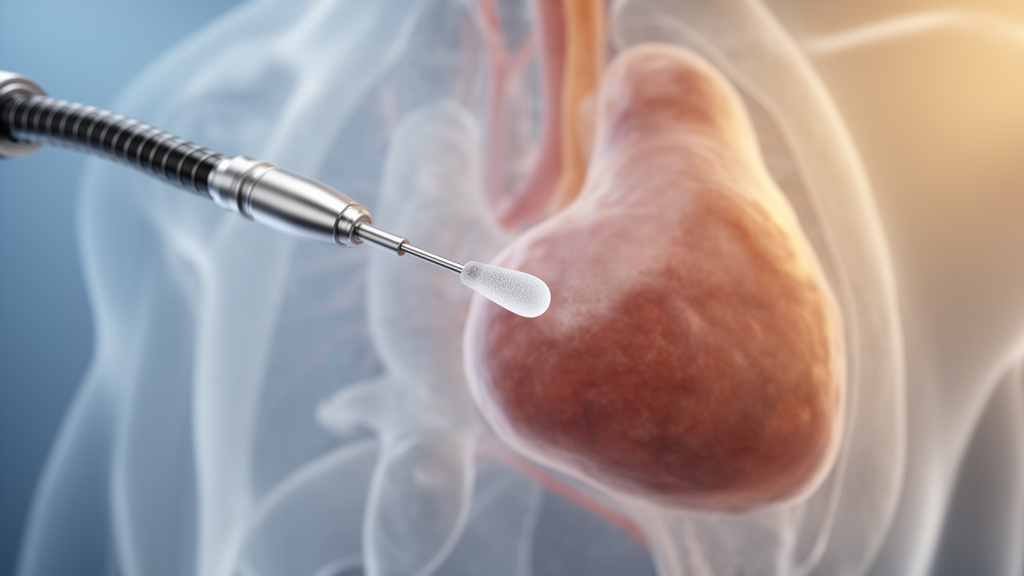
For years, doctors hunting for signs of lung cancer or sarcoidosis deep inside the chest have relied on a somewhat awkward maneuver: threading an ultrasound bronchoscope down the airway, freezing a snippet of lymph node with a cryoprobe, and then pulling the entire scope out of the patient with the frozen specimen still attached. A new study suggests there may be a smoother way, one that keeps the scope in place and the airway under constant view while still delivering diagnostically useful tissue.
The technique, known as endobronchial ultrasound-guided transbronchial mediastinal cryobiopsy, or EBUS-TBMC, has gained traction because it yields larger, architecturally intact tissue samples than the standard needle aspiration method, EBUS-TBNA. Published in Respirology Case Reports, the new prospective case series from researchers in Australia tested whether a slim 1.1 mm cryoprobe could be withdrawn through the 2.2 mm working channel of a linear EBUS bronchoscope, rather than requiring the cumbersome en-bloc removal of the entire scope with the frozen sample attached.
The conventional en-bloc approach has real drawbacks. Pulling the scope out means briefly losing direct visualization of the airway, which delays recognition and management of any bleeding. It also means the vocal cords must be traversed repeatedly, increasing laryngeal irritation, and it can be difficult to re-navigate back to the same biopsy tract in a large or heterogeneous lymph node. Each removal and reinsertion adds procedural time and inefficiency.
Retrieving the specimen through the working channel, by contrast, would keep the scope continuously in place. But the trade-off has been uncertainty: would a smaller probe, squeezed through a narrow channel, produce tissue fragments too small or too crushed for reliable histopathology? The new study set out to answer that question directly by performing both methods on the same lymph node targets in the same patients.
Between August 2025 and January 2026, the team performed EBUS-TBMC on 14 consecutive patients, with 13 ultimately included in the analysis after one case was excluded due to non-separated histopathology processing. They attempted the procedure on 14 lymph node stations. Using a needle tract created with either an Olympus Vizishot 2 Flex 22G or a Mediglobe SonoTip TopGain 22G CrownTip needle, the bronchoscopist advanced the 1.1 mm Erbe cryoprobe and performed two sets of two cryobiopsy passes per station, alternating between through-the-channel retrieval and conventional en-bloc removal. The freeze time was held constant at 3 seconds for both approaches.
The results were striking. EBUS-TBMC was successfully completed on 13 of the 14 lymph node stations, a feasibility rate of 92.9 percent, with a single failed attempt. Of those 13 successful targets, 12 yielded complete paired samples from both methods, giving a paired-biopsy completion rate of 92.3 percent. One through-the-channel attempt failed because the needle tract was lost in a large target after the initial en-bloc biopsy.
Crucially, when the researchers compared specimen sizes across the 12 completed pairs, they found no statistically significant difference. The median size of en-bloc cryobiopsy samples was 3 mm, with a range of 2 to 6 mm, while through-the-channel samples also measured a median of 3 mm, ranging from less than 1 mm to 4 mm. The p-value of 0.197 indicated the difference was not statistically meaningful, despite the numerically larger en-bloc specimens.
Diagnostic yield told a similar story. En-bloc cryobiopsy achieved a diagnostic yield of 93 percent, while through-the-channel cryobiopsy reached 79 percent, a difference that did not reach statistical significance (p = 0.48). Only two through-the-channel samples were deemed non-representative despite corresponding en-bloc samples being adequate. Notably, the first case in the series served as a pilot, and its through-the-channel samples were inadequate; the authors included it deliberately to demonstrate methodological rigor and self-correction rather than to inflate the results.
When compared head-to-head with conventional EBUS-TBNA, the advantage of cryobiopsy became even clearer. EBUS-TBMC achieved a diagnostic yield of 93 percent, while EBUS-TBNA managed only 46 percent across the same cohort. The gap was particularly pronounced in benign disease, especially granulomatous conditions such as sarcoidosis, where needle aspiration has long been known to underperform relative to cryobiopsy. Seven of the 13 patients had non-malignant outcomes, five had malignancies including non-small cell lung cancer, small cell lung cancer, carcinoid, and metastatic papillary thyroid cancer, and one was presumed reactive.
Safety outcomes were reassuring. Chest x-rays were completed in 10 of the 13 cases, and no pneumothorax or pneumomediastinum was observed. There were no bleeding events. Inspection of the bronchoscope by the hospital’s Central Sterile Services Department after the procedures revealed no leaks or damage, suggesting that repeated passage of frozen tissue through the working channel does not compromise the expensive equipment, at least in this small series.
The authors propose a pragmatic hybrid strategy: operators would begin with through-the-channel retrievals, assess sample adequacy macroscopically in real time, and switch to en-bloc removal only if the samples appear small or fragmented and airway conditions remain stable. This approach could streamline workflow, reduce total procedure time, and maintain continuous airway access throughout, all while preserving the diagnostic power that has made cryobiopsy increasingly attractive for both malignant and benign mediastinal lymphadenopathy.
The study is not without limitations. It was a single-operator series with a small sample size, which increases the risk of overestimating effect sizes and limits generalizability. The method of specimen measurement was not pre-defined, and one-dimensional measurements may not fully capture differences in three-dimensional volume. The results may also not translate directly to other linear EBUS bronchoscopes with different working channel diameters or puncturing angles. Larger multicentre studies will be needed to confirm non-inferiority and establish the technique’s safety profile more definitively.
Nevertheless, this is the first series to directly compare through-the-channel and en-bloc cryobiopsy within the same lesion, and the findings suggest that a modestly smaller specimen does not necessarily compromise diagnostic adequacy. Histopathological diagnosis, including atypical carcinoid and papillary thyroid carcinoma, was achievable through the channel approach. If confirmed at scale, the technique could simplify a procedure that is becoming increasingly central to the diagnosis of both lung cancer and inflammatory chest disease, offering patients a faster, safer, and more efficient pathway to answers.
Subject of Research: Feasibility and diagnostic yield of EBUS-guided transbronchial mediastinal cryobiopsy retrieved through the bronchoscope working channel versus conventional en-bloc removal
Article Title: Prospective Case Series to Determine the Feasibility, Diagnostic Yield and Safety of Performing EBUS Guided Trans‐Bronchial Mediastinal Cryobiopsy (EBUS‐TBMC) of Lymph Nodes Using 1.1 mm Cryoprobe Through a Working Channel of Linear EBUS Bronchoscope Versus Conventional En‐Bloc Cryobiopsy
Article References: Ng, J., & Manners, D. (2026). Prospective Case Series to Determine the Feasibility, Diagnostic Yield and Safety of Performing EBUS Guided Trans‐Bronchial Mediastinal Cryobiopsy ( EBUS ‐ TBMC ) of Lymph Nodes Using 1.1 mm Cryoprobe Through a Working Channel of Linear EBUS Bronchoscope Versus Conventional En‐Bloc Cryobiopsy. Respirology Case Reports, 14(10), Article e70784. https://doi.org/10.1002/rcr2.70784
Image Credits: AI Generated
DOI: 10.1002/rcr2.70784
Keywords: EBUS, cryobiopsy, mediastinal lymphadenopathy, lung cancer diagnosis, sarcoidosis, bronchoscopy, transbronchial biopsy, interventional pulmonology, diagnostic yield, patient safety, Prospective, Case
News Source: Ophelia Keating. (October 16, 2026). Cryobiopsy Through the Scope: A Slimmer Probe Could Change How Doctors Sample Chest Lymph Nodes. Scienmag.