Project will focus on microbial interactions with wheat
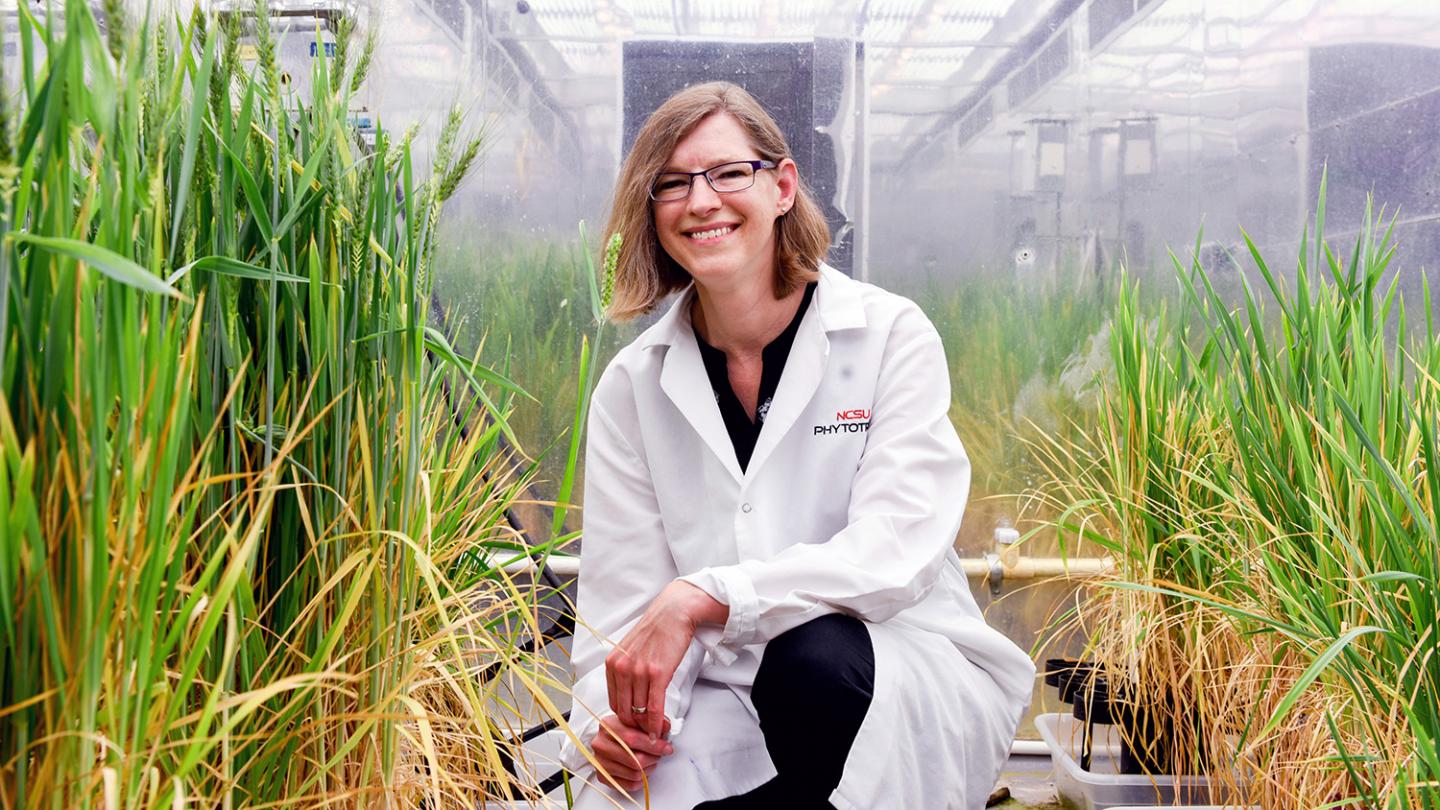
Credit: Becky Kirkland, NC State University
Research suggests that microbes in the soil, roots and leaves have important impacts on plant health and productivity. Now, new interdisciplinary research at North Carolina State University and three Danish universities will examine the roles of plant-associated microbes and their interactions with plants. The goal is to help make crops more resilient against environmental stresses while reducing the need for chemical treatments and irrigation.
The new Collaborative Crop Resilience Program (CCRP) is funded by the Novo Nordisk Foundation, the parent organization of NC State partner and biological solutions leader Novozymes. NC State will receive approximately $8 million of the project’s $30 million in funding over six years.
The program will be led by NC State’s Amy Grunden, William Neal Reynolds Distinguished Professor of Plant and Microbial Biology, who helped develop the program’s proposal after holding a highly successful workshop in Denmark on plant microbe interactions. The University of Copenhagen, Aarhus University and the Technical University of Denmark will collaborate on the project.
NC State Chancellor Randy Woodson said that the grant-funded program represents a milestone for the university.
“The CCRP positions NC State at the forefront of discovery in plant sciences and in translating these discoveries into solutions for farmers, life-sciences companies and consumers,” he said.
The project will take a holistic view of plants and their interactions with microbes in the soil, roots and foliage. The plant’s microbiome – its microbes and the ways they interact with the plant – plays a critical role in plant health and well-being, similar to the way the human gut microbiome influences human health.
Wheat, one of the world’s most important crops in both production and value, will be the featured crop in various studies – including heat, cold and drought tolerance – occurring in Denmark and North Carolina. The findings in wheat may also apply to other important cereal crops, like corn and rice, the researchers say.
“The goal is to improve plant productivity in the face of climate change and emerging pathogens and pests by leveraging microbes to help plants avoid stresses while acquiring nutrients to reduce fertilizer, pesticide and irrigation,” Grunden said.
“But we have two big challenges: We don’t know enough about how plants recruit and maintain their microbiomes. And we don’t yet know how to use big data analytics to understand plant-microbe-soil interactions given the complexity of these relationships in a constantly changing environment,” Grunden said.
Three projects comprise the CCRP:
- 1) “Matrix” focuses on poorly understood wheat plant-microbial interactions above ground. Field and greenhouse studies in Denmark and North Carolina will provide data on how microbes and metabolites influence wheat resilience and yield.
2) “Interact” focuses on the interactions between wheat plants and microbes below ground. Field and greenhouse studies in Denmark and North Carolina will help provide predictive models for microbiome structure/function and wheat performance under different environmental stresses, like cold resistance in Denmark and heat resistance in North Carolina.
3) “InRoot” focuses on development of new crop varieties and microbial interventions that will improve productivity, reduce the need for fertilizers and pesticides, and alleviate negative environmental impact. Three types of plants will be studied: Lotus japonicas, a Japanese legume to model soybean; wheat to represent cereal crops; and Arabadopsis thaliana, the lab rat of plant systems.
Richard Linton, dean of NC State’s College of Agriculture and Life Sciences, said that the grant funding builds on, and advances, the North Carolina Plant Sciences Initiative (NCPSI).
“The initiative was envisioned as a way to create the kind of problem-solving interdisciplinary partnerships needed to address complex problems related to food, health and agriculture,” he said. “That’s precisely what this new research partnership is all about.”
NCPSI helped spur the 2018 Danish workshop on plant-microbe interactions. That workshop, in turn, drove the proposal to the Novo Nordisk Foundation for a grand vision to improve crop security and resilience.
“The CCRP and NCPSI are really parallel and overlapping efforts,” Grunden said. “Excellence in plant sciences and interdisciplinary research drive both programs, especially the CCRP with its specific focus on plant security through plant improvement, data science and sustainability. Food security is a problem too great for one discipline to solve, so integrating collaborations across disciplines is key to finding solutions.”
###
Media Contact
Amy Grunden
[email protected]
Original Source
https:/