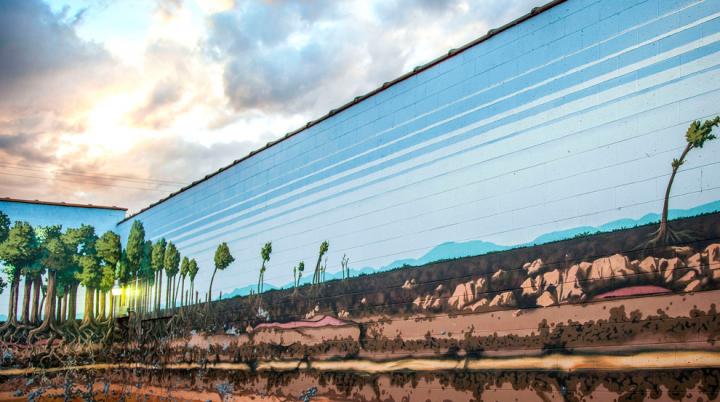
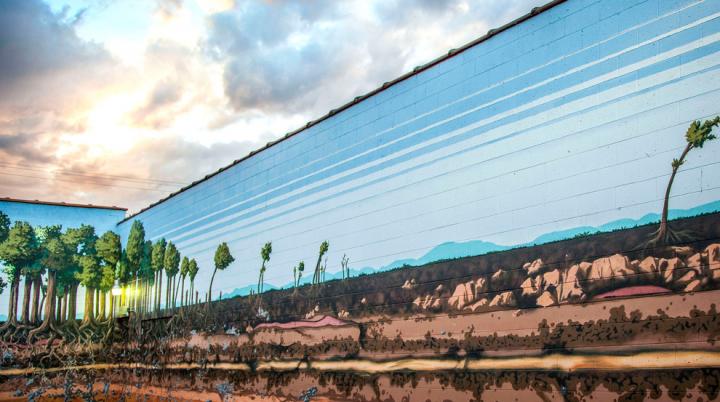
Credit: Photo courtesy of the Laramie Mural Project (bhp imaging photo).
The Earth's critical zone isn't called critical for nothing. Known as our planet's outer skin, it is essential for human survival.
The critical zone extends from the top of the tallest tree down through the soil and into the water and rock beneath it. It stops at what's called the weathering zone — or where soils first begin to develop. This zone allows crops to grow well and supports our buildings. It also allows for animals and microbes to live, and filters our water. These soil characteristics affect everything from the ground up.
Henry Lin of Pennsylvania State University follows the research on the critical zone and recently wrote a review on work in the area. Over the last five years there have been over 200 peer-reviewed articles published on topics related to the critical zone.
"The critical zone is where soil, rock, water, air, and living organisms all interact, which determines how many resources we are able to use," Lin says. "The critical zone provides various services to human society."
Lin explains the critical zone isn't just something physical. It is also a research approach. Scientists can study the critical zone as a whole to understand the Earth's layers across space and time. The approach also assists with long-term management of natural resources.
"The critical zone approach provides a framework for combining belowground and aboveground, non-living and living, and space and time in our ecosystems," he says. "To truly understand this zone, research from many areas must be mixed into one framework. It includes perspectives on time, depth, and coupling."
Each of these three concepts in the framework has specific impacts on the critical zone. For example, slow changes to soil over time lead to specific soil structures that control water movement. However, at the same time, each pulse of water moving through soil causes changes to the soil as well. How do these fast and slow processes affect each other?
When looking at depth, Lin points to an example of work being done using ground-penetrating radar to map what the critical zone looks like below what human eyes can see. Lastly, the coupled approach combines the study of the critical zone with its impact on natural resources and the benefits the ecosystem provides humans.
Lin says research in these three areas is important to understand the effects humans can have on the critical zone. By studying this zone, it is even possible to look at how it's changed over time and predict what will happen to it down the road.
Looking to that future, Lin calls for more work to be done. For example, he would like to see the global community work together to create a network of critical zone study and develop a library of databases about the zone.
"With our ongoing development, the critical zone is under ever-increasing pressures from humans, such as rapid growth of human and livestock population, land use increases, and global environmental changes," he says. "Possible negative effects include degraded soil health and water quality. It's important to continue closely studying this area."
###
Read Lin's review in Vadose Zone Journal. His research is supported in part by the National Science Foundation Hydrologic Sciences Program and the Critical Zone Observatory Program. Our thanks to Venkat Lakshmi for contributions to this story.
Media Contact
Susan Fisk
[email protected]
608-273-8091
@ASA_CSSA_SSSA
http://www.agronomy.org
############
Story Source: Materials provided by Scienmag