Baltimore, MD—New work led by Carnegie’s Phillip Cleves uses cutting-edge CRISPR/Cas9 genome editing tools to reveal a gene that’s critical to stony corals’ ability to build their reef architectures. It is published in Proceedings of the National Academy of Sciences.
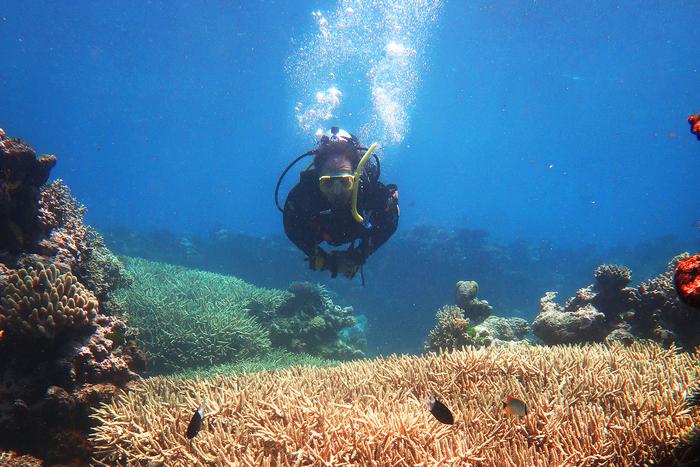
Credit: Photo is courtesy of Amanda Tinoco.
Baltimore, MD—New work led by Carnegie’s Phillip Cleves uses cutting-edge CRISPR/Cas9 genome editing tools to reveal a gene that’s critical to stony corals’ ability to build their reef architectures. It is published in Proceedings of the National Academy of Sciences.
Stony corals are marine invertebrates that build large skeletons, which form the basis of reef ecosystems. These biodiversity hotspots are home to about a quarter of known marine species.
“Coral reefs have tremendous ecological value,” said Cleves. “But they are in decline due to human activity. Carbon pollution that we spew into the air is both warming oceans—causing fatal bleaching events—and altering seawater chemistry—resulting in ocean acidification that impedes reef growth.”
Over time, the excess carbon dioxide released into our atmosphere by burning fossil fuels is taken up into the ocean, where it reacts with the water to form an acid that is corrosive to coral, shellfish, and other marine organisms.
Stony corals are vulnerable to ocean acidification because they construct their skeletons by the accretion of calcium carbonate, a process called calcification, which becomes increasingly difficult as the surrounding water’s pH decreases. Because of the importance of coral skeleton formation in building reefs, a major research focus has been to understand the genes controlling the process and how it has evolved in corals.
For several years, Cleves’ lab has used the Nobel Prize-winning CRISPR/Cas9 technology to identify cellular and molecular processes that could help guide coral conservation and rehabilitation efforts. For example, they previously revealed a gene that is critical to how a coral responds to heat stress—information that may help predict how corals will handle future bleaching events.
Now, his team—including Carnegie’s Amanda Tinoco—used genome editing tools to determine that a particular gene, called SLC4γ, is required for young coral colonies to begin building their skeletons. The protein it encodes is responsible for transporting bicarbonate across cellular membranes. Interestingly, SLC4γ is only present in stony corals, but not in their non-skeleton-forming relatives. Together, these results imply that stony corals used the novel gene, SLC4γ, to evolve skeleton formation.
“By applying cutting-edge molecular biology techniques to pressing environmental problems, we can reveal the genes that determine ecologically important traits.” Cleves concluded. “In developing these genetic tools to study coral biology, we can greatly improve our understanding of their biology and learn how to mount successful conservation efforts for these fragile communities.”
Earlier this year, Cleves was selected by The Pew Charitable Trusts as one of seven recipients of the 2023 Pew Fellowship in Marine Conservation and the first researcher to receive the organization’s Marine and Biomedical Science Fellowship. This program supports research that applies techniques or technologies more commonly used in biomedical science to enhance marine conservation.
Other co-authors on the study include Carnegie’s Lorna Mitchison-Field, Jacob Bradford and Dimitri Perrin of Queensland University of Technology, Christian Renicke and John Pringle of Stanford University, and Line Bay of the Australian Institute of Marine Science.
__________________
This work was funded by start-up funds from the Carnegie Institution for Science, an International Macquarie University Research Excellence Scholarship, an Australian Institute for Marine Science internal grant, an NSF-IOS EDGE grant, and a Simons Foundation grant.
The Carnegie Institution for Science (carnegiescience.edu) is a private, nonprofit organization headquartered in Washington, D.C., with three research divisions on both coasts. Since its founding in 1902, the Carnegie Institution has been a pioneering force in basic scientific research. Carnegie scientists are leaders in the life and environmental sciences, Earth and planetary science, and astronomy and astrophysics.
Journal
Proceedings of the National Academy of Sciences
Method of Research
Experimental study
Subject of Research
Animals
Article Title
Role of the bicarbonate transporter SLC4γ in stony-coral skeleton formation and evolution
Article Publication Date
5-Jun-2023