


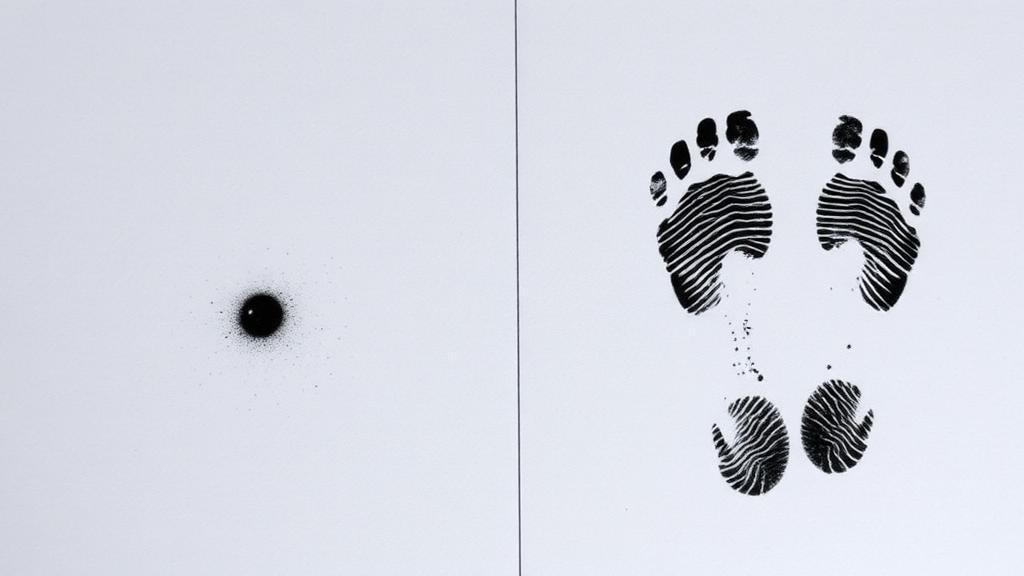
Handprints and footprints left at crime scenes can reliably help estimate a person’s height, but the regression equations that convert print measurements into stature estimates are so population-specific that applying them across ethnic groups without validation risks systematic bias. That is the central conclusion of a systematic review published in the Egyptian Journal of Forensic Sciences, which synthesised 32 studies spanning 14 countries and found statistically significant positive correlations between stature and print dimensions in every one of them.
The review, conducted by Sharan Kaur Kertar Singh, Rus Dina Rus Din and T. Nataraja Moorthy, followed PRISMA 2020 guidelines and searched Web of Science, Scopus, PubMed and Google Scholar up to December 2024. From 205 identified records, 61 duplicates were removed and 144 records screened at title and abstract level. After full-text assessment of 55 articles, 32 studies met the inclusion criteria and entered a qualitative synthesis. Methodological quality was appraised with the Joanna Briggs Institute Critical Appraisal Checklist for Analytical Cross-Sectional Studies, and all 32 studies met the predefined threshold for high quality.
The included studies covered populations from Asia, Africa, Australia, Europe and the Middle East, with 19 examining Southeast and South Asian groups. Twenty studies used static inked impressions, three used 3D surface scanning, and the remaining nine used mixed methods or digital photography. Sample sizes ranged from 22 to 2,072 participants, and every study employed a cross-sectional design with stepwise or simple linear regression as the primary analysis. No formal meta-analysis was possible because the studies differed too much in predictors, acquisition methods, landmark definitions and statistical reporting to pool quantitatively.
Across all handprint studies, correlation coefficients for the strongest individual predictors ranged from r = 0.23 to r = 0.75 in males and from r = 0.30 to r = 0.74 in females, with most peak values between r = 0.55 and r = 0.75. Handprint length and palm print length emerged as the most consistently optimal predictors, while breadth measures such as hand breadth produced weaker associations, typically below r = 0.40, and were rarely selected in stepwise models. Standard errors of estimate for the best handprint models ranged from roughly ±3.8 cm to ±7.3 cm.
The footprint evidence told a similar story with somewhat stronger associations. Correlation coefficients for the best footprint predictors ranged from r = 0.51 to r = 0.90, with Malaysian pooled-sample analyses exceeding r = 0.85. Maximum foot length and toe-to-heel diagonal lengths were the most reliable single predictors, while breadth and girth measurements consistently performed worse. Best-performing footprint models showed standard errors of estimate between approximately ±4.1 cm and ±6.9 cm, broadly comparable to the handprint figures.
Two instructive exceptions highlighted the limits of generalisation. In a Malaysian Chinese sample, correlations were markedly lower than elsewhere, reaching only r ≤ 0.23 in males and r ≤ 0.30 in females, and the authors note a possible unit reporting inconsistency in the published regression coefficients. In an Egyptian sample, the optimal predictor reversed by sex: thumb print length was strongest in males at r = 0.51, whereas handprint length was superior in females at r = 0.74, suggesting sex- and population-specific variation in digit proportionality.
The most practically significant finding concerns inter-population variability. Even within Malaysia, peak sex-specific correlations ranged from r = 0.23 in Malaysian Chinese handprints to r = 0.84 in Melanau female footprints, despite shared geographic and environmental conditions. Across all datasets, peak coefficients spanned r = 0.23 to r = 0.90, corresponding to R² values of roughly 5% to 81%. The review stresses, however, that differences in regression coefficients alone do not establish how large the estimation error would be when an equation is applied to an external population, because few included studies performed independent cross-population validation.
The review also flagged methodological subtleties with direct forensic consequences. Dynamic footprints made while walking generally show larger dimensions than static standing prints, and regression models built on static prints should not be applied directly to dynamic impressions. Reel and colleagues found heel-to-fifth toe length was the strongest predictor in dynamic prints at r = 0.858, compared with heel-to-fourth toe length in static prints at r = 0.786. Separately, ghosting, the lighter extensions beyond expected footprint margins at the toes and heel, was shown by Švábová and colleagues to yield more accurate stature predictions when included in length measurements, indicating it reflects genuine functional foot contact rather than artefact.
Pooled sex models also drew criticism. The authors argue that the higher correlations typical of pooled Malaysian footprint analyses are partly artefactual, because combining sexes widens the stature range and inflates correlations without improving the underlying model. Where biological sex can be established from other evidence, sex-specific models are preferable, and pooled models should be reserved for cases where sex cannot be determined.
The review concludes that print-based stature estimation, with standard errors typically between ±4 and ±7 cm, is broadly comparable to established soft-tissue anthropometric methods and sufficient for investigative use in narrowing the pool of potential suspects. Three priorities follow: developing population-specific anthropometric standards for underrepresented groups, standardising print acquisition protocols and landmark definitions, and systematically incorporating external validation and prediction intervals so practitioners receive a realistic assessment of estimation uncertainty before such evidence reaches the courtroom.
Subject of Research: Stature estimation from handprint and footprint anthropometry in forensic science
Article Title: Handprints and footprints as forensic anthropometric evidence for stature estimation: a systematic review
Article References: Singh, S. K. K., Rus Din, R. D., & Moorthy, T. N. (2026). Handprints and footprints as forensic anthropometric evidence for stature estimation: a systematic review. Egyptian Journal of Forensic Sciences, 16(1), Article 81. https://doi.org/10.1186/s41935-026-00580-3
Image Credits: AI Generated
DOI: 10.1186/s41935-026-00580-3
Keywords: forensic science, stature estimation, handprints, footprints, anthropometry, regression equations, systematic review, population specificity, crime scene evidence, biological profiling, forensic, anthropometric
News Source: Ophelia Keating. (October 29, 2026). Crime Scene Handprints and Footprints Can Estimate Body Height, Review Finds. Scienmag.



