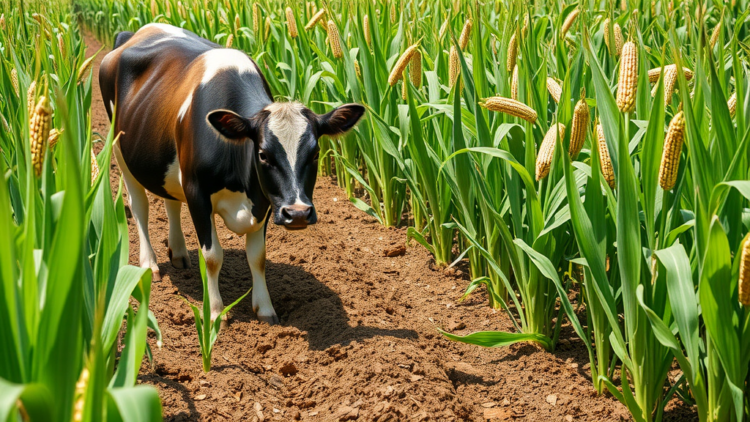
Chinese agriculture has long been trapped in a thorny triangle of interlocking problems: farmers apply too much chemical fertilizer, conventional plastic mulch film lingers in the soil for decades, and the vast mountains of livestock manure generated by the country’s animal husbandry sector go largely unused. Each of these problems feeds the others. Over-fertilization acidifies and compacts arable soil while nutrient use efficiency steadily declines. Polyethylene mulch, the thin plastic sheeting laid over crop rows to conserve moisture and suppress weeds, resists degradation and accumulates year after year, fragmenting into microplastics that damage soil microbial communities. Meanwhile, cow manure and other livestock wastes are produced in enormous, widely distributed volumes with limited pathways for recycling them back into cropland. A team at China Agricultural University, led by Yong Hou, has now reported a technology that attempts to cut this knot in a single stroke: a biodegradable mulch film made from cow manure that can sustain crop yields even when fertilizer inputs are slashed.
The research, published in the journal Engineering Agriculture under the title describing a manure-based slurry film and its microbially mediated nutrient activation mechanism, combined multi-season field experiments growing silage maize with a full life cycle assessment of the film’s environmental profile. The field results are the study’s headline finding. When the manure-based slurry film replaced conventional polyethylene mulch, silage maize yields held steady even as chemical fertilizer application was reduced by 30 percent. Under a more modest 15 percent fertilizer reduction, the film actually delivered a significant yield increase compared with the polyethylene control. For a crop that anchors much of China’s dairy and beef feed supply, maintaining output while cutting fertilizer by nearly a third would represent a substantial economic and environmental gain.
The mechanism behind these results, according to the authors, is not a physical effect but a biological one. Unlike polyethylene film, which works as an inert barrier that traps heat and moisture, the manure-based slurry film continuously releases soluble organic matter along with nitrogen, phosphorus, and other nutrients into the surrounding soil. This steady nutrient drip reshapes the soil microbiome in ways that appear central to the yield outcomes. The researchers documented increased abundance of functional bacterial groups, including Proteobacteria and Actinobacteria, both known to participate in nutrient cycling. Populations of nitrifying bacteria rose, and potassium-solubilizing bacteria were revived, improving the availability of a nutrient that is often locked into mineral forms that crops cannot access.
These microbial shifts form what the study describes as a positive feedback loop: nutrient input from the film activates functional bacteria, which convert and release nitrogen, phosphorus, and potassium in plant-available forms, which in turn improves overall fertilizer use efficiency. The timing of this biological support matters as much as its magnitude. The authors report that the film promotes root growth during the seedling stage, when a strong root system establishes the plant’s capacity to forage for nutrients. Later, during the grain-filling stage, when demand for phosphorus and potassium peaks, the film’s slow biological supply pathways strengthen precisely those nutrient flows. The result is that dry matter accumulation continues even under reduced fertilizer conditions, something that conventional physical mulching alone cannot achieve.
This distinction between physical and biological mulching is what positions the technology as a genuinely new approach to fertilizer reduction rather than a variant of existing practices. Current methods for improving fertilizer use efficiency each carry significant drawbacks that have limited their adoption. Fertilizer synergists, chemical additives designed to slow nutrient loss or inhibit nitrification, are costly and may themselves disturb soil microbial communities. Deep fertilizer placement, which puts nutrients closer to active root zones, requires specialized equipment and considerable labor, making large-scale promotion difficult. Combined organic and inorganic fertilization delivers good results in trials but imposes high application costs on farmers and has proven impractical for routine use. Biodegradable mulch films made from other materials can ease residual plastic pollution, but they generally suffer from low cost-effectiveness, poor mechanical stability in field conditions, and unclear life-cycle environmental benefits.
The manure-based slurry film approach also tackles the lingering problem of livestock waste head-on. By using cow manure as the raw material for a value-added product, it connects three previously disconnected links in the agricultural system: crop-livestock nutrient cycling, fertilizer reduction, and the reduction of residual film pollution. The film simultaneously reduces chemical fertilizer and plastic mulch inputs at the source while improving the soil microecology it covers, enhancing functional bacterial abundance and optimizing arable land quality. In principle, every hectare planted with the film diverts manure from waste streams, substitutes a biodegradable material for persistent plastic, and replaces a portion of synthetic fertilizer with nutrients already captured in the manure supply chain.
The study is nonetheless candid about the technology’s limitations, and its life cycle assessment reveals an uncomfortable truth: the manure-based slurry film’s current environmental impact is greater than that of polyethylene film. The production process involves relatively high energy and water consumption, and until these inputs are reduced, the film’s overall green credentials remain qualified rather than absolute. Large-scale application will require simplifying the manufacturing process and improving its energy efficiency. This kind of honest accounting is rare and valuable in agricultural technology reporting, where new materials are often promoted on field performance alone without scrutiny of what happens upstream at the factory gate.
What the life cycle assessment provides, then, is not a verdict against the technology but a roadmap for iteration. By clarifying both the microbial enhancement mechanism in the field and the full environmental costs of production, the study gives engineers specific targets for optimization: reduce energy intensity, recycle process water, and streamline fabrication so that the film’s upstream footprint falls below the savings it generates downstream. The authors frame the work as a scientific basis for technology iteration, large-scale production, and eventual industrial application, aimed at pushing agricultural inputs toward low-cost, biodegradable, and resource-recyclable categories. If those engineering goals are met, the film could help build what the researchers describe as an efficient, low-carbon, and clean farmland production system in which food security and ecological security are pursued together rather than traded off against each other.
For the broader field of sustainable agriculture, the study offers a proof of concept that waste streams can be engineered into inputs that do more than replace a conventional product. The manure-based film does not merely substitute for polyethylene; it actively manages soil biology, synchronizes nutrient release with crop demand, and tolerates sharp fertilizer cuts that would stunt a conventionally mulched crop. That combination of functions, drawn from a material that would otherwise be a disposal burden, is what makes the finding notable. The next test will be industrial: whether a production process that currently consumes substantial energy and water can be refined quickly enough, and scaled affordably enough, to move the film from experimental plots into the millions of hectares of Chinese farmland where mulch plastic and excess fertilizer accumulate with every growing season.
Subject of Research: Biodegradable cow manure mulch film for fertilizer reduction and soil health in maize production
Article Title: Cow manure transformed into biodegradable mulch film: 30% fertilizer reduction still maintains yield, while improving soil and reducing pollution
Article References: Cow manure transformed into biodegradable mulch film: 30% fertilizer reduction still maintains yield, while improving soil and reducing pollution. (n.d.). Original publication
Image Credits: AI Generated
DOI: Not provided
Keywords: cow manure, biodegradable mulch film, fertilizer reduction, silage maize, soil microbiome, microplastic pollution, crop-livestock cycling, life cycle assessment, nutrient activation, soil health, China Agricultural University, sustainable agriculture
Cite Scienmag News
APA MLA Chicago
Alan Morgan. (September 25, 2026). Cow Manure Becomes Biodegradable Mulch Film, Keeping Maize Yields With 30% Less Fertilizer. Scienmag. https://scienmag.com/cow-manure-becomes-biodegradable-mulch-film-keeping-maize-yields-with-30-less-fertilizer/
Alan Morgan. “Cow Manure Becomes Biodegradable Mulch Film, Keeping Maize Yields With 30% Less Fertilizer.” Scienmag, 25 September 2026, https://scienmag.com/cow-manure-becomes-biodegradable-mulch-film-keeping-maize-yields-with-30-less-fertilizer/. Accessed 25 September 2026.
Alan Morgan. “Cow Manure Becomes Biodegradable Mulch Film, Keeping Maize Yields With 30% Less Fertilizer.” Scienmag. September 25, 2026. https://scienmag.com/cow-manure-becomes-biodegradable-mulch-film-keeping-maize-yields-with-30-less-fertilizer/
Copy citation Download RIS
Tags: biodegradable mulch filmbiodegradable mulch film developmentChina Agricultural Universitycow manurecow manure recycling in agriculturecrop yield preservation with less fertilizercrop-livestock cyclingenvironmental impact of plastic mulchfertilizer reductionintegrated waste management in farmingLife Cycle Assessmentlivestock manure utilization in crop productionmicrobially mediated nutrient activationmicroplastic pollutionnutrient activationreducing plastic pollution in agriculturereduction of chemical fertilizer in maize farmingsilage maizesoil healthsoil health and microplastics pollutionsoil microbiomesustainable agriculturesustainable plastic mulch alternatives