


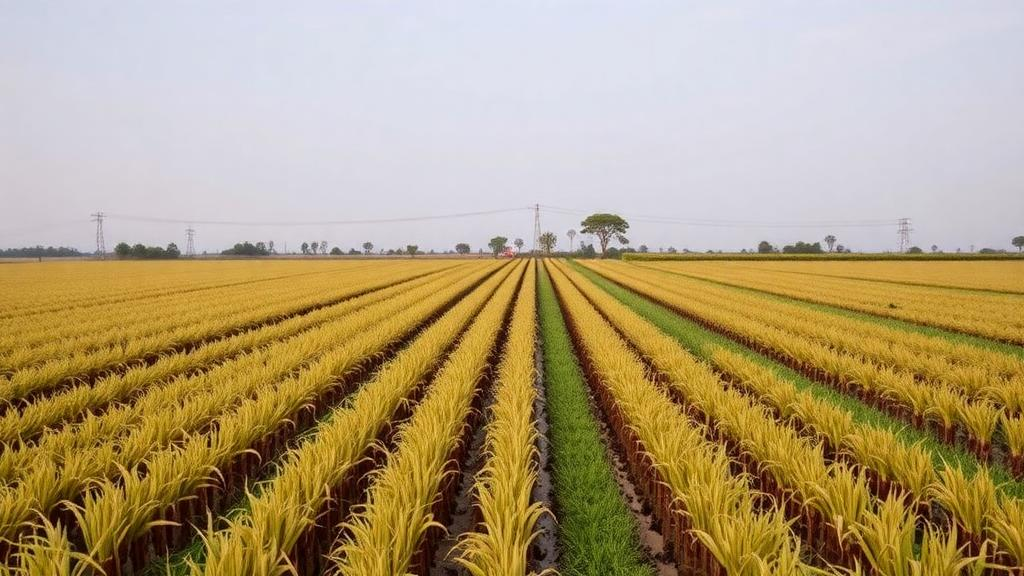
Farms in southern Brazil that diversified their crops and kept their soil permanently covered with vegetation weathered a run of severe droughts and historic floods far better than neighboring conventional operations, according to research conducted by the Center for Carbon Research in Tropical Agriculture at the University of São Paulo. Over three growing seasons marked by climatic extremes, diversified systems reached yields as much as 76 percent above the state average, while farms relying on simplified rotations hovered close to the average and swung dramatically from year to year. The findings, published on October 22 in the journal Agriculture, Ecosystems & Environment, were also presented by Professor Mauricio Roberto Cherubin of the Luiz de Queiroz College of Agriculture during FAPESP Week Netherlands.
The study compared traditional cropping models with areas that used so-called cover crops, plants grown not for sale but to protect and nourish the soil between harvests. Traditional operations in the comparison typically cultivated one type of grain after another, such as wheat followed by soybeans, or relied on a single plant species to cover the soil. These simplified systems performed markedly worse: their harvests came in only about 8 percent above the state’s overall average, and their yields fluctuated sharply, ranging from 33 percent to 39 percent higher or lower from one season to the next. That volatility, the researchers argue, demonstrates how vulnerable simple systems are to climate surprises.
The research window was deliberately demanding. Between 2022 and 2025, the team followed three consecutive growing seasons across Rio Grande do Sul, a state chosen for its strategic weight in Brazilian agriculture and its acute exposure to extreme weather. The 2022/2023 and 2024/2025 seasons brought severe droughts, with rainfall up to 54 percent below normal, ranking among the driest years ever recorded in the region. The 2023/2024 season delivered the opposite extreme, receiving 40 percent more rainfall than average. Because every farm evaluated experienced the same severe conditions at the same time, the scientists could effectively isolate climate from the equation and attribute differences in harvest outcomes to the planting techniques adopted on each field.
To capture real-world production conditions rather than experimental plots, the researchers analyzed data from 13 experiments run by farmers on commercial farms spread across the state, in municipalities including São Luiz Gonzaga, Rolador, Bozano, Panambi, Boa Vista das Missões, Sarandi, Santa Cecília do Sul, Não-Me-Toque, Lagoa dos Três Cantos, Quinze de Novembro, Jacuizinho, Júlio de Castilhos and São Gabriel. In the most complex systems analyzed, farmers combined commercial crops such as soybeans, corn, wheat and canola with a rich assortment of cover and service crops: grasses including black oats, white oats, Ukrainian oats, rye, triticale and millet; the legume vetch; fast-decomposing dicots such as buckwheat; and brassicas like forage turnip.
The team paired field observations with satellite data from NASA to compare rainfall levels in the fields against the 30-year average, anchoring the yield analysis in precise measurements of climatic stress. At the 13 participating farms, 78 soil samples were collected at a depth of 0 to 10 centimeters. To assess soil health, the scientists examined 12 characteristics divided into chemical, physical and biological categories. The chemical analysis covered factors such as acidity and the soil’s capacity to hold and release nutrients to plants. The physical analysis measured compaction, porosity and the efficiency of water retention. The biological assessment focused on the activity of enzymes that function as a thermometer for life in the soil, revealing whether it is active and able to recycle vital elements such as carbon and sulfur.
Using a statistical technique, these indicators were synthesized into four soil health functions: biochemical regulation, physical support, water storage and carbon storage. An advanced statistical method capable of mapping direct and indirect cause-and-effect relationships then linked these functions to the degree of plant diversity and to clay content. The analyses showed that diversifying crops significantly increased the soil’s capacity to store water, regardless of how much clay the soil contained. According to Cherubin, deputy coordinator of CCARBON, a Research, Innovation, and Dissemination Center funded by FAPESP, the result demonstrates that retaining more water does not depend solely on a soil’s natural physical properties, such as whether it is sandier or clayier, but on the biological structuring generated by planting practices, including root activity and the work of microorganisms.
The researchers propose a mechanical explanation rooted in plant anatomy. The deep roots of cover crops are able to break through compacted layers and open biological channels in the soil. Biopores, the natural tunnels left behind by decomposing roots, act as conduits for air and water, forming what Cherubin describes as a veritable network within the soil. When the main crop, such as soybeans or corn, is subsequently planted, its roots find open paths to grow downward without expending excessive energy, reaching moisture stored in deeper layers during dry periods. In this way, the architecture left by previous cover crops becomes an inheritance that buffers the cash crop against the next drought.
Cherubin framed the biological logic in vivid terms when explaining the work to Agência FAPESP. Keeping the soil healthy and functional, he said, requires ensuring the presence of living plants and vegetation cover throughout the year. Introducing a diverse mixture of cover crops, he explained, is like offering the soil a varied and continuous menu, keeping soil organisms active year-round and optimizing the cycling of nutrients, the biological fixation of nitrogen and the availability of phosphorus for the main crop. The recently published study grew out of Viviana Meneghini’s master’s thesis at the university, which was supported by a FAPESP scholarship and supervised by Cherubin.
The study also documented the limits of these practices. Even sustainable systems were hit hard by major disasters. During the 2024 floods in Rio Grande do Sul, nearly half of the farmers who had adopted crop diversification, 44 percent, had to change their plans. With soil waterlogged and harvests delayed, they abandoned cover crops and opted to plant commercial wheat in an attempt to recoup losses quickly. The finding tempers any suggestion that diversified systems confer immunity; they raise the baseline of resilience, but historic flooding still forced operational sacrifices even among its adopters.
The stakes extend well beyond the study farms. Rio Grande do Sul accounts for 8.4 percent of national grain production. Its soybean fields cover 6.8 million hectares, representing 14.4 percent of the total area planted with soybeans in Brazil and the equivalent of 3.4 percent of the global market. The state has endured a punishing sequence of extremes: severe droughts between 2019 and 2023, historic floods during the 2023/2024 growing season that caused estimated losses of BRL 45 billion in unharvested soybean crops alone, and a return of intense droughts in the 2024/2025 season. For Cherubin, the findings are essential to securing the future of rain-fed agriculture, which relies solely on rainwater, in a scenario of increasingly frequent droughts and storms. Healthy soil with a wide variety of roots, he argues, acts as a natural shock absorber against the weather, smoothing out the roller-coaster cycle of a bountiful harvest one year and severe losses the next.
Subject of Research: How crop diversification and cover crops buffer commercial grain farms in Rio Grande do Sul against droughts and floods
Article Title: Crop diversification protects fields from extreme weather and boosts productivity
Article References: Crop diversification protects fields from extreme weather and boosts productivity. Original publication (Bibliographic details unavailable.)
Image Credits: AI Generated
DOI: Not provided
Keywords: crop diversification, cover crops, soil health, drought resilience, flood impacts, Rio Grande do Sul, soybeans, water storage, biopores, rain-fed agriculture, University of São Paulo, soil biology
News Source: Alan Morgan. (October 29, 2026). Cover Crops Shield Brazilian Farms From Droughts and Floods While Lifting Yields. Scienmag.



