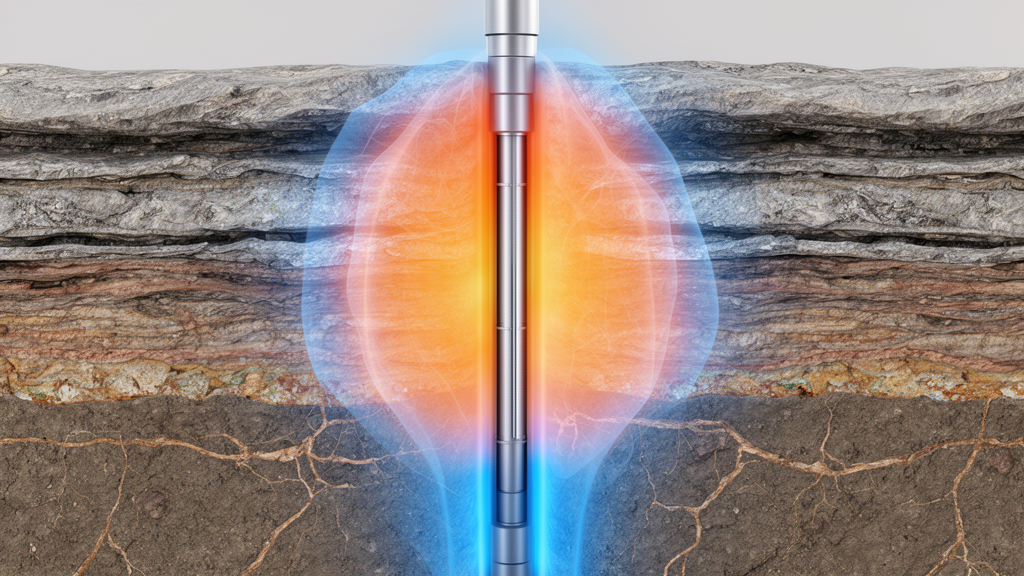
A numerical investigation incorporating thermo-hydro-mechanical coupling and an intelligent surrogate model has revealed that geothermal productivity in Enhanced Geothermal Systems is significantly sensitive to bedrock specific heat capacity and geothermal gradient, while identifying optimal development efficiency at a fracture width of 0.6 millimeters and a fracture angle of 45 degrees.
Deep geothermal energy extraction constitutes a thermo-hydro-mechanical coupled process in which fluid flow and heat transfer are primarily governed by reservoir thermophysical properties and fracture networks. To evaluate heat extraction performance under the individual influence of these key parameters, researchers constructed a numerical model incorporating coupled physics alongside an SOA-RFR-GA hybrid prediction model designed to replace computationally intensive forward simulations with a high-fidelity surrogate that reduces computational overhead while preserving predictive accuracy.
Simulation forecasts indicated distinct temporal behaviors across the evaluated reservoir properties. Specifically, higher reservoir specific heat capacity was found to prolong thermal breakthrough time, whereas an increased geothermal gradient elevated initial geothermal productivity. Over extended operational timeframes, geothermal productivity exhibited a positive correlation with bedrock porosity and a negative correlation with the fracture roughness coefficient.
Through a systematic sensitivity analysis assessing six key parameters, the study quantified the relative influence exerted by both intrinsic reservoir properties and engineered fracture characteristics on thermal extraction performance. The sensitivity results confirmed that productivity responds most substantially to the geothermal gradient and bedrock specific heat capacity, while demonstrating that efficiency peaks under specific geometric fracture configurations.
Drawing on these sensitivity outcomes, the authors formulated a surrogate-model-based evaluation framework utilizing a two-stage strategy that prioritizes inherent thermophysical parameters prior to engineered fracture design. This analytical framework provides design implications and practical guidance for fracturing operations and resource development across Enhanced Geothermal Systems.
Deep geothermal energy extracted through Enhanced Geothermal Systems represents an energy resource with substantial development prospects, owing to its enormous potential and environmental friendliness. Realizing the sustainable development and effective utilization of this resource depends on understanding the underlying subsurface dynamics governing heat extraction. Within deep geothermal reservoirs, extraction operations function as a coupled thermo-hydro-mechanical process. In this operating environment, the primary mechanisms controlling subsurface fluid flow and heat transfer are reservoir thermophysical properties and fracture networks. To systematically assess how these variables govern performance, researchers developed a numerical model incorporating thermo-hydro-mechanical coupling, designed to evaluate thermal extraction under the individual influence of both reservoir thermophysical properties and fracture characteristics.
To resolve the substantial computational burden associated with multi-field modeling, the researchers introduced the SOA-RFR-GA hybrid intelligent prediction model. By serving as a high-fidelity surrogate model, this machine learning framework replaces computationally intensive thermo-hydro-mechanical forward simulations, thereby lowering computational overhead while preserving predictive accuracy. The investigators utilized this surrogate modeling architecture to forecast geothermal productivity and execute a systematic sensitivity analysis across six key parameters. This evaluation quantified the relative influence of intrinsic reservoir properties alongside engineered fracture characteristics, providing an objective comparison of how separate geological and structural factors impact overall thermal extraction performance.
The resulting simulations identified distinct physical behaviors and temporal correlations across the investigated reservoir properties. The analysis revealed that reservoir specific heat capacity prolongs the thermal breakthrough time during extraction, whereas a higher geothermal gradient increases initial geothermal productivity. Over extended operational durations, geothermal productivity correlates positively with bedrock porosity, but correlates negatively with the fracture roughness coefficient.
Beyond intrinsic formation properties, the modeling established concrete benchmarks for engineered fracture configurations, showing that optimal geothermal development efficiency is achieved at a fracture width of 0.6 millimeters and a fracture angle of 45 degrees. Integrating these findings, the study formulated a surrogate-model-based evaluation framework employing a two-stage strategy. This framework systematically prioritizes inherent thermophysical parameters prior to engineered fracture design, extracting sensitivity-based implications to guide geothermal projects.
Subject of Research: Numerical simulation and sensitivity analysis of enhanced geothermal system heat extraction
Article Title: Numerical simulation and sensitivity analysis of EGS thermal extraction based on THM-coupled model
Article References: Lv, J., Lu, Y., Yu, K., Ma, J., Hu, P., & Xu, Z. (2026). Numerical simulation and sensitivity analysis of EGS thermal extraction based on THM-coupled model. Geomechanics and Geophysics for Geo-Energy and Geo-Resources. https://doi.org/10.1007/s40948-026-01233-4
Image Credits: AI Generated
DOI: 10.1007/s40948-026-01233-4
Keywords: enhanced geothermal systems, geothermal energy, thermo-hydro-mechanical coupling, thermal extraction, surrogate modeling, sensitivity analysis, fracture characteristics, numerical simulation, Numerical, simulation, sensitivity, analysis
News Source: Violet Maxwell. (November 8, 2026). Coupled Thermal Model Pinpoints Key Parameters for Geothermal Heat Extraction. Scienmag.