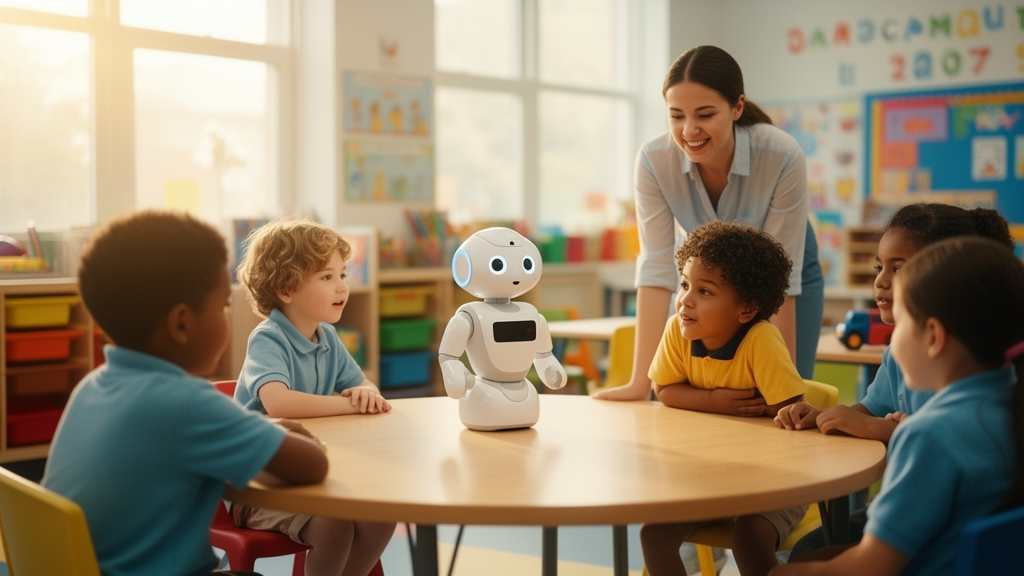
A classroom deployment study conducted in a public elementary school in Southern China has detailed how an artificial intelligence-empowered social robot operated across an eight-week second-grade Chinese language curriculum. Published in the journal AI, Brain and Child, the empirical investigation examined the practical integration, instructional roles, and operational limitations that emerged when introducing an interactive robotic unit into regular classroom reading lessons. Rather than evaluating standalone software applications or relying on simulated laboratory trials with researcher-selected inventories, the researchers introduced the robotic device into an authentic school environment where native-speaking second graders completed structured reading tasks alongside their classroom teacher. The research team systematically recorded weekly sessions and conducted post-intervention interviews with both the instructor and students to establish how robotic capabilities functioned within a dynamic classroom ecosystem.
The study was designed to address three primary research questions focusing on how an artificial intelligence social robot can be incorporated into an established language curriculum, the specific functional and social roles the device plays during instruction, and the practical challenges and future opportunities identified by teachers and young learners. Prior investigations into educational robotics frequently concentrated on experimental contexts or evaluated master-learning models centered primarily on measurable cognitive outcomes. To address the documented scarcity of empirical evaluations conducted within live curricula, the researchers structured their fieldwork around the Technological Pedagogical Content Knowledge framework and Doyle’s Classroom Ecology Paradigm, conceptualizing the classroom as an interconnected microsystem where educators, pupils, instructional materials, and technological tools continuously influence each other during the educational process.
Forty-four typically developing, native-Chinese-speaking second-grade students participated in the eight-week intervention, comprising twenty-two girls and twenty-two boys from an upper-middle-class public primary school in a large metropolitan center in Southern China. Background demographic assessments indicated that the participating children inhabited resource-rich literacy environments: nearly thirty percent read daily out of personal interest, approximately seventy percent dedicated thirty minutes to an hour to weekend reading, and almost half possessed personal home collections ranging between twenty-six and one hundred books. Furthermore, approximately ninety percent of the participants came from households reporting monthly incomes exceeding RMB 10,000 yuan, with half of the parents holding undergraduate credentials and the remaining half holding postgraduate degrees. The participating educator was a senior elementary teacher possessing eight years of teaching experience, holding a master’s degree in Chinese language instruction, and sharing the regional dialect and cultural familiarity of the local community.
Instructional sessions were conducted once per week for thirty-five to forty minutes across an eight-week timeframe, utilizing official curriculum materials alongside extracurricular reading books compatible with the second-grade Chinese textbook. To govern classroom discourse systematically, the instructional team adopted the Initiation-Response-Feedback structure alongside expanded sub-models designated as Initiation-Response-Question-Answer and Initiation-Response-Revoicing-Feedback. Within this collaborative framework, lesson plans were designed so that the human educator maintained ultimate authority over student feedback while using the artificial intelligence robot as a supplementary tool. For example, during a lesson where an elementary pupil defined a fossil strictly as animal remains, the teacher redirected the child back into the passage to locate exact textual evidence before commanding the robotic system to deliver a formal, scientifically complete definition.
Hardware selection followed six pre-established criteria: functional adaptability for primary language learning, a compact humanoid physical design, ease of portability without causing intimidation, user-friendly operation, positive market recognition, and commercial affordability. The research team selected the CS-RK2 model, commercially designated as Fluorite and manufactured by Hangzhou EZVIZ Software Co., Ltd., which retails at approximately 200 USD. Measuring twelve by twelve by twelve centimeters, the compact humanoid robot is equipped with three-hundred-and-sixty-degree rotational capability, a tilting head, movable arms, low-latency intelligent voice processing, and a facial display screen that portrays animations and emotive visual expressions. Crucially for early childhood reading tasks, the unit features an integrated front-facing optical camera capable of scanning printed texts to execute page-by-page read-aloud functionality with thirty-six voice skills, alongside pre-programmed interactive games and audiovisual communication tools.
Data collection and evaluation encompassed approximately three hundred and twenty minutes of multi-camera video footage capturing moment-to-moment interactions, supplemented by verbatim transcripts of the instructor’s reflective interview and the pupils’ Mandarin responses processed through NVivo 14.0 software. Classroom recordings utilized a three-camera configuration, with one forward camera capturing close-up facial expressions and linguistic nuances while two rear cameras tracked physical movements and whole-class dynamics, supported by an out-of-frame observer teacher tasked with student safety and technical management. Systematic coding of the video transcripts was established following sample coding sessions, achieving an initial coder agreement rate of eighty-nine percent before all residual disagreements were resolved through consensus. Qualitative analysis of the children’s interview feedback produced one hundred and ninety-two distinct concepts organized into thirty sub-categories.
Analysis of lesson plans revealed one hundred planned robotic functions, which the researchers organized into three functional categories: learning facilitation accounted for forty-six percent, knowledge transfer represented forty-five percent, and emotional support comprised nine percent. Speech ratio measurements across all seven recorded curriculum lessons illustrated that the human teacher remained the dominant figure in the instructional space, accounting for an average of 61.42 percent of total classroom speech. The artificial intelligence robot contributed 15.92 percent of spoken dialogue, while the second-grade students accounted for 27.34 percent of classroom speech time. Periods of total classroom silence were recorded at a low average of 3.35 percent, which the authors interpreted as quantitative evidence of sustained verbal activity and an active communicative climate throughout the robot-assisted instructional blocks.
Observation of seventy-nine discrete behavioral enactments demonstrated that the robot assumed three distinct operational roles during curriculum execution: teaching assistant, learning companion, and social partner. As a teaching assistant, representing 60.76 percent of observed occurrences with forty-eight instances, the device supported instructional delivery by modeling standard oral reading of textbook passages fifteen times across the intervention, defining vocabulary such as coal, and delivering extended scientific definitions. As a learning companion, accounting for 31.65 percent of instances across twenty-five observations, the robot joined students as an interactive peer during cooperative tasks, such as corrective reading activities wherein pupils listened to intentional robotic reading mistakes to detect and correct errors. As a social partner, representing 7.59 percent of observed instances across six episodes, the system provided emotional engagement through pre-lesson conversational exchanges, greeting routines, and recreational dancing that lessened classroom tension.
Despite these instructional integrations, thematic analysis of the educator’s interview highlighted substantial professional burdens across three categories: teaching-related strains, ethical and security concerns, and technical limitations. Teaching-related friction included increased preparatory workload, as the educator had to master operating parameters, pre-screen curricular materials, and conduct repeated trial runs—testing queries at least three times before class to identify exact phrasing that generated accurate robotic output. Ethical challenges arose when the robot interrupted instructional discourse unprompted, while physical monitoring features and onboard cameras created potential risks regarding data security, privacy compliance, and pupil discomfort. Technical constraints were particularly evident in the robot’s inability to recognize complex nonverbal emotional cues such as sighs, fatigue, or frustration, leaving the device unable to offer the adaptive socio-emotional support characteristic of human teachers.
The participating second graders similarly identified significant operational hurdles, which researchers categorized into functional defects, teaching errors, and technical failures. Under functional defects, children described speech recognition lapses where the robot misheard commands and played unintended songs or wrong musical versions. Teaching errors included instances where the robot interrupted the classroom teacher during general discussion, exhibited cumbersome controls, omitted words, inserted extraneous words during passage readings, or delivered explanations that were overly lengthy and difficult for second graders to retain. Technical failures centered around network latency and connection stalls that forced the class to pause instruction, as well as an unnatural, mechanical reading cadence that lacked emotional warmth compared to human speech.
Reflecting on these findings, the authors emphasized that successful robotic integration requires rigorous collaborative co-design between classroom teachers and researchers, alongside the grounding of lesson sequences in established instructional frameworks like the Initiation-Response-Feedback model. Because existing consumer robots are not engineered specifically for primary pedagogical environments, the study concluded that current market devices function effectively only as supplementary tools operating under direct teacher oversight rather than autonomous educational systems. To advance the field, the researchers recommended that educational institutions provide comprehensive teacher training and called upon technology developers to engineer dedicated educational robots equipped with pedagogical intelligence, robust speech recognition, and advanced emotional understanding tailored to the complex ecological demands of young classrooms.
The authors explicitly outlined several methodological limitations that restrict the broader generalizability of their conclusions. Because the investigation prioritized the operational integration process rather than standardized learning gains, student language achievement was not measured, leaving the direct developmental impact of robot-assisted teaching unquantified and highlighting the necessity for future controlled experimental trials. Additionally, the study was confined to a single classroom of forty-four upper-middle-class students possessing rich educational backgrounds and high prior familiarity with home technologies, which may have artificially suppressed novelty effects. The researchers noted that future studies must incorporate larger, diverse student cohorts from varied socioeconomic contexts, systematically measure baseline artificial intelligence literacy, and deploy specialized educational hardware to evaluate robotic instructional tools under varied educational conditions.
Subject of Research: Integration of an AI social robot into early childhood language education
Article Title: AI-empowered social robots in early childhood classrooms: roles, challenges, and opportunities
Article References: Myat Kyaw, H. M., Zou, L., Yu, J., & Li, Y. (2025). AI-empowered social robots in early childhood classrooms: roles, challenges, and opportunities. AI, Brain and Child, 1(1), Article 12. https://doi.org/10.1007/s44436-025-00013-3
Image Credits: AI Generated
DOI: 10.1007/s44436-025-00013-3
Keywords: artificial intelligence, social robots, early childhood education, language learning, classroom technology, educational robotics, human-robot interaction, elementary education, AI-empowered, social, robots, early
News Source: Denise Maddox. (November 11, 2026). Study Analyzes AI Social Robot Roles and Setbacks in Primary Classroom. Scienmag.