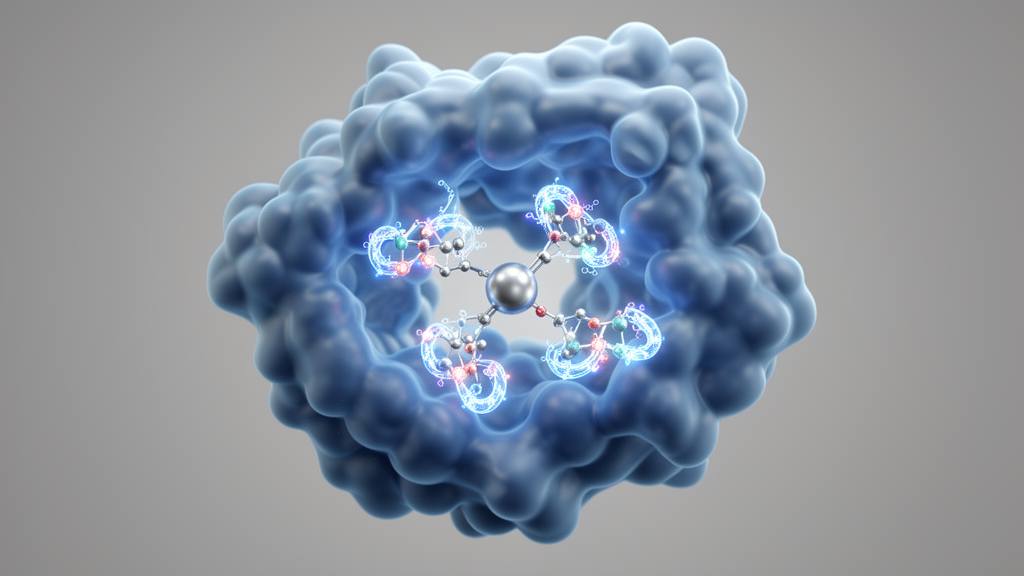
Carbonic anhydrases are zinc-containing metalloenzymes that catalyze the reversible hydration of carbon dioxide to bicarbonate and a proton, a reaction that quietly underpins pH regulation throughout the human body. In tumors, two membrane-associated isoforms, CA IX and CA XII, take on a darker role: they acidify the extracellular environment, helping cancer cells survive hypoxia, invade surrounding tissue, and resist therapy. Disrupting this pH machinery has long been considered a rational anticancer strategy, and a new study from Pharmacia now reports the design, synthesis, and computational evaluation of six novel coumarin-hydrazide-hydrazone derivatives, labeled AT1 through AT6, as potential inhibitors of these tumor-associated enzymes.
The synthetic route began with 6-aminocoumarin, a yellowish-green coumarin scaffold already recognized in medicinal chemistry as a non-classical carbonic anhydrase inhibitor platform. In the first step, the amine was chloroacetylated with chloroacetyl chloride under ice-bath cooling in a benzene and dimethylformamide mixture, with triethylamine scavenging hydrogen chloride, affording the chloroacetamide intermediate B in 90 percent yield as a gray-to-white powder melting at 200 to 204 degrees Celsius. Key infrared signatures confirmed the transformation, including N-H stretching bands at 3431, 3277, and 3231 inverse centimeters, the coumarin lactone carbonyl at 1713, and the new amide carbonyl at 1682.
From there, the chemists introduced a GABA-derived linker by nucleophilic substitution with methyl 4-aminobutanoate hydrochloride in dimethylformamide, refluxing for ten hours to yield the ester intermediate C in 86 percent yield as a brown sticky oil. Hydrazinolysis with 99 percent hydrazine hydrate at 60 degrees Celsius then converted the ester into the hydrazide intermediate D, obtained in 90 percent yield as a brown powder melting at 216 to 218 degrees Celsius. The final and decisive step was an acid-catalyzed condensation of hydrazide D with six different para-substituted benzaldehydes in methanol, refluxed for six hours, producing the hydrazone derivatives AT1 through AT6 in yields ranging from 70 to 95 percent with melting points between 190 and 218 degrees Celsius.
Spectroscopic characterization tied the whole series together. The appearance of azomethine C=N absorption bands in the 1647 to 1603 inverse centimeter region, together with downfield NH and CONH proton signals near 10 to 11 parts per million in the proton NMR spectra recorded on a 500 MHz Bruker instrument, confirmed hydrazone formation. Substituent-specific resonances, such as the methoxy singlet of AT3 at 3.67 parts per million and the dimethylamino singlet of AT6 at 3.41, further supported the proposed structures. The presence of a single major set of azomethine and aromatic signals suggests one predominant hydrazone isomer, although the E/Z configuration was assigned tentatively without advanced NMR or crystallographic confirmation.
With the molecules in hand, the team turned to structure-based virtual screening against two carbonic anhydrase models: 2H4N, a structurally characterized reference isoform, and 7PP9, a tumor-associated human CA XII structure. Docking validation by redocking the co-crystallized ligands gave root-mean-square deviation values of 2.12 angstroms for 2H4N and 1.87 angstroms for 7PP9, reasonably reproducing the crystallographic poses. The catalytic zinc ion was retained in the active site throughout, with an explicit tetrahedral metal coordination constraint applied at a maximum distance of 2.5 angstroms to guide ligand poses toward chemically relevant zinc interactions.
The docking results delivered the study’s most striking finding: every synthesized derivative scored more favorably against the tumor-associated CA XII model than against the reference isoform. Against 7PP9, AT1 bearing a para-hydroxy group led the series with a docking score of -9.531 kilocalories per mole, followed by AT2 at -6.893, AT5 at -6.587, AT3 at -5.987, and AT4 at -5.429, all outperforming the clinical reference inhibitor dorzolamide, which scored -5.235. AT1 achieved this through hydrogen bonds with ASN67, ASN94, and TRP5, a zinc-associated metal contact, and a pi interaction near HIS64. The most dramatic isoform shift belonged to AT1, which improved from -4.768 in 2H4N to -9.531 in 7PP9, a pattern the authors interpret as predicted selectivity toward the tumor-associated binding site.
Ranking was refined with Prime molecular mechanics/generalized Born surface area analysis, which estimates binding free energy as the difference between the complex and the sum of the separated protein and ligand. For the 2H4N model, AT5 with its nitro substituent showed the most favorable value at -46.79 kilocalories per mole, ahead of AT4 at -41.97, and both exceeded the acetazolamide reference at -20.31. For 7PP9, AT3 topped the ranking at -50.56, followed by AT6 at -47.71, while dorzolamide managed only -16.42. Because these calculations used single minimized docked poses without trajectory frames or replicates, the values are reported without standard deviations and must be treated as relative computational estimates rather than measured binding free energies.
Predicted drug-likeness profiling with QikProp and SwissADME suggested generally acceptable physicochemical behavior. All molecular weights fell below 500 daltons, lipophilicity values sat within the corrected QikProp interval, and predicted human oral absorption ranged from 34.889 percent for AT5 to 73.890 percent for AT4, showing how strongly the para-substituent shapes permeability. The BOILED-Egg visualization placed the compounds outside the blood-brain barrier yolk and near or outside the gastrointestinal absorption region, with markers indicating probable P-glycoprotein substrate behavior, implying that passive central nervous system penetration is unlikely and efflux mechanisms may limit exposure.
To test whether the best-ranked binding pose could survive realistic atomic motion, the AT3-2H4N complex was subjected to a 200 nanosecond Desmond molecular dynamics simulation under the NPT ensemble at 300 kelvin and 1.01325 bar, controlled by a Nosé-Hoover chain thermostat and a Martyna-Tobias-Klein barostat with a RESPA integrator using 2 femtosecond bonded and 6 femtosecond far-field time steps. The protein backbone root-mean-square deviation stabilized within roughly 1.3 to 2.2 angstroms, while the ligand RMSD fluctuated more strongly, approaching 4 angstroms near the end of the trajectory, interpreted as conformational mobility of a molecule with several rotatable bonds rather than dissociation from the pocket.
Contact analysis reinforced that picture of binding-site retention. Persistent interactions were maintained with active-site residues including HIS96, ASN94, HIS119, GLU106, THR199, and THR200, together with contacts involving the catalytic zinc region, while the secondary-structure profile showed no major loss of alpha-helical or beta-strand content. The root-mean-square fluctuation profile revealed a prominent local mobility around residue 200, close to the CA active-site environment, which may reflect loop adjustment around the binding pocket. The authors are careful about what these simulations can and cannot establish: a single finite trajectory cannot determine binding residence time or inhibitory potency.
Indeed, the study’s most important caveat is that everything reported is computational prioritization, not experimental proof. No carbonic anhydrase inhibition assay, Ki or IC50 measurement, or cell-based anticancer experiment is included in the dataset, so the compounds cannot yet be described as confirmed carbonic anhydrase inhibitors or anticancer agents. The authors call for biochemical assays against human CA II and CA XII using acetazolamide and dorzolamide as references, and for strengthened characterization including high-resolution mass spectrometry, carbon-13 NMR, and HPLC purity assessment. Still, the convergence of docking, binding free energy estimation, predicted drug-likeness, and molecular dynamics around the coumarin-hydrazone scaffold gives medicinal chemists a rational, isoform-selective starting point for the wet-lab work that will decide whether these computationally favored molecules can genuinely starve tumors of their pH advantage.
Subject of Research: New coumarin-hydrazone derivatives designed and computationally evaluated as potential carbonic anhydrase inhibitors targeting tumor-associated CA IX and CA XII.
Article Title: Design, synthesis, characterization, molecular docking, MM-GBSA analysis, and molecular dynamics simulation of novel coumarin-hydrazone derivatives as potential carbonic anhydrase inhibitors
Article References: Mohammed, A. J., Naser, N. H., & Al-Hachami, W. A. (2026). Design, synthesis, characterization, molecular docking, MM-GBSA analysis, and molecular dynamics simulation of novel coumarin-hydrazone derivatives as potential carbonic anhydrase inhibitors. Pharmacia, 73, Article e185850. https://doi.org/10.3897/pharmacia.73.e185850
Image Credits: AI Generated
DOI: 10.3897/pharmacia.73.e185850
Keywords: Design, synthesis, characterization, molecular, docking, MM-GBSA, analysis, dynamics, simulation, novel, coumarin-hydrazone, derivatives
News Source: Nathaniel Bowman. (October 18, 2026). Coumarin-Hydrazone Molecules Emerge as Computational Candidates Against Tumor Enzyme CA XII. Scienmag.