In a groundbreaking development from the University of Massachusetts Amherst, physicists have put forward a daring hypothesis that could rewrite our understanding of some of the universe’s most elusive phenomena. In 2023, a neutrino—an unimaginably tiny subatomic particle—was detected crashing into Earth with an energy level far beyond any previously recorded. This particle’s staggering energy output, a hundred thousand times greater than anything the Large Hadron Collider has ever generated, baffled scientists worldwide. The origin of such a neutrino could not be explained by any known cosmic event or source, opening an intriguing window into phenomena yet to be fully understood.
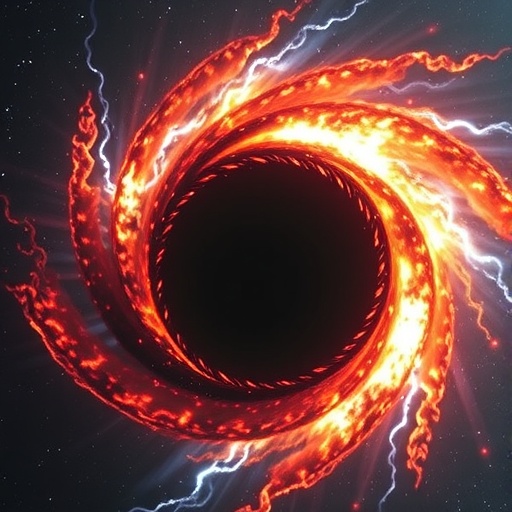
Researchers at UMass Amherst propose that this extraordinary neutrino might be the product of an explosion from a special breed of black holes, known as quasi-extremal primordial black holes (PBHs). These exotic objects differ significantly from the traditional black holes formed by dying stars. While conventional black holes are the aging remnants of massive stars that collapse under their gravity in supernovae explosions, PBHs are theorized to have formed in the primordial soup of the early universe, mere moments after the Big Bang. Their existence remains hypothetical but offers tantalizing possibilities for new physics.
Stephen Hawking’s theoretical work in the 1970s laid the foundation for our understanding of PBHs. He suggested that unlike the vast, stable black holes born from stellar collapse, these primordial varieties could be much lighter and thus hotter due to their minuscule size. This heating effect leads to the emission of “Hawking radiation,” a process through which PBHs gradually lose mass and eventually evaporate completely in a fiery blast. This final burst of energy, the physicists hypothesize, could be the source of the ultra-high-energy neutrinos observed in recent experiments.
Andrea Thamm, one of the key researchers, explains that as these PBHs lose mass, their temperature rises, leading to an exponential increase in particle emission. This evaporation process culminates in an explosive discharge of particles, including neutrinos, which can be detected by sophisticated cosmic neutrino observatories. This scenario not only accounts for the extreme energy signature of the detected neutrino but also presents a method to directly observe Hawking radiation, a phenomenon never before experimentally confirmed.
The importance of this discovery extends beyond neutrino detection. Should these explosions be confirmed, they would provide an unprecedented catalog of all elementary particles, encompassing those well-established by the Standard Model of particle physics, as well as particles that remain theoretical, such as candidates for dark matter. This theoretical neutrino “catalog” would offer scientists a unique cosmic laboratory to probe the fundamental constituents of matter and the underlying forces that govern the universe.
The detection event by the KM3NeT Collaboration, which captured the extraordinary neutrino, offered a compelling empirical foothold for this hypothesis. Nonetheless, a contradictory silence from another major neutrino observatory, IceCube, presents a puzzle. IceCube, despite its sensitivity, has never recorded a neutrino event anywhere near the energy level observed by KM3NeT, raising questions about the frequency and prevalence of such PBH explosions.
To explain this apparent contradiction, the UMass Amherst team introduced an advanced model involving a “dark charge,” an exotic concept that modifies the behavior of PBHs. This dark charge is akin to electric charge but exists in a hidden sector, involving a hypothesized heavier cousin to the electron called the “dark electron.” It endows PBHs with unique properties, especially in how they emit particles and interact with their surroundings, differentiating them from simpler existing models of PBHs.
Physicist Joaquim Iguaz Juan elaborates that these quasi-extremal PBHs could avoid inconsistent experimental detections due to their distinctive behaviors governed by this dark charge. This complexity does not merely offer theoretical elegance but provides an experimentally verifiable framework that accounts for the neutrino detection disparities while remaining consistent with other astrophysical observations.
Incorporating this dark charge hypothesis also opens exciting avenues for addressing the enigmatic nature of dark matter, which forms approximately 27% of the universe’s mass-energy content yet remains invisible to direct detection. The team suggests that if PBHs with dark charge exist in sufficient numbers, they could constitute a significant portion—or even the entirety—of dark matter. This aligns neatly with astrophysical data gathered from galaxy dynamics and the cosmic microwave background, which both imply a hidden but gravitationally influential mass component in the cosmos.
Michael Baker, a co-author on the study, emphasizes the potential paradigm shift: if the observed high-energy neutrino is indeed a signature of a PBH explosion influenced by dark charge, we may be witnessing the first experimental glimpse of physics beyond the Standard Model. This discovery would not only confirm Hawking radiation after decades of theoretical anticipation but also validate the existence of PBHs and advance our understanding of dark matter’s constitution.
The implications extend to experimental astrophysics and cosmology, as current and next-generation cosmic observatories could capitalize on these findings. The ability to detect neutrino bursts from PBHs offers an entirely new method of probing the early universe’s conditions and particle content, potentially unveiling particles that have remained hidden from terrestrial accelerators.
This research represents a symbiosis of theoretical physics and experimental astrophysics at the frontier of knowledge. It challenges conventional wisdom, introduces novel concepts like dark charge, and beckons a new era where black hole explosions are not just cosmic catastrophes but keyholes into the universe’s deepest secrets.
In summary, the University of Massachusetts Amherst team’s work constitutes a monumental stride toward solving enduring cosmic mysteries. Their dark-charge quasi-extremal primordial black hole model offers solutions to the vexing neutrino observation discrepancy, proposes a method for detecting Hawking radiation experimentally, and could finally shed light on the elusive nature of dark matter. As the hunt intensifies, this captivating theory not only fuels scientific imagination but promises transformative discoveries in the fundamental structure of the universe.
Subject of Research: Primordial black holes, high-energy neutrinos, dark matter, Hawking radiation
Article Title: Explaining the PeV neutrino fluxes at KM3NeT and IceCube with quasiextremal primordial black holes
Web References:
UMass Amherst Article: https://www.umass.edu/news/article/exploding-black-hole-could-reveal-foundations-universe
Physical Review Letters DOI: http://dx.doi.org/10.1103/r793-p7ct
References:
Baker, M., Thamm, A., Iguaz Juan, J., et al. Physical Review Letters, “Explaining the PeV neutrino fluxes at KM3NeT and IceCube with quasiextremal primordial black holes,” 2023. DOI: 10.1103/r793-p7ct
Hawking, S. (1970). Primordial Black Holes. Monthly Notices of the Royal Astronomical Society, 152(1), 75.
Image Credits: NASA’s Goddard Space Flight Center
Keywords
Primordial black holes, neutrinos, Hawking radiation, dark charge, dark matter, particle physics, cosmic neutrinos, KM3NeT, IceCube, astrophysics, universe fundamental particles, cosmic microwave background
Tags: black hole explosion theorycosmic phenomena explorationearly universe cosmologyexotic black hole typeslarge hadron collider comparisonsneutrino detection 2023primordial black holesStephen Hawking contributionssubatomic particle energytheoretical physics breakthroughsUMass Amherst researchUnderstanding the universe’s mysteries