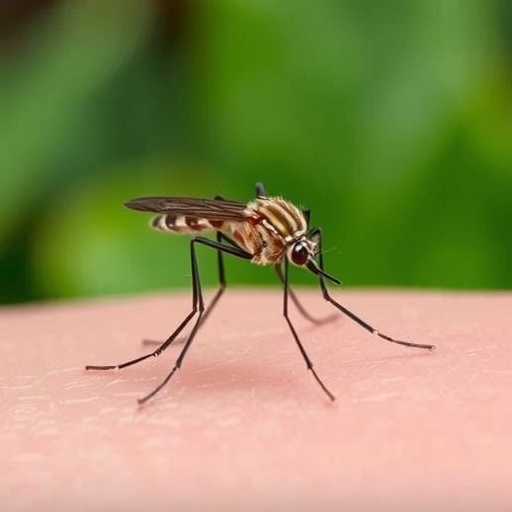
As the warm months arrive, many find themselves battling the relentless nuisance of mosquito bites during outdoor activities. While synthetic repellents such as DEET have long been the gold standard, concerns about skin irritation and environmental impact have fueled an increasing demand for natural alternatives. In a groundbreaking study published in ACS Omega, a team of researchers led by Lizandra Lima Santos presents an innovative plant-based mosquito repellent formulation infused with patchouli oil, which demonstrated efficacy comparable to traditional DEET products.
The research approach stemmed from the hypothesis that the distinctive earthy fragrance of patchouli oil, widely used in perfumes and incense, could serve as an effective olfactory mask against mosquitoes. This natural aromatic complexity might disrupt the mosquito’s ability to detect human hosts, effectively rendering the wearer “invisible” to these biting insects. Prior attempts with other natural oils such as citronella and eucalyptus have encountered challenges due to their rapid volatility and subsequent loss of repellency over time.
Recognizing the volatility issue, the researchers embarked on formulating a stable, long-lasting repellent by integrating patchouli oil into an unscented cream base. This strategic encapsulation was designed to slow the degradation of the oil when exposed to air, effectively extending its protective qualities. Such a method bridges the gap between nature-derived repellents and synthetic longevity, ensuring the active components remain effective for extended periods after application.
To rigorously test their formulation, volunteers applied the patchouli-infused lotion to their forearms before exposure to Aedes aegypti mosquitoes, a primary vector for various infectious diseases. Control groups included one with no repellent and another using a commercially available DEET lotion for benchmarking purposes. The direct exposure method, using cages containing fifty hungry female mosquitoes, allowed precise observation of bite incidence over a three-hour timeframe.
The findings were remarkable: both the patchouli oil formulation and the DEET lotion provided complete protection, with no bites recorded on treated skin throughout the evaluation period. In stark contrast, untreated limbs experienced numerous bites, confirming the aggressive feeding behavior of the mosquitoes and validating the test conditions. This parity in protection challenges the conventional view that natural repellents require higher concentrations or frequent reapplication compared to synthetics.
One of the most intriguing aspects of this development is the effective repellency achieved at a relatively low concentration of patchouli oil. Typically, plant-based repellents depend on higher dosages to achieve satisfactory protection, potentially causing increased skin sensitivity or other adverse effects. Here, the low concentration not only ensures comfort and tolerability but also promises reduced cost of production and accessibility for broader use.
From a biochemical perspective, the mechanism underlying patchouli oil’s repellency is believed to involve interference with the olfactory receptors of Aedes aegypti mosquitoes. These receptors are finely tuned to detect carbon dioxide and other volatile compounds emitted by humans. The complex mixture of sesquiterpenes and other compounds in patchouli oil may effectively mask these cues or overstimulate the sensory pathways, leading to behavioral avoidance.
Future work outlined by the research team will focus on comprehensive toxicological evaluations to ascertain the formulation’s safety for prolonged human use. Clinical trials assessing potential allergic reactions, skin irritation, and long-term effects are essential before commercialization. Moreover, optimizing the formulation for various climates and skin types will be critical for global applicability, especially in regions burdened by mosquito-borne diseases.
This study’s significance extends beyond personal comfort, intersecting public health and ecological sustainability. The widespread use of synthetic repellents has raised environmental concerns, including contamination of water sources and non-target organism toxicity. A viable plant-based alternative like this patchouli-infused lotion could mitigate such risks without compromising efficacy, enhancing community acceptance and adherence.
The promising results also invite exploration into other essential oils and natural substances, possibly leading to a new generation of bioactive repellents that combine multiple botanical extracts. Such polyherbal combinations might offer synergistic effects, broader spectrum protection, and reduced resistance development among vector populations, a growing issue with synthetic agents.
In a world increasingly attuned to the ecological cost of chemical products, this innovative approach represents a harmonious convergence of traditional botanical knowledge and modern formulation science. Its potential impact is vast, touching outdoor enthusiasts, public health initiatives, and environmental conservation efforts. The road ahead includes rigorous testing and formulation refinement, but the foundations laid by this study illuminate a future where patchouli oil and similar natural compounds could reshape mosquito bite prevention strategies globally.
The American Chemical Society’s publication of this research underscores its scientific rigor and relevance. As mosquito-borne illnesses such as dengue, Zika, and chikungunya continue to challenge global health systems, novel solutions like this patchouli oil formulation offer hope for safer, more sustainable protective measures. The multidisciplinary effort combining chemistry, biology, and pharmacology exemplifies the transformative power of collaborative science.
With summer approaching and mosquito populations on the rise in many regions, the development of an effective, natural repellent derived from patchouli oil ignites excitement and offers a refreshing alternative to chemical-based products. This advancement could change how individuals protect themselves outdoors, reduce chemical exposure risks, and potentially decrease the global disease burden associated with mosquito vectors.
Subject of Research: Development and efficacy testing of a patchouli oil-infused mosquito repellent lotion against Aedes aegypti mosquitoes
Article Title: Could patchouli oil save your skin from mosquito bites?
News Publication Date: 30-Mar-2026
Web References: https://dx.doi.org/10.1021/acsomega.6c00802
Image Credits: Lizandra Lima Santos
Keywords
Mosquito repellents, Patchouli oil, Natural insect repellents, Aedes aegypti, DEET alternative, Essential oils, Plant-based formulation, Vector control, Insect sensory disruption, Environmental sustainability, Biopesticides, Skin protection
Tags: alternatives to DEET mosquito repellentsanti-mosquito natural fragranceenvironmental impact of insect repellentslong-lasting natural mosquito repellentmosquito bite prevention with essential oilsnatural mosquito repellent with patchouli oilpatchouli oil olfactory maskingpatchouli oil skin protectionpatchouli oil volatility controlplant-based insect repellent efficacystable essential oil formulationssynthetic vs natural mosquito protection