• HOME
  • NEWS
  • EXPLORE
    • CAREER
      • Companies
      • Jobs
    • EVENTS
    • iGEM
      • News
      • Team
    • PHOTOS
    • VIDEO
    • WIKI
  • BLOG
  • COMMUNITY
    • FACEBOOK
    • INSTAGRAM
    • TWITTER
Tuesday, July 7, 2026
BIOENGINEER.ORG
No Result
View All Result
  • Login
  • HOME
  • NEWS
  • EXPLORE
    • CAREER
      • Companies
      • Jobs
        • Lecturer
        • PhD Studentship
        • Postdoc
        • Research Assistant
    • EVENTS
    • iGEM
      • News
      • Team
    • PHOTOS
    • VIDEO
    • WIKI
  • BLOG
  • COMMUNITY
    • FACEBOOK
    • INSTAGRAM
    • TWITTER
  • HOME
  • NEWS
  • EXPLORE
    • CAREER
      • Companies
      • Jobs
        • Lecturer
        • PhD Studentship
        • Postdoc
        • Research Assistant
    • EVENTS
    • iGEM
      • News
      • Team
    • PHOTOS
    • VIDEO
    • WIKI
  • BLOG
  • COMMUNITY
    • FACEBOOK
    • INSTAGRAM
    • TWITTER
No Result
View All Result
Bioengineer.org
No Result
View All Result
Home NEWS Science News

Cost-saving, longer-lasting biodegradable adhesive patented by Kansas State University

Bioengineer by Bioengineer
January 10, 2017
in Science News
Reading Time: 2 mins read
0
Share on FacebookShare on TwitterShare on LinkedinShare on RedditShare on Telegram
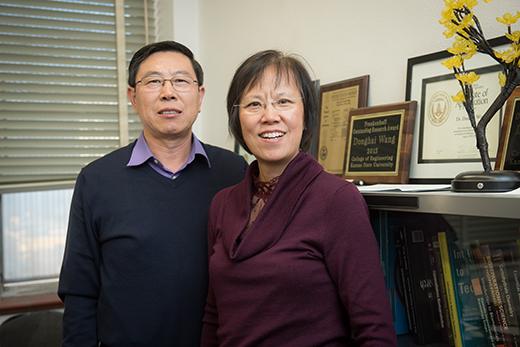
IMAGE

Credit: Kansas State University

MANHATTAN, Kan. — Kansas State University researchers have patented the first plant-based resin of its kind that would be ideal for re-adherable painters' tape, labels, packing tapes, stationery notes and other adhesive uses. It also can provide shiny coatings.

"Painters generally finish projects with mounds of used tape made of low-quality paper that does not recycle," said Susan Sun, university distinguished professor of grain science and industry and lead researcher on the project. "If they could use biodegradable tape, like ours, it would greatly reduce the amount of waste."

In addition to adhesive applications, the resin could be used in coatings on wooden surfaces, slick magazine pages, bags of potato chips and other items needing shiny and protective surfaces that are either flexible or rigid.

Sun said the resin outperforms previous bio-based adhesives because it adheres to a surface for a longer period of time, has a longer shelf life and is more water-resistant. Because the substance is plant-based, its resources are biodegradable and renewable.

"Our resin is unique because it is made from soybean, corn and other plant oils," Sun said. "Currently available resins are made from petroleum-based products, which are less sustainable, and from plant fatty acids, which cost more to process."

The research has been featured in several publications, including Biomacromolecules, Journal of Materials Chemistry and others. It has been presented at the International Material Research Conference in China, the Green Chemistry and Engineering Conference in Washington, D.C., the American Chemical Society National Meeting in Anaheim, California, and other events.

###

Initial funding was provided by the Kansas Soybean Commission and the United Soybean Board. Additional funding sources include the U.S. Department of Agriculture and the National Institute of Food and Agriculture.

Sun developed the resin with Donghai Wang, professor of biological and agricultural engineering, and Kollbe Ahn, a 2011 Kansas State University grain science doctoral graduate who is now a research professor at the University of California, Santa Barbara.

The patent was issued to the Kansas State University Research Foundation, a nonprofit corporation responsible for managing technology transfer activities at the university.

Media Contact

Susan Sun
[email protected]
785-532-4077
@KStateNews​

http://www.k-state.edu

############

Story Source: Materials provided by Scienmag

Share12Tweet8Share2ShareShareShare2

Related Posts

Flame retardant BDE-209 targets molecularly linked to ulcerative colitis

July 6, 2026
Ultra-high frequency particle impacts mimic rockbursts to shatter hard rock

Ultra-high frequency particle impacts mimic rockbursts to shatter hard rock

July 6, 2026

Kidney transplant outcomes in older adults studied by German researchers

July 6, 2026

Embodied cognition yields interpretable trajectory predictions for autonomous systems.

July 6, 2026
Please login to join discussion

POPULAR NEWS

  • Detection of EDCs in Breast Milk and Infant Urine Up to Six Months Highlights Early Exposure Risks

    77 shares
    Share 31 Tweet 19
  • New Drug Candidate Developed at McMaster Shows Potential for Treating Brain Cancer

    58 shares
    Share 23 Tweet 15
  • Saying Goodbye to PGY-6: Pediatric Fellowship Realities

    103 shares
    Share 41 Tweet 26
  • KTU Researchers Explore Ultrasound’s Role in Enhancing Blood Flow Beyond Diagnostics

    53 shares
    Share 21 Tweet 13

About

We bring you the latest biotechnology news from best research centers and universities around the world. Check our website.

Follow us

Recent News

Flame retardant BDE-209 targets molecularly linked to ulcerative colitis

Ultra-high frequency particle impacts mimic rockbursts to shatter hard rock

Kidney transplant outcomes in older adults studied by German researchers

Subscribe to Blog via Email

Enter your email address to subscribe to this blog and receive notifications of new posts by email.

Join 83 other subscribers
  • Contact Us

Bioengineer.org © Copyright 2023 All Rights Reserved.

Welcome Back!

Login to your account below

Forgotten Password?

Retrieve your password

Please enter your username or email address to reset your password.

Log In
No Result
View All Result
  • Homepages
    • Home Page 1
    • Home Page 2
  • News
  • National
  • Business
  • Health
  • Lifestyle
  • Science

Bioengineer.org © Copyright 2023 All Rights Reserved.