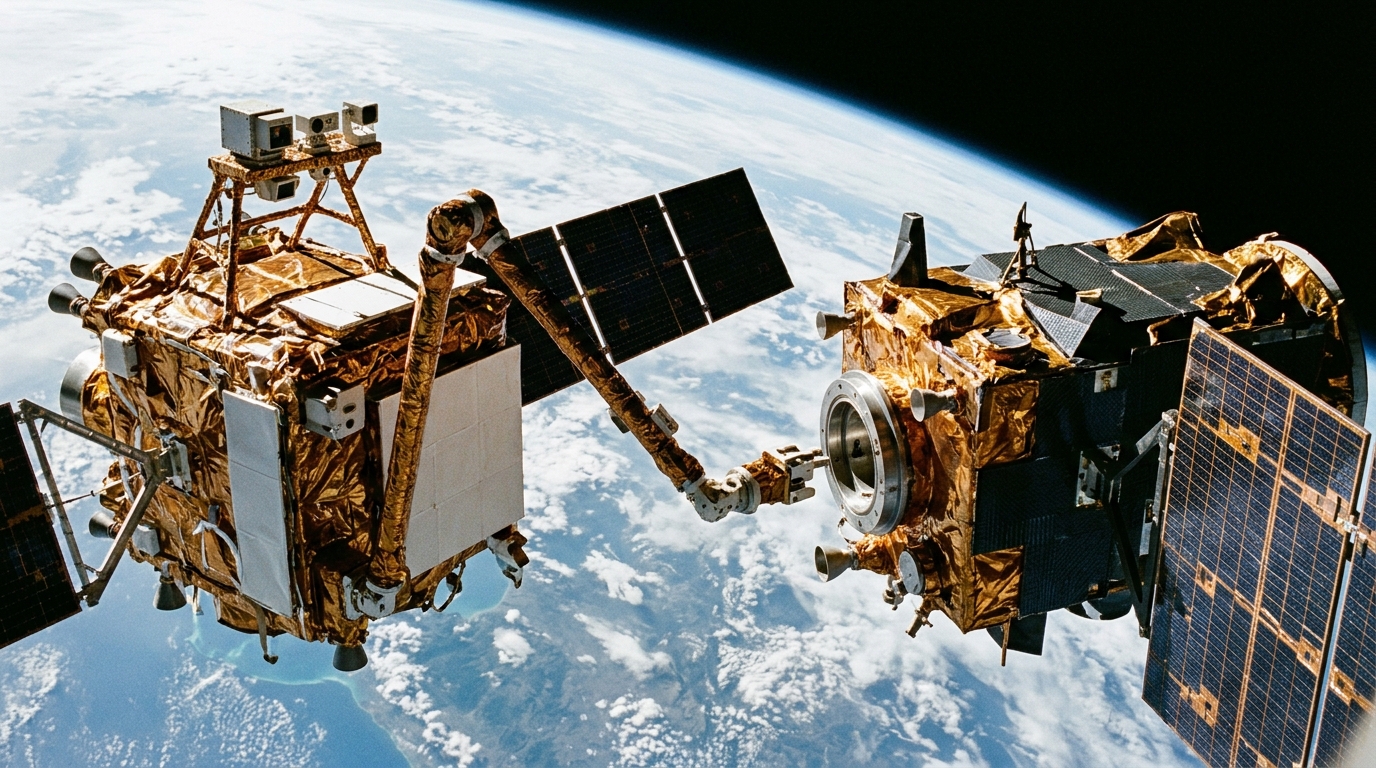
Researchers at the University of Illinois Urbana-Champaign have developed a software framework called CORTEX, which stands for Convex Optimization for Rendezvous Trajectory Execution, to enable autonomous close-range rendezvous for spacecraft servicing. The system is designed to address the growing challenge of servicing non-functioning satellites in low Earth orbit, a task that requires a servicer spacecraft to approach a target that has lost the ability to communicate or maneuver. Minduli Wijayatunga, an aerospace engineering faculty member in the Grainger College of Engineering, led the development of this framework, which aims to allow spacecraft to make critical go/no-go decisions without waiting for instructions from Earth due to communication time delays.
The motivation for this research stems from the increasing density of objects in low Earth orbit. According to the European Space Agency, there are approximately 19,440 satellites currently on orbit, of which 3,540 are non-functioning and not emitting signals to warn other spacecraft of their location. Additionally, there are over 8,000 metric tons of space debris that are uncooperative, meaning they cannot thrust or send signals. As the number of launched satellites increases, the need to service these dormant objects will grow, necessitating autonomous systems that can operate independently in the complex orbital environment.
CORTEX is built on principles of convex optimization, a mathematical approach used for trajectory design and guidance. The framework specifically accounts for environmental factors such as eclipses, timing the rendezvous to occur during optimal windows of sunlight. This ensures that the servicer can see the target, complete close-proximity operations, and depart safely. The inclusion of sunlight windows and a replanning versus abort architecture represents a novel aspect of the CORTEX system.
The core function of CORTEX is to decide whether to replan a new trajectory to approach the target or to abort the approach and retreat to a passively safe orbit. If the servicer deviates significantly from its nominal mission trajectory, the algorithm replans the trajectory and re-approaches the target. However, if the spacecraft is in severe violation of its keep-out zone, CORTEX commands a return to a passively safe orbit. This decision-making process is designed to recover from unexpected events, such as thruster failures or high-order orbital perturbations that push the spacecraft away from its intended path. The system allows the servicer to track the trajectories of uncooperative objects autonomously and make these critical safety decisions without ground intervention.
To validate the framework, the research team conducted hardware experiments in a lab to stress test the system. During these tests, the servicer spacecraft was manually pushed to simulate perturbations that send it off course from its target. Thrusters were also turned off during periods when they were supposed to be active, and state and thrust errors were artificially increased to simulate unexpected situations such as solar storms. In some hardware tests, when the servicer violated the approach corridor, it left the keep-out zone and retreated to a safe position. In other instances, the servicer was able to recover from the deviations and carry on with its mission, showcasing the system’s ability to handle both failure and recovery scenarios.
The study, titled “CORTEX: An autonomous, end-to-end, convex-based framework for close-range rendezvous trajectory design and guidance with hardware testbed validation,” was published in the journal Acta Astronautica. The authors include Minduli C. Wijayatunga, Julian Guinane, Nathan D. Wallace, Xiaofeng Wu, and Salah Sukkarieh. While autonomous servicing has not yet been attempted on an uncooperative target in space, the approach is not purely theoretical. Close-range approach to an uncooperative object has already been experimentally validated in space by the ADRAS-J mission, providing a precedent for the feasibility of such operations.
Wijayatunga has indicated that this work has spawned several follow-up projects. One such project involves using reinforcement learning to replan the phase that occurs right before close rendezvous. This phase, known as far rendezvous, happens when the target is visible at a range from 30 kilometers down to 3 kilometers.
Subject of Research: Autonomous spacecraft rendezvous framework for servicing non-functioning satellites
Article Title: CORTEX: The brains behind autonomous close-range rendezvous for spacecraft servicing
Article References: CORTEX: The brains behind autonomous close-range rendezvous for spacecraft servicing. Original publication (Bibliographic details unavailable.)
Image Credits: AI Generated
DOI: Not provided
Keywords: spacecraft servicing, autonomous rendezvous, low Earth orbit, convex optimization, space debris, trajectory design, University of Illinois, Acta Astronautica, space safety, orbital mechanics, CORTEX, brains
News Source: Scienmag.