• HOME
  • NEWS
  • EXPLORE
    • CAREER
      • Companies
      • Jobs
    • EVENTS
    • iGEM
      • News
      • Team
    • PHOTOS
    • VIDEO
    • WIKI
  • BLOG
  • COMMUNITY
    • FACEBOOK
    • INSTAGRAM
    • TWITTER
Tuesday, October 20, 2026
BIOENGINEER.ORG
No Result
View All Result
  • Login
  • HOME
  • NEWS
  • EXPLORE
    • CAREER
      • Companies
      • Jobs
        • Lecturer
        • PhD Studentship
        • Postdoc
        • Research Assistant
    • EVENTS
    • iGEM
      • News
      • Team
    • PHOTOS
    • VIDEO
    • WIKI
  • BLOG
  • COMMUNITY
    • FACEBOOK
    • INSTAGRAM
    • TWITTER
No Result
View All Result
Bioengineer.org
No Result
View All Result
Home NEWS Science News Technology

Corn-straw biochar/MXene/MnO2 composite reaches 1,049.95 F g−1 in electrode study

by
October 20, 2026
in Technology
Reading Time: 2 mins read
0
Corn-straw biochar/MXene/MnO2 composite reaches 1,049.95 F g−1 in electrode study

Corn Straw Waste Transformed Into High-Performance Supercapacitor Electrodes

Share on FacebookShare on TwitterShare on LinkedinShare on RedditShare on Telegram

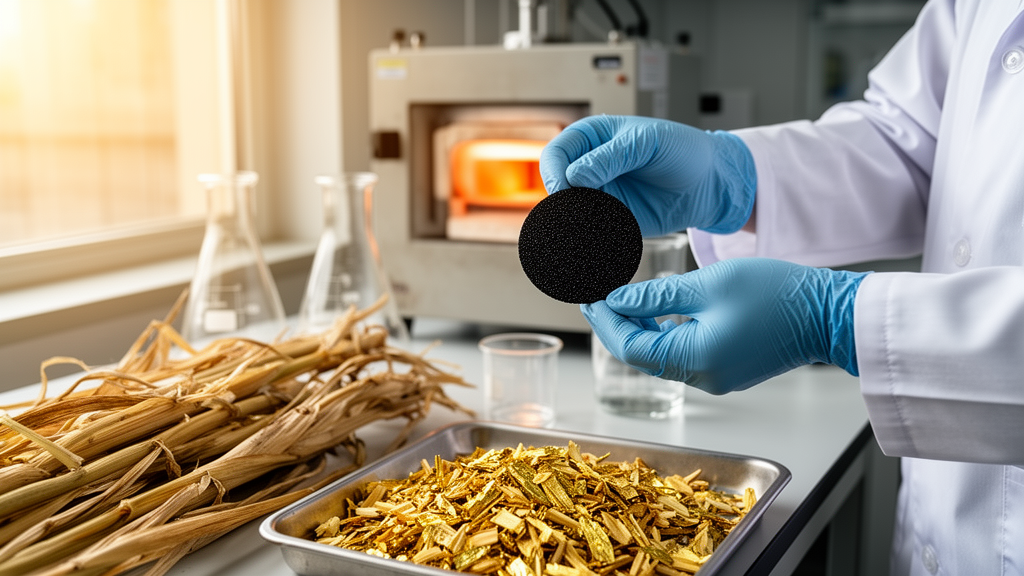
A laboratory materials study reported that a ternary composite made from corn-straw biochar, MXene and manganese dioxide achieved a specific capacitance of 1,049.95 F g−1 per electrode at a scan rate of 5 mV s−1. The findings are summarized in the published abstract of an experimental article in the Journal of Materials Science; the full study was not available for independent assessment.

The researchers constructed the material, designated hCC/Ti3C2Tx@MnO2 (CTM), through sequential hydrothermal compositing of corn-straw biochar, MXene and MnO2. They prepared composites with different amounts of KMnO4 and characterized their phase structure, morphology and electrochemical performance. According to the abstract, the composite contained Ti–O–Mn interfacial bonding, which the authors associated with faster charge transfer and directional electron migration. All of the tested composites reportedly exhibited high specific capacitance and good cycling stability, although the abstract did not provide the number of cycles, retention percentage or other detailed cycling-stability measurements.

Among the tested formulations, CTM-2, produced with a KMnO4 addition of 0.24 g, gave the strongest reported results. Its specific surface area was 1,041.72 m2 g−1, and its surface-capacitive contribution was 0.91. The abstract also reports enhanced conductivity, rate capability and cycling stability, but does not give the numerical values for the latter two properties. These measurements concern laboratory-scale composite electrodes and do not by themselves establish performance in a full commercial supercapacitor or under practical operating conditions.

When CTM-2 was assembled into a symmetric device, the abstract reports a specific capacitance of 192.25 F and a specific capacitance per electrode of 769 F g−1 at a current density of 0.1 A g−1. The authors present the biochar-based composite as a promising electrode material for supercapacitors, but the available abstract does not report energy density, power density, device-level cycling life or comparisons with commercial devices.

Subject of Research: Electrochemical performance of a corn-straw biochar, MXene and MnO2 composite for supercapacitor electrodes

Article Title: Engineering MXene/MnO2 heterojunctions on biomass-derived carbon for enhanced capacitive performance

Article References: Cai, Y., Jin, Y., Zhang, Y., Wei, X., Chen, X., & Xu, Y. (2026). Engineering MXene/MnO2 heterojunctions on biomass-derived carbon for enhanced capacitive performance. Journal of Materials Science, 61(42), 33279-33296. https://doi.org/10.1007/s10853-026-13737-1

Image Credits: AI Generated

DOI: 10.1007/s10853-026-13737-1

Keywords: MXene, MnO2, biochar, supercapacitors, specific capacitance, symmetric devices, electrode materials, hydrothermal synthesis, Engineering, heterojunctions, biomass-derived, carbon

News Source: Denise Maddox. (October 20, 2026). Corn-straw biochar/MXene/MnO2 composite reaches 1,049.95 F g−1 in electrode study. Scienmag.


Tags: biocharBiomass-derivedcarbonElectrode MaterialsengineeringheterojunctionsHydrothermal synthesisMnO2MXenespecific capacitanceSupercapacitorssymmetric devices
Share12Tweet7Share2ShareShareShare1

Related Posts

Supramolecular Ligation Turns Polymer Folds into Covalent Bonds

Supramolecular Ligation Turns Polymer Folds into Covalent Bonds

October 20, 2026
Diffusion and graph networks improve music-conditioned dance generation and style control

Diffusion and graph networks improve music-conditioned dance generation and style control

October 20, 2026

Hybrid machine-learning model improves TiN thickness prediction with limited calibration data

October 20, 2026

Deep reinforcement learning improves simulated short-video session duration and diversity

October 20, 2026

POPULAR NEWS

  • Review assesses AI-guided weed control opportunities and risks

    Review assesses AI-guided weed control opportunities and risks

    29 shares
    Share 12 Tweet 7
  • Protocol plans three open-label AUD medication pilots in adults with HIV

    29 shares
    Share 12 Tweet 7
  • Supramolecular Ligation Turns Polymer Folds into Covalent Bonds

    29 shares
    Share 12 Tweet 7
  • Extremely High NT-proBNP in Unselected Hospital Admissions: A Retrospective Analysis of Diagnoses and Outcomes

    29 shares
    Share 12 Tweet 7

About

We bring you the latest biotechnology news from best research centers and universities around the world. Check our website.

Follow us

Recent News

Review assesses AI-guided weed control opportunities and risks

Protocol plans three open-label AUD medication pilots in adults with HIV

Supramolecular Ligation Turns Polymer Folds into Covalent Bonds

Subscribe to Blog via Email

Enter your email address to subscribe to this blog and receive notifications of new posts by email.

Join 85 other subscribers
  • Contact Us

Bioengineer.org © Copyright 2023 All Rights Reserved.

Welcome Back!

Login to your account below

Forgotten Password?

Retrieve your password

Please enter your username or email address to reset your password.

Log In
No Result
View All Result
  • Homepages
    • Home Page 1
    • Home Page 2
  • News
  • National
  • Business
  • Health
  • Lifestyle
  • Science

Bioengineer.org © Copyright 2023 All Rights Reserved.