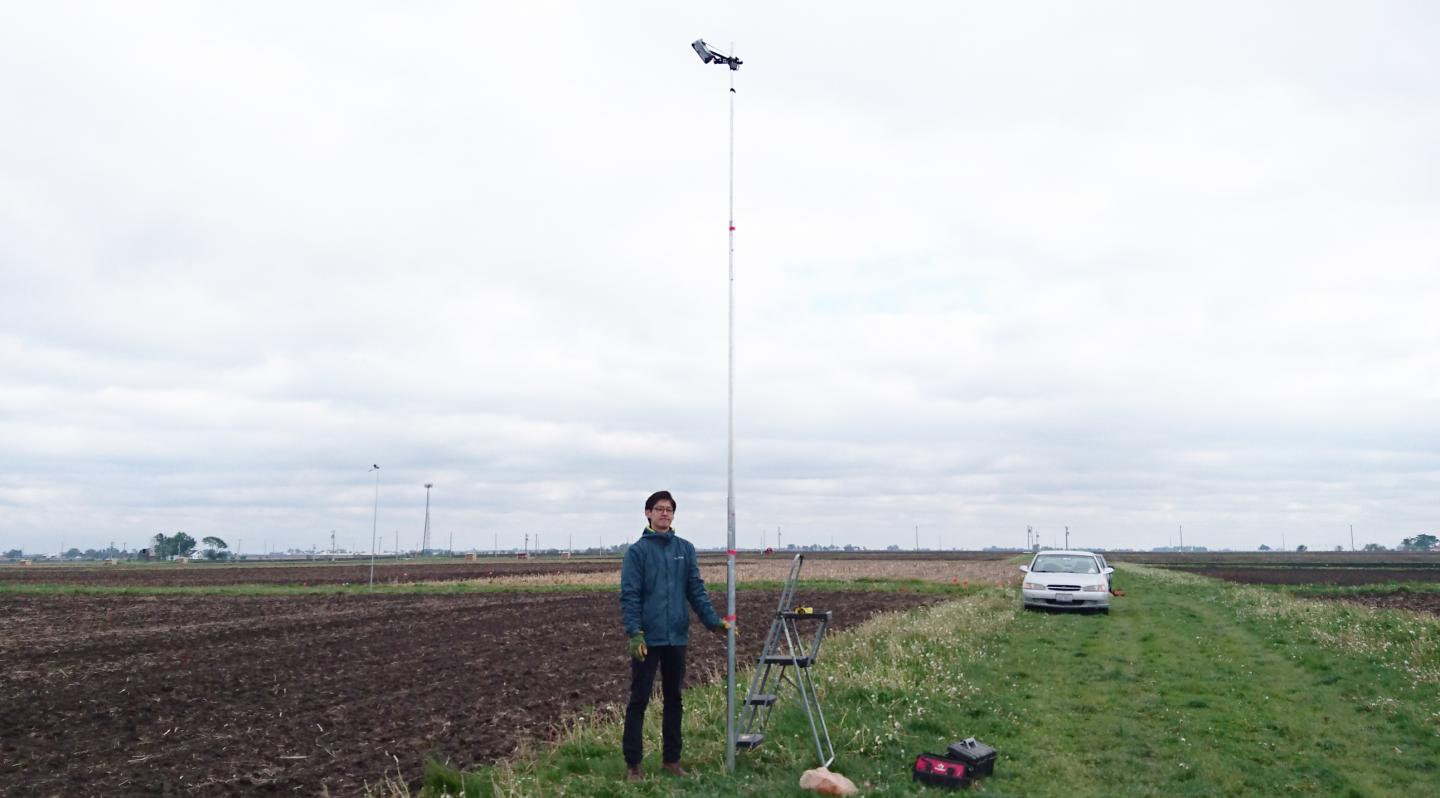
Credit: Image courtesy of Hyungsuk Kimm, University of Illinois.
URBANA, Ill. – University of Illinois scientists, with help from members of the Illinois Corn Growers Association, have developed a new, scalable method for estimating crop productivity in real time. The research, published in Remote Sensing of Environment, combines field measurements, a unique in-field camera network, and high-resolution, high-frequency satellite data, providing highly accurate productivity estimates for crops across Illinois and beyond.
“Our ultimate goal is to provide useful information to farmers, especially at the field level or sub-field level. Previously, most available satellite data had coarse spatial and/or temporal resolution, but here we take advantage of new satellite products to estimate leaf area index (LAI), a proxy for crop productivity and grain yield. And we know the satellite estimates are accurate because our ground measurements agree,” says Hyungsuk Kimm, a doctoral student in the Department of Natural Resources and Environmental Sciences (NRES) at U of I and lead author on the study.
Kimm and his colleagues used surface reflectance data, which measures light bouncing off the Earth, from two kinds of satellites to estimate LAI in agricultural fields. Both satellite datasets represent major improvements over older satellite technologies; they can “see” the Earth at a fine scale (3-meter or 30-meter resolution) and both return to the same spot above the planet on a daily basis. Since the satellites don’t capture LAI directly, the research team developed two mathematical algorithms to convert surface reflectance into LAI.
While developing the algorithms to estimate LAI, Kimm worked with Illinois farmers to set up cameras in 36 corn fields across the state, providing continuous ground-level monitoring. The images from the cameras provided detailed ground information to refine the satellite-derived estimates of LAI.
The true test of the satellite estimates came from LAI data Kimm measured directly in the corn fields. Twice weekly during the 2017 growing season, he visited the fields with a specialized instrument and measured corn leaf area by hand.
In the end, the satellite LAI estimates from the two algorithms strongly agreed with Kimm’s “ground-truth” data from the fields. This result means the algorithms delivered highly accurate, reliable LAI information from space, and can be used to estimate LAI in fields anywhere in the world in real time.
“We are the first to develop scalable, high-temporal, high-resolution LAI data for farmers to use. These methods have been fully validated using an unprecedented camera network for farmland,” says Kaiyu Guan, assistant professor in the Department of NRES and Blue Waters professor at the National Center for Supercomputing Applications. He is also principal investigator on the study.
Having real-time LAI data could be instrumental for responsive management. For example, the satellite method could detect underperforming fields or segments of fields that could be corrected with targeted management practices such as nutrient management, pesticide application, or other strategies. Guan plans to make real-time data available to farmers in the near future.
“The new LAI technology developed by Dr. Guan’s research team is an exciting advancement with potential to help farmers identify and respond to in-field problems faster and more effectively than ever before,” says Laura Gentry, director of water quality research for the Illinois Corn Growers Association.
“More accurate measurements of LAI can help us to be more efficient, timely, and make decisions that will ultimately make us more profitable. The last few years have been especially difficult for farmers. We need technologies that help us allocate our limited time, money, and labor most wisely. Illinois Corn Growers Association is glad to partner with Dr. Guan’s team, and our farmer members were happy to assist the researchers with access to their crops in validating the team’s work. We’re proud of the advancement this new technology represents and are excited to see how the Guan research team will use it to bring value directly to Illinois farmers,” Gentry adds.
###
The article, “Deriving high-spatiotemporal-resolution leaf area index for agroecosystems in the U.S. Corn Belt using Planet Labs CubeSat and STAIR fusion data,” is published in Remote Sensing for Environment [DOI: 10.1016/j.rse.2019.111615]. Co-authors include Hyungsuk Kimm, Kaiyu Guan, Chongya Jiang, Bin Peng, Laura Gentry, Scott Wilkin, Sibo Wang, Yaping Cai, Carl Bernacchi, Jian Peng, and Yunan Luo. The work was supported by NASA programs, including NASA New Investigator, NASA Carbon Monitoring System, and NASA Harvest Program.
The Department of Natural Resources and Environmental Sciences is in the College of Agricultural, Consumer and Environmental Sciences at the University of Illinois.
Media Contact
Lauren Quinn
[email protected]
217-300-2435
Original Source
https:/
Related Journal Article
http://dx.