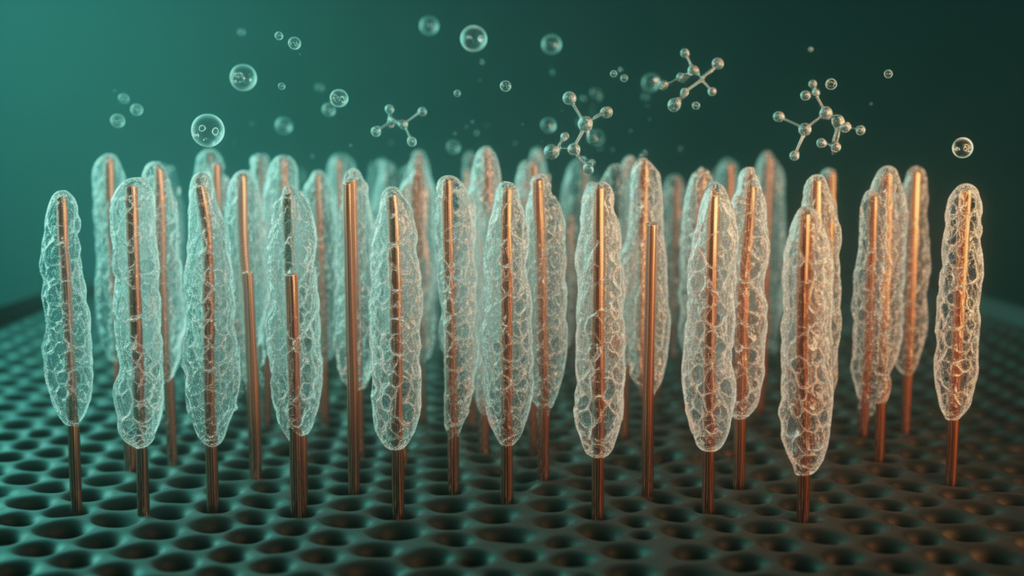
Chemists have built a hybrid catalyst that wraps copper nanowires in a shell of covalent organic framework, or COF, and used it to convert carbon dioxide into multi-carbon chemicals with markedly higher efficiency than bare copper. In tests reported in the journal Carbon Neutrality, the coated catalyst reached a Faradaic efficiency of 77 percent for C2+ products at a current density of 227.4 mA cm−2 in alkaline electrolyte, while unmodified copper nanowires managed only 41.9 percent at the same potential of −1.08 V vs. RHE. The work, led by Mingyu Wang and colleagues with senior author Buxing Han, offers a concrete demonstration of how an organic framework layer can reshape the microscopic environment around a metal catalyst to steer electrochemistry toward more valuable products.
The electrocatalytic CO2 reduction reaction, often abbreviated eCO2RR, is pursued as a way of turning a waste greenhouse gas into useful chemicals and fuels such as ethylene, ethanol and acetate. Copper occupies a special place in this field because its electronic structure allows it to catalyze the carbon–carbon coupling step that links single-carbon intermediates into two-carbon and larger molecules. Yet conventional copper catalysts are hampered by weak CO2 adsorption, low surface coverage of the key *CO intermediate, limited selectivity, insufficient activity, poor stability and a persistent tendency to split water into hydrogen instead of reducing CO2. The new study set out to address those weaknesses by combining copper with a material class whose strengths lie elsewhere.
Covalent organic frameworks are porous solids built entirely from organic molecules joined by covalent bonds. They offer highly ordered pore structures, large specific surface areas, tunable chemical composition and functionalized sites. When combined with metal catalysts, the framework’s pores can act as channels for mass transport, enhancing CO2 adsorption, while the *CO intermediates generated during the reaction can accumulate within the pores, creating a localized high-concentration environment that alters the adsorption behavior of reaction intermediates. The research team exploited these properties by growing a COF shell directly on the surface of copper nanowires using a hydrothermal method that induces polymerization of COF monomers around the metal core.
The synthesis was verified with a battery of characterization techniques. Scanning electron microscopy showed a uniform COF layer coating the nanowires, and energy-dispersive X-ray spectroscopy elemental mapping revealed that copper, carbon and nitrogen were distributed throughout the catalyst, consistent with the intended coating structure. X-ray photoelectron spectroscopy confirmed that copper in the as-prepared catalyst exists in the zero-valent state, serving as the active core, while the N 1s spectrum showed peaks attributed to C−N=C and C−N bonds in the framework. X-ray diffraction displayed peaks at 43.6, 50.7 and 74.4 degrees corresponding to the (111), (200) and (220) planes of metallic copper, and powder X-ray diffraction of the COF, refined with residual factors of Rp = 4.84% and Rwp = 6.86%, confirmed a long-range ordered framework. Fourier transform infrared spectroscopy showed the imine bond characteristic peak at 1621 cm−1, and solid-state nuclear magnetic resonance further confirmed imine bond formation, together verifying the structural integrity of the hybrid.
One of the most striking physical changes brought by the COF layer concerns wettability. Contact angle measurements gave 119.45 degrees for the bare copper nanowire electrode, rising to 143.55 degrees after COF modification, indicating substantially enhanced surface hydrophobicity. According to the authors, this hydrophobic character promotes the formation of a localized gas–liquid–solid microenvironment during electrolysis, which helps enrich CO2 near the catalyst surface and thereby supports both the activity and the selectivity of the reduction reaction. The COF loading level mattered: among catalysts prepared with different amounts of COF monomer, the variant designated Cu NWs@COF-24, named for the mass of monomer added, showed the highest activity toward C2+ products in 1 M KOH.
Performance testing was carried out in a flow cell with a three-electrode configuration in 1 M KOH, using gas chromatography and nuclear magnetic resonance to quantify gaseous and liquid products after constant-potential electrolysis across a range from −0.68 to −1.48 V vs. RHE. Linear sweep voltammetry showed a higher cathodic current density for the hybrid catalyst under CO2-fed conditions than under argon, evidencing its activity toward CO2. At −1.08 V vs. RHE, the hybrid delivered the headline figures: 77 percent Faradaic efficiency for C2+ products at 227.4 mA cm−2. Among the multi-carbon products, ethanol dominated with an efficiency of approximately 43.8 percent, ethylene followed at about 23.9 percent, and acetic acid accounted for around 7.9 percent. Bare copper nanowires at the same potential reached only 41.9 percent C2+ efficiency, with markedly lower ethanol and ethylene yields and a marked increase in hydrogen and single-carbon products.
The advantage was not confined to alkaline conditions. The hybrid catalyst maintained strong C2+ production capability in acidic and neutral electrolytes as well, whereas pristine copper nanowires produced only hydrogen in acidic electrolyte. The authors attribute the acidic-media performance to the hydrophobic COF shell repelling protons and enriching CO2 at the three-phase interface, while the microporous confinement effect of the framework concentrates CO2 around the copper sites and stabilizes *CO intermediates, suppressing the competing hydrogen evolution reaction. At potentials more negative than −1.08 V vs. RHE, both catalysts showed increased hydrogen evolution, and notably the pure copper nanowires experienced less hydrogen competition than the hybrid under those high-overpotential conditions, a phenomenon the team links to disruption of the hydrophobic effect at high current densities, which causes the COF layer to competitively adsorb protons and alter the local reaction environment.
Stability emerged as a second benefit of the coating. In a continuous electrolysis test at −1.08 V vs. RHE in the flow cell, the hybrid catalyst held both its C2+ Faradaic efficiency and its current density steady for approximately seven hours, while bare copper nanowires maintained stable performance for only two hours under the same conditions. Post-reaction characterization reinforced the picture: X-ray diffraction patterns showed copper diffraction peaks intact without shifting, X-ray photoelectron spectroscopy confirmed the persistence of metallic Cu0 species and unchanged N 1s features corresponding to the COF structure, and scanning electron microscopy with elemental mapping showed the morphology preserved without fragmentation or severe agglomeration. Electrochemical impedance spectroscopy additionally showed that the hybrid electrode had lower charge transfer resistance than bare copper, indicating more favorable kinetics for the reduction reaction.
Mechanistic experiments and calculations converged on an explanation for the enhanced selectivity. In situ attenuated total reflection surface-enhanced infrared absorption spectroscopy revealed a peak at 1439 cm−1 attributed to the C−O stretch of *COOH, indicating activation of CO2 toward *CO formation, and a peak at 2103 cm−1 corresponding to adsorbed *CO, whose intensity grew as the potential shifted negatively. On bare copper nanowires, the *CO signal appeared only at more negative potentials and with significantly lower intensity, consistent with their lower C2+ efficiency and greater tendency toward single-carbon products. CO2 adsorption experiments showed that the hybrid catalyst physically adsorbs substantially more CO2 than pristine copper nanowires, an effect attributed to the structural advantages of the COF layer.
Density functional theory calculations added a computational layer to the argument. Comparing a model Cu(111) surface with and without a COF overlayer, the calculations showed that the COF-covered surface transfers more electrons, 0.77 e versus 0.67 e, to the adsorbed *CO intermediate, and that the *CO adsorption energy is significantly lower, meaning stronger, on the COF-modified surface. The computed free energy barrier for direct *CO dimerization to *OCCO, the carbon–carbon coupling step considered the gateway to C2+ products, was 2.17 eV on the hybrid surface versus 2.38 eV on bare copper, indicating that multi-carbon formation is more favorable on the coated catalyst. Taken together, the experimental and computational results support the authors’ account that the COF layer optimizes electrode wettability, strengthens CO2 and *CO adsorption, and lowers the energy barrier for C–C coupling, thereby promoting multi-carbon product formation. The team frames the work as a validation of microenvironment regulation through hybrid structures with organic frameworks, and as a design principle for future CO2 reduction electrocatalysts, while the reported stability window of roughly seven hours in a flow cell marks the scale at which the current demonstration has been verified.
Subject of Research: Hybrid copper nanowire and covalent organic framework catalysts for electrochemical CO2 reduction to multi-carbon products
Article Title: Synergistic Cu nanowires/COF hybrid catalyst for high-efficiency CO2 electroreduction to C2+ products
Article References: Wang, M., Jia, S., Cheng, H., Chen, X., Xue, C., Deng, T., Dong, M., Xia, Z., Cheng, M., Chen, C., Wu, H., He, M., & Han, B. (2026). Synergistic Cu nanowires/COF hybrid catalyst for high-efficiency CO2 electroreduction to C2+ products. Carbon Neutrality, 5(1), Article 27. https://doi.org/10.1007/s43979-026-00182-x
Image Credits: AI Generated
DOI: 10.1007/s43979-026-00182-x
Keywords: CO2 electroreduction, copper nanowires, covalent organic framework, C2+ products, Faradaic efficiency, electrocatalysis, ethylene, ethanol, carbon–carbon coupling, flow cell, hydrophobicity, DFT calculations
News Source: Bethany Barker. (October 28, 2026). Copper Nanowires Wrapped in COF Shells Push CO2 Electroreduction Toward Multi-Carbon Products. Scienmag.