• HOME
  • NEWS
  • EXPLORE
    • CAREER
      • Companies
      • Jobs
    • EVENTS
    • iGEM
      • News
      • Team
    • PHOTOS
    • VIDEO
    • WIKI
  • BLOG
  • COMMUNITY
    • FACEBOOK
    • INSTAGRAM
    • TWITTER
Sunday, May 31, 2026
BIOENGINEER.ORG
No Result
View All Result
  • Login
  • HOME
  • NEWS
  • EXPLORE
    • CAREER
      • Companies
      • Jobs
        • Lecturer
        • PhD Studentship
        • Postdoc
        • Research Assistant
    • EVENTS
    • iGEM
      • News
      • Team
    • PHOTOS
    • VIDEO
    • WIKI
  • BLOG
  • COMMUNITY
    • FACEBOOK
    • INSTAGRAM
    • TWITTER
  • HOME
  • NEWS
  • EXPLORE
    • CAREER
      • Companies
      • Jobs
        • Lecturer
        • PhD Studentship
        • Postdoc
        • Research Assistant
    • EVENTS
    • iGEM
      • News
      • Team
    • PHOTOS
    • VIDEO
    • WIKI
  • BLOG
  • COMMUNITY
    • FACEBOOK
    • INSTAGRAM
    • TWITTER
No Result
View All Result
Bioengineer.org
No Result
View All Result
Home NEWS Science News Chemistry

CoP-electrocatalytic reduction of nitroarenes: a controllable way to azoxy-, azo- and amino-aromatic

Bioengineer by Bioengineer
November 6, 2019
in Chemistry
Reading Time: 3 mins read
0
IMAGE
Share on FacebookShare on TwitterShare on LinkedinShare on RedditShare on Telegram

IMAGE

Credit: ©Science China Press


Azoxy-, azo- and amino-aromatics are among the most widely used building blocks found important applications in materials science, pharmaceuticals and synthetic chemistry. Especially, azobenzenes are considered as one of the largest and most versatile class of organic dyes, accounting for around 70% of worldwide production of industrial dyes. Nitro reduction was a direct and commonly used way to access azoxy-, azo- and amino-compounds due to their wide commercial availability and ease of implementation. However, the reduction degree is hard to control due to its multiple electron-proton coupled steps. Amine products are always obtained for current methods, whereas the synthesis of highly valuable azoxy- and azo-compounds with high selectivity remains a critical challenge. Additionally, flammable and high pressure hydrogen, toxic hydrazine hydrate, etc. are still the main hydrogen sources. They cause serious safety risk and environmental concerns as well as leading to the poor functional group compatibility.

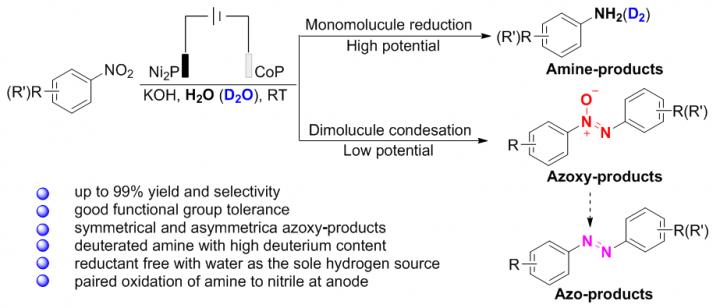
In this regard, the selective and green synthesis of azoxy-, azo- and amino-compounds in a controllable manner is highly desirable. In a new research article published in National Science Review, the Zhang group at Tianjin University presents a latest advance in electrochemical synthesis of azoxy-, azo- and amino-aromatics in aqueous solution through nitro reduction over a CoP nanosheet cathode. The products selectivity are well tuned by just applying different potentials, which alters the concentration and types of reactive intermediates such as nitrosobenzene, phenylhydroxylamine or *H at the electrode surface and finally determining the product distributions.

Therefore, the Zhang group proposed a facile potential-tuned strategy for the efficient synthesis of azoxy-, azo- and amino-aromatics via aqueous selective reduction of nitroarene feedstocks over a CoP nanosheet cathode. A variety of azoxy-, azo- and amino-products bearing different functional groups are fabricated with up to 99% selectivity and 99% yield. Interestingly, the deuterated amines with up to 99% deuterated content can be easily prepared by replacing water with deuterated water, which are difficult to obtain by current methods. Importantly, they can develop their method to paired oxidation of octlyamine and reduction of nitro substrate in a CoP || Ni2P two-electrode electrolyzer to simultaneously generate octylnitrile and azoxy-aromatics with high selectivity and efficiency using a 1.5 V battery. Only 1.25 V is required to achieve a current density of 20 mA cm-2, which is much lower than that of overall water splitting (1.70 V). Their findings may pave a promising distributed approach to produce both azoxy aromatic and nitrile products with low cost and high efficiency and the potential-tuned strategy by using water as the hydrogenation source can find wide applications in other types of electrochemical reduction reactions for controllable and green synthesis.

###

See the article:

Potential-Tuned Selective Electrosynthesis of Azoxy-, Azo- and Amino-Aromatics over a CoP Nanosheet Cathode

Xiaodan Chong, Cuibo Liu, Yi Huang, Chenqi Huang, Bin Zhang

Natl Sci Rev DOI: 10.1093/nsr/nwz146
https://doi.org/10.1093/nsr/nwz146

The National Science Review is the first comprehensive scholarly journal released in English in China that is aimed at linking the country’s rapidly advancing community of scientists with the global frontiers of science and technology. The journal also aims to shine a worldwide spotlight on scientific research advances across China.

Media Contact
Bin Zhang
[email protected]

Related Journal Article

http://dx.doi.org/10.1093/nsr/nwz146

Tags: Chemistry/Physics/Materials Sciences
Share13Tweet8Share2ShareShareShare2

Related Posts

Transforming Microalgae Waste into High-Performance Membranes for Enhanced Municipal Wastewater Treatment — Chemistry

Transforming Microalgae Waste into High-Performance Membranes for Enhanced Municipal Wastewater Treatment

May 29, 2026
Hydrochar Transforms Agricultural Waste into a Potent Solution for Healthier, Carbon-Rich Soils — Chemistry

Hydrochar Transforms Agricultural Waste into a Potent Solution for Healthier, Carbon-Rich Soils

May 29, 2026

FAPESP Aims to Strengthen Scientific Collaboration Between São Paulo and the United Kingdom

May 29, 2026

Mild Ketone-to-Ketyl Conversion Enables Redox-Neutral Coupling

May 29, 2026
Please login to join discussion

POPULAR NEWS

  • ESMO 2025: mRNA COVID Vaccines Enhance Efficacy of Cancer Immunotherapy

    319 shares
    Share 128 Tweet 80
  • Multi-Hospital Study Reveals Long Covid Burden Is Twice as High as Current Estimates

    81 shares
    Share 32 Tweet 20
  • Common Food Preservatives Associated with Elevated Blood Pressure and Increased Heart Disease Risk

    56 shares
    Share 22 Tweet 14
  • AI-Powered Atlas Uncovers Extensive Whole-Body Damage Linked to Obesity

    53 shares
    Share 21 Tweet 13

About

We bring you the latest biotechnology news from best research centers and universities around the world. Check our website.

Follow us

Recent News

Impact of Immigration Restrictions on the US Healthcare Workforce

Study Reveals Cancer Diagnostic Delays Linked to Population-Based Screening Using Cell-Free DNA Multicancer Early Detection Test

Innovative AI Technique Predicts Radiation Dosage Prior to Treatment in Advanced Prostate Cancer

Subscribe to Blog via Email

Success! An email was just sent to confirm your subscription. Please find the email now and click 'Confirm' to start subscribing.

Join 82 other subscribers
  • Contact Us

Bioengineer.org © Copyright 2023 All Rights Reserved.

Welcome Back!

Login to your account below

Forgotten Password?

Retrieve your password

Please enter your username or email address to reset your password.

Log In
No Result
View All Result
  • Homepages
    • Home Page 1
    • Home Page 2
  • News
  • National
  • Business
  • Health
  • Lifestyle
  • Science

Bioengineer.org © Copyright 2023 All Rights Reserved.