Credit: ©Science China Press
Azoxy-, azo- and amino-aromatics are among the most widely used building blocks found important applications in materials science, pharmaceuticals and synthetic chemistry. Especially, azobenzenes are considered as one of the largest and most versatile class of organic dyes, accounting for around 70% of worldwide production of industrial dyes. Nitro reduction was a direct and commonly used way to access azoxy-, azo- and amino-compounds due to their wide commercial availability and ease of implementation. However, the reduction degree is hard to control due to its multiple electron-proton coupled steps. Amine products are always obtained for current methods, whereas the synthesis of highly valuable azoxy- and azo-compounds with high selectivity remains a critical challenge. Additionally, flammable and high pressure hydrogen, toxic hydrazine hydrate, etc. are still the main hydrogen sources. They cause serious safety risk and environmental concerns as well as leading to the poor functional group compatibility.
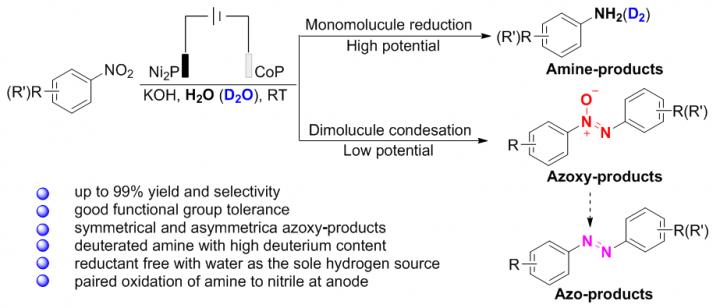
In this regard, the selective and green synthesis of azoxy-, azo- and amino-compounds in a controllable manner is highly desirable. In a new research article published in National Science Review, the Zhang group at Tianjin University presents a latest advance in electrochemical synthesis of azoxy-, azo- and amino-aromatics in aqueous solution through nitro reduction over a CoP nanosheet cathode. The products selectivity are well tuned by just applying different potentials, which alters the concentration and types of reactive intermediates such as nitrosobenzene, phenylhydroxylamine or *H at the electrode surface and finally determining the product distributions.
Therefore, the Zhang group proposed a facile potential-tuned strategy for the efficient synthesis of azoxy-, azo- and amino-aromatics via aqueous selective reduction of nitroarene feedstocks over a CoP nanosheet cathode. A variety of azoxy-, azo- and amino-products bearing different functional groups are fabricated with up to 99% selectivity and 99% yield. Interestingly, the deuterated amines with up to 99% deuterated content can be easily prepared by replacing water with deuterated water, which are difficult to obtain by current methods. Importantly, they can develop their method to paired oxidation of octlyamine and reduction of nitro substrate in a CoP || Ni2P two-electrode electrolyzer to simultaneously generate octylnitrile and azoxy-aromatics with high selectivity and efficiency using a 1.5 V battery. Only 1.25 V is required to achieve a current density of 20 mA cm-2, which is much lower than that of overall water splitting (1.70 V). Their findings may pave a promising distributed approach to produce both azoxy aromatic and nitrile products with low cost and high efficiency and the potential-tuned strategy by using water as the hydrogenation source can find wide applications in other types of electrochemical reduction reactions for controllable and green synthesis.
###
See the article:
Potential-Tuned Selective Electrosynthesis of Azoxy-, Azo- and Amino-Aromatics over a CoP Nanosheet Cathode
Xiaodan Chong, Cuibo Liu, Yi Huang, Chenqi Huang, Bin Zhang
Natl Sci Rev DOI: 10.1093/nsr/nwz146
https:/
The National Science Review is the first comprehensive scholarly journal released in English in China that is aimed at linking the country’s rapidly advancing community of scientists with the global frontiers of science and technology. The journal also aims to shine a worldwide spotlight on scientific research advances across China.
Media Contact
Bin Zhang
[email protected]
Related Journal Article
http://dx.