Respiratory syncytial virus (RSV) is one of the main reasons leading to hospitalisation among young children worldwide and each year, an estimated 101,000 children below the age of 5 years die due to RSV infections [1]. Since the end of 2022, the use of a long-acting monoclonal antibody (nirsevimab) in infants as means of passive immunisation against RSV has been allowed in the European Union and European Economic Area (EU/EEA). However, only a few countries in the EU/EEA started using nirsevimab prior to the RSV season 2023/24.
In their rapid communication published in Eurosurveillance, Ernst et al. describe first experiences from Luxembourg where a one-dose nirsevimab prophylaxis has been recommended for all babies born in 2023 accompanied by a suggested catch-up immunisation for children under the age of two years at high risk of serious illness. [2] A national immunisation campaign started in the autumn 2023 which reached an estimated 84% of new-borns (1,277 doses/1,524 births) in 2023.
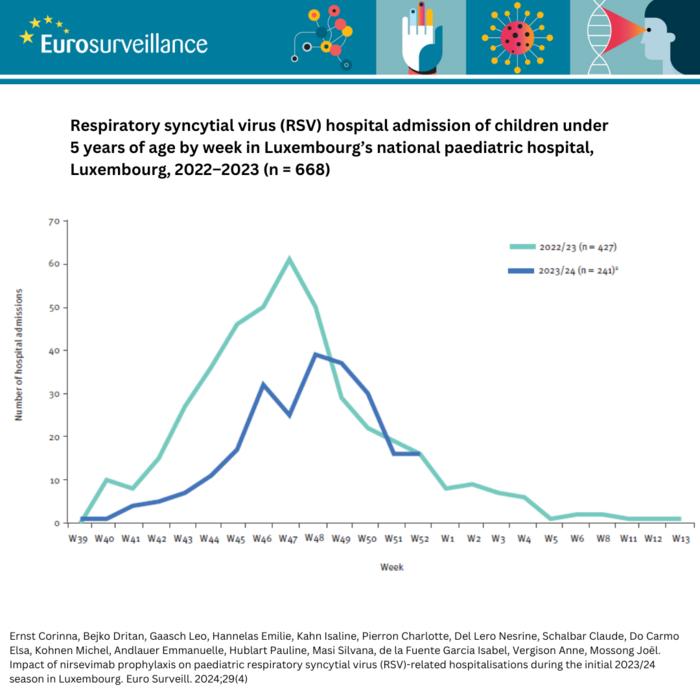
Besides estimating coverage of nirsevimab immunisation in Luxembourg among new-borns up to mid-December 2023, Ernst et al. looked at potential effects of this immunisation in children under 5 years of age. To do this, they compared RSV-related paediatric hospitalisation data from Luxembourg’s national paediatric hospital in 2022 and 2023, i.e. before and after the national nirsevimab immunisation recommendation.
Credit: Eurosurveillance
Respiratory syncytial virus (RSV) is one of the main reasons leading to hospitalisation among young children worldwide and each year, an estimated 101,000 children below the age of 5 years die due to RSV infections [1]. Since the end of 2022, the use of a long-acting monoclonal antibody (nirsevimab) in infants as means of passive immunisation against RSV has been allowed in the European Union and European Economic Area (EU/EEA). However, only a few countries in the EU/EEA started using nirsevimab prior to the RSV season 2023/24.
In their rapid communication published in Eurosurveillance, Ernst et al. describe first experiences from Luxembourg where a one-dose nirsevimab prophylaxis has been recommended for all babies born in 2023 accompanied by a suggested catch-up immunisation for children under the age of two years at high risk of serious illness. [2] A national immunisation campaign started in the autumn 2023 which reached an estimated 84% of new-borns (1,277 doses/1,524 births) in 2023.
Besides estimating coverage of nirsevimab immunisation in Luxembourg among new-borns up to mid-December 2023, Ernst et al. looked at potential effects of this immunisation in children under 5 years of age. To do this, they compared RSV-related paediatric hospitalisation data from Luxembourg’s national paediatric hospital in 2022 and 2023, i.e. before and after the national nirsevimab immunisation recommendation.
Promising first signs: fewer hospitalisations, change in age structure and less severe illness
The authors could show a drop in hospitalisations related to RSV infections with a distinct decrease (69%) among infants younger than six months of age (232 confirmed cases in 2022 and 72 cases in 2023). In the wider age group of children under the age of 5 years, in total 241 children were hospitalised with a laboratory-confirmed RSV infection in 2023, compared with 389 cases in 2022 (38% decrease).
According to the available data in Luxembourg, the authors also noted a shift in the age structure among the children that were hospitalised due to RSV infection: the mean age of hospitalised children increased from slightly below 8 months in 2022 to more than 14 months in 2023, i.e. children were generally older when they were hospitalised. Ernst et al. attributed this to the “effect of the administration strategy shortly after birth. Most hospitalised children had not yet received a nirsevimab immunisation […]”.
In addition, data showed a reduced severity among the children that had to be hospitalised in 2023. Instead of around 5 days in 2022, children were hospitalised for around 3 days in 2023 and admissions of infants to the intensive-care unit fell from 28 in 2022 to 9 in 2023 in the age group of the most vulnerable (younger than six months).
The authors conclude that this “suggests that nirsevimab prophylaxis reduced severe RSV infections, particularly in infants < 6 months old, thereby alleviating healthcare strain” - while acknowledging that their comparison at this point in time only looks at two consecutive seasons and did not cover the full 2023/24 RSV season yet.
—-Ends—-
References/notes to editors:
[1] Li Y, Wang X, Blau DM, Caballero MT, Feikin DR, Gill CJ, et al. Global, regional, and national disease burden estimates of acute lower respiratory infections due to respiratory syncytial virus in children younger than 5 years in 2019: a systematic analysis. Lancet. 2022;399(10340):2047-64. https://doi.org/10.1016/S0140-6736(22)00478-0 PMID: 35598608
[2] Ernst Corinna, Bejko Dritan, Gaasch Leo, Hannelas Emilie, Kahn Isaline, Pierron Charlotte, Del Lero Nesrine, Schalbar Claude, Do Carmo Elsa, Kohnen Michel, Andlauer Emmanuelle, Hublart Pauline, Masi Silvana, de la Fuente Garcia Isabel, Vergison Anne, Mossong Joël. Impact of nirsevimab prophylaxis on paediatric respiratory syncytial virus (RSV)-related hospitalisations during the initial 2023/24 season in Luxembourg. Euro Surveill. 2024;29(4):pii=2400033. https://doi.org/10.2807/1560-7917.ES.2024.29.4.2400033
[3] Respiratory syncytial virus (RSV) is a common respiratory virus that causes mild, cold-like symptoms. People who contract RSV usually recover in around a week without the need for medical treatment. However, in infants under six months of age, people over 65, and people with a compromised immune system, RSV can cause severe illness and death. Symptoms usually appear two to eight days after being infected. Read more: https://www.ecdc.europa.eu/en/respiratory-syncytial-virus-rsv
Journal
Eurosurveillance
DOI
10.2807/1560-7917.ES.2024.29.4.2400033
Method of Research
Data/statistical analysis
Subject of Research
People
Article Title
Impact of nirsevimab prophylaxis on paediatric respiratory syncytial virus (RSV)-related hospitalisations during the initial 2023/24 season in Luxembourg
Article Publication Date
25-Jan-2024
COI Statement
none declared