Credit: Eric Chevet et al.
Information generated by screening tools, readily available therapies and potential pathways to drug development are the cornerstone of informed clinical research and clinical trial design. In a new review in the August 2017 issue of SLAS DISCOVERY (formerly the Journal of Biomolecular Screening), authors Eric Chevet, Ph.D., of Inserm U1242 (Rennes, France) et al. analyze the recent literature and review the impact of unfolded protein response (UPR) in health and disease.
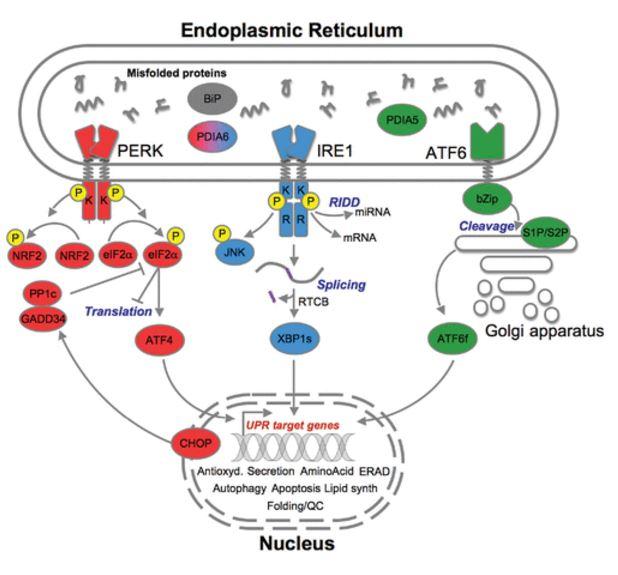
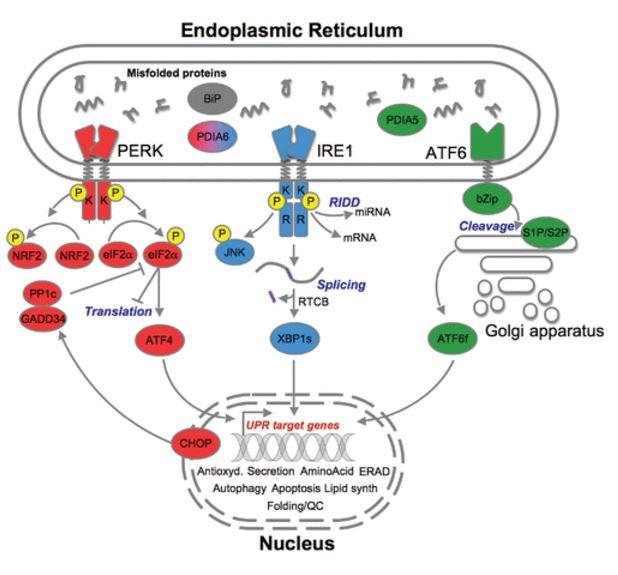
In addition to providing an in-depth description of the molecules found to target the three arms of UPR, the review provides an overview of tools available for the screening and development of novel therapeutic agents that can modulate the UPR for future disease intervention.
The UPR is activated in response to endoplasmic reticulum (ER) stress. ER is the first compartment of the secretory pathway in eukaryotic cells. Its main functions comprise calcium and lipid homeostasis maintenance as well as the productive folding of secretory and transmembrane proteins. When the protein synthesis and folding demand exceeds the ER capacity, improperly folded proteins accumulate in this compartment, thus leading to a situation called ER stress.
To cope with this imbalance, the cell activates the UPR. The UPR is an integrated adaptive biochemical process that is inextricably linked with cell homeostasis and paramount to the maintenance of normal physiological function. Prolonged ER stress can push the UPR past beneficial functions, such as reduced protein production and increased protein folding and clearance to apoptotic signaling. When this occurs, the UPR contributes to the commencement, maintenance and exacerbation of a multitude of disease states, making it an attractive global target for tackling conditions sorely in need of novel therapeutic intervention.
###
Visit SLAS DISCOVERY Online to read "Control of the Unfolded Protein Response in Health and Disease." SLAS Discovery is one of two MEDLINE-indexed scientific journals published by SLAS. For more information about SLAS and its journals, visit http://www.slas.org/journals.
About our Society and Journals
SLAS (Society for Laboratory Automation and Screening) is an international community of more than 27,000 individual scientists, engineers, researchers, technologists and others from academic, government and commercial laboratories. The SLAS mission is to be the preeminent global organization providing forums for education and information exchange and to encourage the study of, and improve the practice of life sciences discovery and technology.
SLAS DISCOVERY: 2016 Impact Factor 2.444. Editor-in-Chief Robert M. Campbell, Ph.D., Eli Lilly and Company, Indianapolis, IN (USA). SLAS Discovery (Advancing Life Sciences R&D) was previously published (1996-2016) as the Journal of Biomolecular Screening (JBS).
SLAS TECHNOLOGY: 2016 Impact Factor 2.850. Editor-in-Chief Edward Kai-Hua Chow, Ph.D., National University of Singapore (Singapore). SLAS Technology (Translating Life Sciences Innovation) was previously published (1996-2016) as the Journal of Laboratory Automation (JALA).
Follow SLAS on Twitter at @SLAS_Org.
Follow SLAS on Facebook at SocietyforLaboratoryAutomationandScreening
Follow SLAS on YouTube at SLASvideo.
Follow SLAS Americas on LinkedIn at Society for Laboratory Automation and Screening (SLAS Americas)
Follow SLAS Europe on LinkedIn at Society for Laboratory Automation and Screening Europe (SLAS Europe)
Media Contact
Tom Manning
[email protected]
630-256-7527 x103
@SLAS_Org
http://https://www.slas.org/
Original Source
http://journals.sagepub.com/doi/full/10.1177/2472555217701685 http://dx.doi.org/10.1177/247255521770