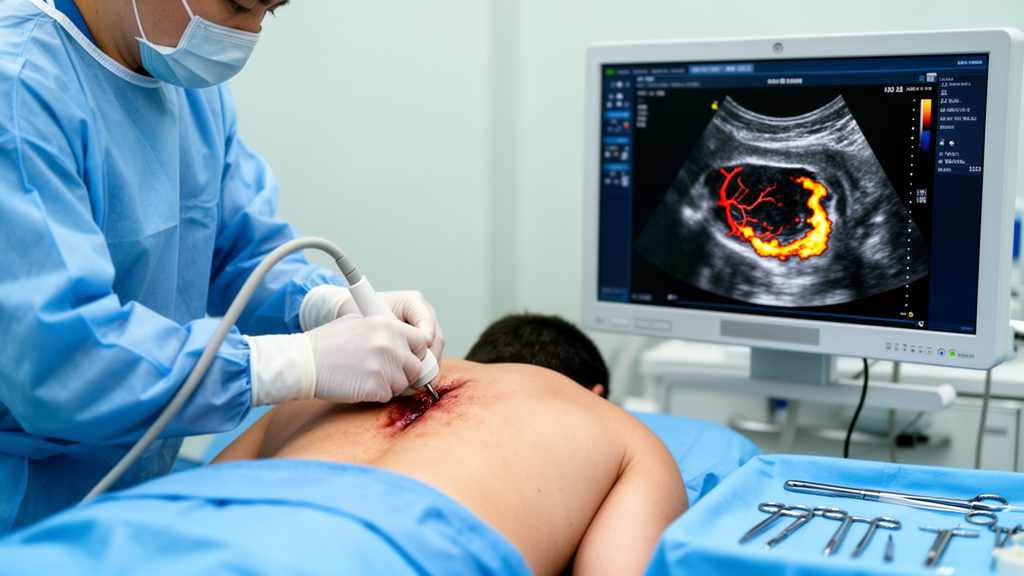
Contrast-enhanced ultrasound (CEUS) was associated with fewer recorded bleeding events than conventional ultrasound during catheter drainage of paravertebral tuberculous abscesses in a retrospective study of 67 patients treated at Hangzhou Red Cross Hospital in China. The finding emerged from a historical-control comparison covering ultrasound-guided drainage procedures performed between January 2010 and January 2025. Bleeding was recorded after 5 of 41 conventional ultrasound-guided procedures, compared with none after 31 CEUS-assisted procedures, a difference that did not meet the study’s threshold for statistical significance. The authors described the result as an exploratory association and emphasized that the small number of bleeding events and the design of the study prevent a causal conclusion.
Paravertebral tuberculous abscesses are collections associated with spinal tuberculosis that can extend along muscle planes and neurovascular pathways. An enlarging abscess may cause pain, a palpable mass, spinal cord compression or neurological deficits. In the study population, all patients had lumbar spinal tuberculosis with a paravertebral abscess at least 3 cm in transverse diameter and had microbiological confirmation of Mycobacterium tuberculosis through a positive Xpert result, with 12 patients also having positive cultures. The researchers compared outcomes from conventional ultrasound-guided drainage, used for 39 patients between January 2010 and March 2019, with CEUS-assisted drainage, used for 28 patients between August 2018 and January 2025.
CEUS involves administering an intravenous ultrasound contrast agent and observing how contrast enters and washes out of a target region. In this study, 2.4 mL of SonoVue was injected through an antecubital vein, followed by a 5 mL saline flush. The team observed contrast inflow and washout in the target cavity for two minutes and used the recording to guide target selection. This approach was intended to show the vascularity of the abscess wall, the vessels along the planned catheter route, and the distribution of liquefied, necrotic or vascularized components and internal septa. After this assessment, catheter placement followed the same ultrasound-guided technique used in the conventional group.
Both groups received an 8F multifunctional drainage catheter, and the teams followed the same catheter-removal criteria: drainage below 50 mL per day for three consecutive days, predominantly clear fluid and no obvious residual pus on ultrasonography. Bilateral psoas abscesses were drained on both sides. Drained material was collected for smear microscopy, mycobacterial culture and Xpert testing, and all patients continued antituberculosis treatment. The procedures were conducted by members of the same interventional ultrasound team using a standardized technique, although operator experience increased over the 15-year study period. The 67 patients underwent 72 drainage procedures in total, and 53 subsequently underwent definitive surgery.
The principal safety difference was the number of recorded bleeding events. Under the study definition, bleeding included blood-stained drainage fluid, active bleeding at the catheter site after removal, or intra-abdominal bleeding identified through imaging or clinical findings. Five of the 41 conventional procedures met this definition. Four involved blood-stained drainage that resolved within one hour with observation, while one approximately 50-mL catheter-site bleed stopped after one hour of local compression. No bleeding event was recorded in the 31 CEUS-assisted procedures. The Fisher exact test produced a P value of 0.066, so the study did not classify the difference as statistically significant.
Most other drainage-related complications were similar between the groups, both in frequency and in the number of affected procedures. Catheter occlusion occurred in five conventional procedures, or 12.20%, and three CEUS-assisted procedures, or 9.68%. Drain-site pain was recorded in two conventional procedures and one CEUS-assisted procedure. Catheter dislodgement occurred twice after conventional drainage and once after CEUS-assisted drainage, while pericatheter purulent discharge was recorded in three and one procedures, respectively. Other events, including intra-abdominal infection, lumbar artery injury, difficulty removing the catheter and suture entrapment, were uncommon. Two catheters in the CEUS group deformed because of positional compression, and repositioning restored drainage in these cases.
Among the 53 patients who underwent definitive surgery, 30 in the conventional group and 23 in the CEUS group, the investigators found no significant between-group differences in operative time, intraoperative blood loss or length of hospital stay. Mean operative blood loss was 483 ± 126 mL in the conventional group and 457 ± 97 mL in the CEUS group. Mean surgical duration was 206 ± 58 minutes versus 183 ± 70 minutes, and mean hospitalization was 21.5 ± 3.2 days versus 20.1 ± 2.6 days. In the surgery subgroup, 28 of 30 patients in the conventional group and 22 of 23 in the CEUS group met the study’s definition of cure. Recurrence was recorded in two and one patients, respectively, and complication rates in the surgical subgroup did not differ significantly.
Markers of inflammation and pain also improved in both groups at one month, without significant differences between them. In patients who underwent surgery, mean erythrocyte sedimentation rate declined from 45.36 ± 10.35 mm/h before treatment to 26.23 ± 11.76 mm/h at one month in the conventional group and from 44.21 ± 11.39 to 27.50 ± 8.23 mm/h in the CEUS group. Mean C-reactive protein levels fell from 46.67 ± 28.36 to 19.03 ± 9.03 mg/L and from 41.14 ± 24.81 to 18.50 ± 6.12 mg/L, respectively. Mean visual analogue pain scores decreased from 6.62 to 1.95 in the conventional group and from 6.54 to 2.18 in the CEUS group. The analysis was descriptive for these pretreatment and one-month values, and no paired change analysis was performed.
Mean catheter dwell time was shorter in the CEUS group, at 9.7 ± 3.7 days, than in the conventional group, at 11.0 ± 2.4 days, although the study did not report a statistical comparison of these values. The authors proposed that CEUS visualization of liquefied or necrotic compartments, vascularized tissue and internal septa may have helped clinicians select a larger, more drainable target and may partly explain the shorter dwell time. They also noted that catheter position affects evacuation: placement within a well-liquefied compartment can improve drainage, whereas thick material, necrotic debris and granulation tissue can obstruct the catheter. In this cohort, viscous material impeded aspiration in two patients, and two patients developed sinus tracts after repeated puncture, illustrating the potential limitations of needle aspiration when pus is thick or contains tissue and bone fragments.
Several limitations constrain interpretation of the comparison. CEUS was introduced during the later part of the study period, so changes in operator experience, equipment, catheter care and clinical management could not be separated from the imaging strategy. Historical records did not consistently document abscess volume, loculation, vertebral involvement, bone destruction, comorbidities or complete coagulation data, limiting adjusted analysis. Follow-up intervals were not uniform, and cure and recurrence were assessed only in the 53 patients who underwent definitive surgery. The sample was also small, no a priori sample-size calculation was performed, and only five bleeding events were recorded. Patient discomfort, nursing workload and catheter-related costs were not measured. The evidence therefore supports a narrower conclusion: in this retrospective cohort, CEUS-assisted drainage supplied additional anatomical information for catheter planning and was associated with fewer recorded bleeding events, but it did not produce statistically significant differences in most measured outcomes.
Subject of Research: Retrospective comparison of CEUS-assisted and conventional ultrasound-guided catheter drainage for paravertebral tuberculous abscesses
Article Title: Contrast-enhanced ultrasound-assisted catheter drainage for paravertebral tuberculous abscesses: a retrospective study of procedural safety
Article References: Li, D., Chen, P., & Zhang, W. (2026). Contrast-enhanced ultrasound-assisted catheter drainage for paravertebral tuberculous abscesses: a retrospective study of procedural safety. Frontiers in Medicine, 13, Article 1970327. https://doi.org/10.3389/fmed.2026.1970327
Image Credits: AI Generated
DOI: 10.3389/fmed.2026.1970327
Keywords: contrast-enhanced ultrasound, catheter drainage, paravertebral abscess, spinal tuberculosis, ultrasound guidance, procedural safety, bleeding complications, retrospective cohort, Contrast-enhanced, ultrasound-assisted, catheter, drainage
News Source: Ophelia Keating. (October 20, 2026). Contrast-enhanced ultrasound linked to fewer bleeding events during spinal abscess drainage. Scienmag.