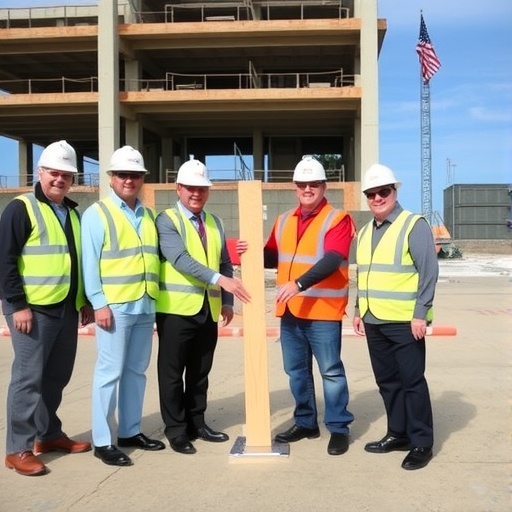
In a significant advancement marking one of Sandia National Laboratories’ most ambitious construction efforts in the past decade, a ceremonial milestone was reached on April 14, 2026, celebrating the placement of the final beam in the Power Sources Capability building. This event symbolizes the completion of the steel framework for a facility poised to revolutionize power source research and production vital to national security missions.
The construction project, initiated in August 2025, has surpassed expectations, progressing ahead of schedule due to meticulous planning and execution. According to Savannah Torres, the project manager, the team has consistently met or exceeded critical milestones, a testament to the strategic management and collaboration among contractors, engineers, and laboratory scientists. The new structure, sprawling across 136,000 square feet in Technical Area II, is slated for full completion by 2028, after which state-of-the-art equipment and personnel will begin transitioning into this centralized facility.
The Power Sources Capability building is designed to consolidate operations that are currently dispersed across four separate buildings, enabling streamlined workflows and enhanced collaboration. This integration addresses longstanding challenges posed by the aging infrastructure, which lacked the capacity and technological provisions necessary for contemporary power source development. By fostering an environment where interdisciplinary teams can coalesce and exchange ideas fluidly, the new building exemplifies the modern shift towards innovation-driven spaces.
At the heart of the project lies the critical mission of supporting the nuclear deterrence infrastructure. Power sources, especially thermal batteries and other specialized energy technologies, are indispensable components of weapon systems. These power units provide the mission-essential energy following strategic separation of weapon systems from delivery platforms, ensuring reliable detonation power. Sandia’s role transcends mere production; the laboratory is deeply engaged in research and development, design refinement, manufacturing processes, and rigorous surveillance to maintain operational excellence.
The facility features unique technical capabilities tailored to the stringent environmental controls required for power source fabrication. Notably, the inclusion of dehumidified dry rooms is crucial due to the sensitivity of materials involved and the necessity for contaminant-free conditions. Such specialized infrastructure underscores the complexity of sustaining a domestic manufacturing base amid a limited supplier landscape, highlighting the imperative for national self-reliance in this domain.
Conceptual design began in earnest in 2019, incorporating extensive value engineering to enhance performance while minimizing costs. This iterative design process is fundamental in navigating the balance between function, budget constraints, and future adaptability. Perry D’Antonio, overseeing technical requirements, emphasized that the project integrates a forward-looking approach, embedding flexibility within the design to accommodate evolving mission needs for the coming half-century.
A significant factor contributing to the success of this endeavor is the collaboration among multiple stakeholders, including Sandia’s internal teams, the National Nuclear Security Administration, general contractors like Hensel Phelps, and the architecture and engineering firm SmithGroup. This multidisciplinary cooperation has been pivotal in overcoming the inherent complexities of constructing a facility that supports some of the nation’s most sensitive and technologically demanding operations.
Beyond physical infrastructure, the building’s design champions human connectivity and creativity. Spaces encourage informal interactions and knowledge exchange, concepts that are increasingly recognized as catalysts for innovation within scientific research environments. Sara Pecak, a senior manager in the program, points out that the architectural vision promotes proximity and engagement among personnel, a deliberate response to previous operational siloing.
Financially, the entire project is projected to culminate at approximately $400 million. This investment not only reflects the scale and intricacy of the construction but also the strategic value attributed to maintaining and advancing power source technologies vital to national defense. The localized cluster of power source development within Technical Area II will strategically position Sandia for enhanced mission support and operational efficiency.
As the project advances towards its anticipated completion, the Power Sources Capability building is poised to become a cornerstone facility underpinning the United States’ nuclear deterrence capabilities. It exemplifies a blend of advanced engineering, environmental sophistication, and visionary planning. Its completion will mark a significant leap forward in the infrastructure supporting national security science and technology.
In summation, the final beam installation celebration is more than a ceremonial construction milestone—it is a manifestation of strategic foresight, engineering excellence, and national commitment to sustaining critical defense capabilities. Sandia National Laboratories, through this project, reaffirms its role at the forefront of innovation and its unwavering dedication to the missions vital to America’s security.
Subject of Research: Power source development for nuclear deterrence systems.
Article Title: Sandia National Laboratories Celebrates Major Progress on Power Sources Capability Building
News Publication Date: April 14, 2026
Web References: https://mediasvc.eurekalert.org/Api/v1/Multimedia/860b2de9-cbe8-4e35-ba54-9d2905ee1bd4/Rendition/low-res/Content/Public
Image Credits: Video Courtesy of Sandia National Laboratories
Keywords
Power Sources, Nuclear Deterrence, Sandia National Laboratories, Thermal Batteries, Dry Rooms, Infrastructure Modernization, National Security, Advanced Engineering, Construction Progress, Energy Technologies, Multidisciplinary Collaboration, Defense Technology
Tags: advanced power source developmentcentralized power source operationsconstruction project management successearly construction schedule completioninterdisciplinary research collaborationmodernization of laboratory infrastructurenational security power research facilityPower Sources Capability building completionSandia National Laboratories construction milestonestate-of-the-art laboratory constructionsteel framework placement ceremonyTechnical Area II facility expansion