• HOME
  • NEWS
  • EXPLORE
    • CAREER
      • Companies
      • Jobs
    • EVENTS
    • iGEM
      • News
      • Team
    • PHOTOS
    • VIDEO
    • WIKI
  • BLOG
  • COMMUNITY
    • FACEBOOK
    • INSTAGRAM
    • TWITTER
Saturday, February 7, 2026
BIOENGINEER.ORG
No Result
View All Result
  • Login
  • HOME
  • NEWS
  • EXPLORE
    • CAREER
      • Companies
      • Jobs
        • Lecturer
        • PhD Studentship
        • Postdoc
        • Research Assistant
    • EVENTS
    • iGEM
      • News
      • Team
    • PHOTOS
    • VIDEO
    • WIKI
  • BLOG
  • COMMUNITY
    • FACEBOOK
    • INSTAGRAM
    • TWITTER
  • HOME
  • NEWS
  • EXPLORE
    • CAREER
      • Companies
      • Jobs
        • Lecturer
        • PhD Studentship
        • Postdoc
        • Research Assistant
    • EVENTS
    • iGEM
      • News
      • Team
    • PHOTOS
    • VIDEO
    • WIKI
  • BLOG
  • COMMUNITY
    • FACEBOOK
    • INSTAGRAM
    • TWITTER
No Result
View All Result
Bioengineer.org
No Result
View All Result
Home NEWS Science News Health

Constructing the first version of the Japanese reference genome

Bioengineer by Bioengineer
January 29, 2021
in Health
Reading Time: 2 mins read
0
IMAGE
Share on FacebookShare on TwitterShare on LinkedinShare on RedditShare on Telegram

IMAGE

Credit: Tohoku University

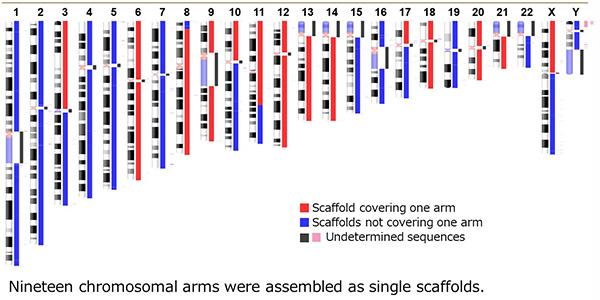
The Japanese now have their own reference genome thanks to researchers at Tohoku University who completed and released the first Japanese reference genome (JG1).

Their study was published in the journal Nature Communications on January 11, 2021.

“JG1 can aid with the clinical sequence analysis of Japanese individuals with rare diseases as it eliminates the genomic differences from the international reference genome,” said Jun Takayama, co-author of the study.

Back in 2003, the Human Genome Project, through a gargantuan global effort, cracked the code of life and mapped all the genes of the human genome.

Since then, more accurate versions of the human reference genome have been realized. Aiding this has been the advancement in next-generation sequencing technologies that allow for short read of approximately several hundred bases in a massively parallel way, reducing the costs and time to sequence DNA and RNA.

The international reference genome is based on an individual of African-European descent. This hampers investigating genetic variants or rare disease and cancer driving genes in Japanese owing to natural genomic difference reflective in different populations.

Associate professor Takayama and professor Gen Tamiya from Tohoku University’s Tohoku Medical Megabank Organization (ToMMo) and the Advanced Research Center for Innovations in Next-Generation Medicine (INGEM) and colleagues from Tohoku University School of Medicine, School of Information Sciences, RIKEN AIP Center, and Miyagi Cancer Research Institute developed JG1 as the first part of the Japanese Reference Genome Assembly (JRGA) project.

This high-precision reference sequence is applicable to the whole human genome analysis and was constructed by analyzing the genomes of three Japanese individuals using high-coverage, long-read next-generation sequencing technologies.

Researchers can efficiently investigate the causal genetic variants of rare diseases and cancer driver genes with JG1.

“JG1 may be applicable to other populations, especially those from Asia. In addition, with the JG1, the accuracy of the Japanese allele frequency and haplotype reference panels gets improved,” added Takayama.

###

Media Contact
Fuji Nagami
[email protected]

Original Source

https://www.tohoku.ac.jp/en/press/constructing_first_japanese_reference_genome.html

Related Journal Article

http://dx.doi.org/10.1038/s41467-020-20146-8

Tags: Medicine/Health
Share12Tweet8Share2ShareShareShare2

Related Posts

Palmitoylation of Tfr1 Drives Platelet Ferroptosis and Exacerbates Liver Damage in Heat Stroke

February 7, 2026

Oxygen-Enhanced Dual-Section Microneedle Patch Improves Drug Delivery and Boosts Photodynamic and Anti-Inflammatory Treatment for Psoriasis

February 7, 2026

Scientists Identify SARS-CoV-2 PLpro and RIPK1 Inhibitors Showing Potent Synergistic Antiviral Effects in Mouse COVID-19 Model

February 7, 2026

Neg-Entropy: The Key Therapeutic Target for Chronic Diseases

February 7, 2026
Please login to join discussion

POPULAR NEWS

  • Robotic Ureteral Reconstruction: A Novel Approach

    Robotic Ureteral Reconstruction: A Novel Approach

    82 shares
    Share 33 Tweet 21
  • Digital Privacy: Health Data Control in Incarceration

    63 shares
    Share 25 Tweet 16
  • Study Reveals Lipid Accumulation in ME/CFS Cells

    57 shares
    Share 23 Tweet 14
  • Breakthrough in RNA Research Accelerates Medical Innovations Timeline

    53 shares
    Share 21 Tweet 13

About

We bring you the latest biotechnology news from best research centers and universities around the world. Check our website.

Follow us

Recent News

Palmitoylation of Tfr1 Drives Platelet Ferroptosis and Exacerbates Liver Damage in Heat Stroke

Oxygen-Enhanced Dual-Section Microneedle Patch Improves Drug Delivery and Boosts Photodynamic and Anti-Inflammatory Treatment for Psoriasis

Scientists Identify SARS-CoV-2 PLpro and RIPK1 Inhibitors Showing Potent Synergistic Antiviral Effects in Mouse COVID-19 Model

Subscribe to Blog via Email

Enter your email address to subscribe to this blog and receive notifications of new posts by email.

Join 73 other subscribers
  • Contact Us

Bioengineer.org © Copyright 2023 All Rights Reserved.

Welcome Back!

Login to your account below

Forgotten Password?

Retrieve your password

Please enter your username or email address to reset your password.

Log In
No Result
View All Result
  • Homepages
    • Home Page 1
    • Home Page 2
  • News
  • National
  • Business
  • Health
  • Lifestyle
  • Science

Bioengineer.org © Copyright 2023 All Rights Reserved.