• HOME
  • NEWS
  • EXPLORE
    • CAREER
      • Companies
      • Jobs
    • EVENTS
    • iGEM
      • News
      • Team
    • PHOTOS
    • VIDEO
    • WIKI
  • BLOG
  • COMMUNITY
    • FACEBOOK
    • INSTAGRAM
    • TWITTER
Friday, December 19, 2025
BIOENGINEER.ORG
No Result
View All Result
  • Login
  • HOME
  • NEWS
  • EXPLORE
    • CAREER
      • Companies
      • Jobs
        • Lecturer
        • PhD Studentship
        • Postdoc
        • Research Assistant
    • EVENTS
    • iGEM
      • News
      • Team
    • PHOTOS
    • VIDEO
    • WIKI
  • BLOG
  • COMMUNITY
    • FACEBOOK
    • INSTAGRAM
    • TWITTER
  • HOME
  • NEWS
  • EXPLORE
    • CAREER
      • Companies
      • Jobs
        • Lecturer
        • PhD Studentship
        • Postdoc
        • Research Assistant
    • EVENTS
    • iGEM
      • News
      • Team
    • PHOTOS
    • VIDEO
    • WIKI
  • BLOG
  • COMMUNITY
    • FACEBOOK
    • INSTAGRAM
    • TWITTER
No Result
View All Result
Bioengineer.org
No Result
View All Result
Home NEWS Science News

Connecting two classes of unconventional superconductors

Bioengineer by Bioengineer
November 11, 2020
in Science News
Reading Time: 2 mins read
0
IMAGE
Share on FacebookShare on TwitterShare on LinkedinShare on RedditShare on Telegram

IMAGE

Credit: © MPI CPfS

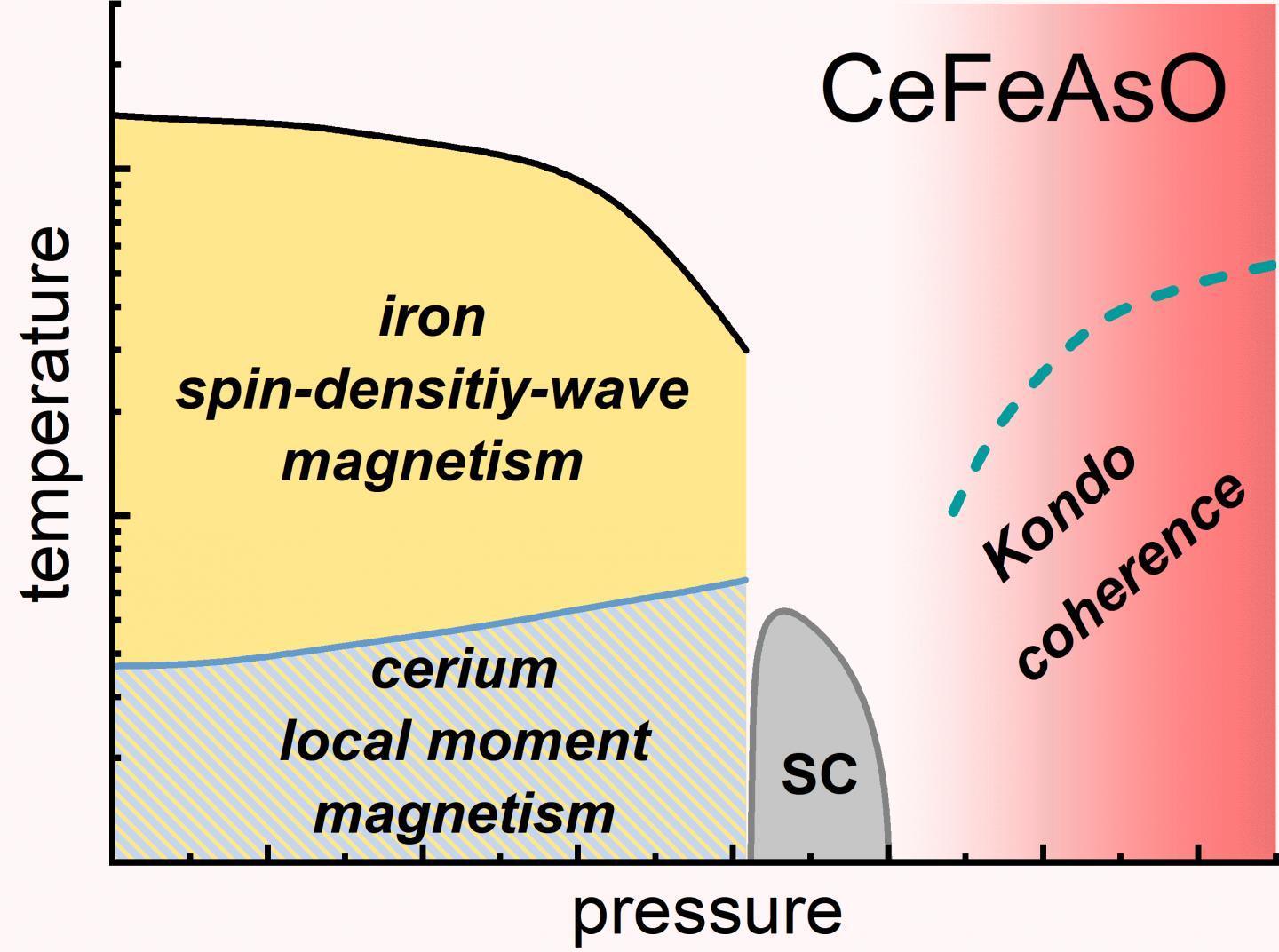
The understanding of unconventional superconductivity is one of the most challenging and fascinating tasks of solid-state physics. Different classes of unconventional superconductors share that superconductivity emerges near a magnetic phase despite the underlying physics is different. Two of these unconventional materials are the heavy-fermion and the iron-based superconductors.

Researcher from the Max Planck Institute for Chemical Physics of Solids applied large hydrostatic pressures to tiny single crystals of CeFeAsO, a non-superconducting parent compound to iron-based superconductors, using diamond anvil pressure cells. By electrical, magnetic and structural measurements they showed that upon increasing the applied pressure, the material characteristics change from that of an iron-pnictide material to that of a heavy-fermion metal. Surprisingly, a narrow superconducting phase emerges in the boundary region between the typical iron-pnictide spin-density-wave magnetism and a Ce-based Kondo-regime. This suggests that the two major phenomena characterizing iron-pnictides and heavy-fermions, spin-density-wave magnetism and the Kondo-effect, work together to produce superconductivity in CeFeAsO.

###

This work is published in Physical Review Letters and has been selected by the editors to be a PRL Editors’ Suggestion. Only about one Letter in six is chosen for this highlighting.

Media Contact
Michael Nicklas
[email protected]

Original Source

https://www.cpfs.mpg.de/3256614/20201111b?c=2889860

Related Journal Article

http://dx.doi.org/10.1103/PhysRevLett.125.207001

Tags: Chemistry/Physics/Materials SciencesMaterialsSuperconductors/Semiconductors
Share12Tweet8Share2ShareShareShare2

Related Posts

Peptidyl-tRNA Hydrolase 2 Suppresses Peripartum Heart Failure

December 19, 2025

Large Language Models in Obesity: A Review

December 19, 2025

Evaluating Self-Assessment Tools for Disaster Nursing Competencies

December 19, 2025

Sickle Cell Disease: Impact on Children’s Health in Sudan

December 19, 2025
Please login to join discussion

POPULAR NEWS

  • Nurses’ Views on Online Learning: Effects on Performance

    Nurses’ Views on Online Learning: Effects on Performance

    70 shares
    Share 28 Tweet 18
  • NSF funds machine-learning research at UNO and UNL to study energy requirements of walking in older adults

    70 shares
    Share 28 Tweet 18
  • Unraveling Levofloxacin’s Impact on Brain Function

    53 shares
    Share 21 Tweet 13
  • MoCK2 Kinase Shapes Mitochondrial Dynamics in Rice Fungal Pathogen

    72 shares
    Share 29 Tweet 18

About

We bring you the latest biotechnology news from best research centers and universities around the world. Check our website.

Follow us

Recent News

Peptidyl-tRNA Hydrolase 2 Suppresses Peripartum Heart Failure

Large Language Models in Obesity: A Review

Evaluating Self-Assessment Tools for Disaster Nursing Competencies

Subscribe to Blog via Email

Enter your email address to subscribe to this blog and receive notifications of new posts by email.

Join 70 other subscribers
  • Contact Us

Bioengineer.org © Copyright 2023 All Rights Reserved.

Welcome Back!

Login to your account below

Forgotten Password?

Retrieve your password

Please enter your username or email address to reset your password.

Log In
No Result
View All Result
  • Homepages
    • Home Page 1
    • Home Page 2
  • News
  • National
  • Business
  • Health
  • Lifestyle
  • Science

Bioengineer.org © Copyright 2023 All Rights Reserved.