Coniferyl alcohol supplementation increased justicidin B accumulation in in vitro root cultures of Linum austriacum, with the strongest measured response occurring at 50 μM, while the response in L. alpinum was modest. The plant culture study found that precursor concentration and treatment timing affected the outcome in L. austriacum, although the researchers did not test cultivation-stage effects in L. alpinum.
The investigators examined whether supplying coniferyl alcohol, a compound positioned upstream of the lignan branch in the phenylpropanoid pathway, could support justicidin B production. The pathway described in the study proceeds through pinoresinol, lariciresinol and secoisolariciresinol before reaching downstream arylnaphthalene lignans including justicidin B.
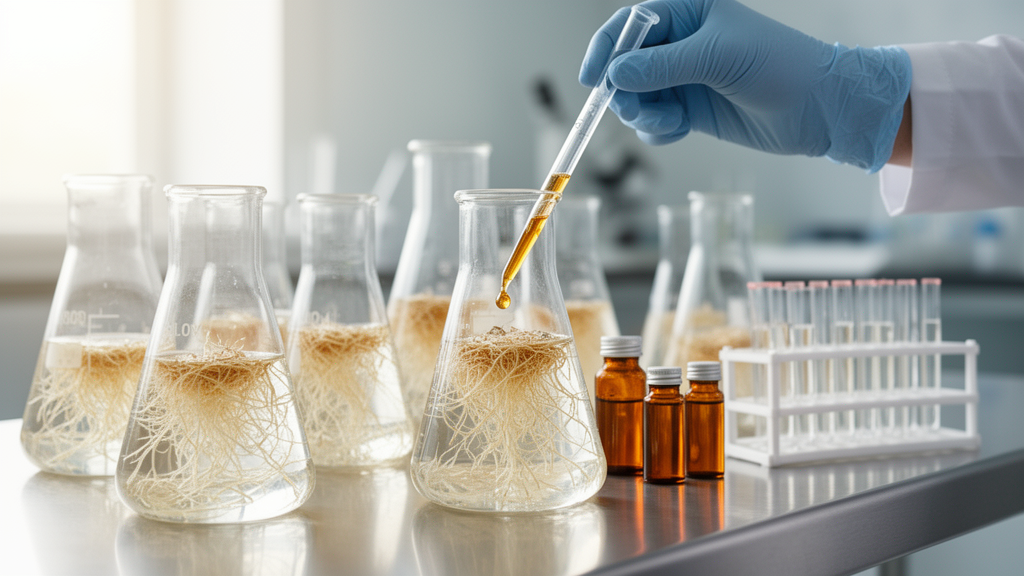
The study used previously established root cultures derived from aseptically germinated seedlings. L. austriacum cultures were maintained on modified Murashige and Skoog medium supplemented with 1 mg/L α-naphthaleneacetic acid and 0.4 mg/L indole-3-acetic acid. L. alpinum cultures were maintained on modified Murashige and Skoog medium containing 5 mg/L indole-3-acetic acid, 2 mg/L kinetin and 1 g/L casein hydrolysate. Root cultures were subcultured every 30 days under controlled conditions before the experiments.
Justicidin B was measured by liquid chromatography coupled with high-resolution electrospray ionization mass spectrometry. The researchers characterized accumulation over a 30-day cultivation period before testing supplementation. In L. alpinum, justicidin B rose gradually from 0.07 μg/mg dry weight on day 5 to 0.08 on day 10 and 0.09 on day 20, remained at 0.09 on day 25 and reached 0.12 μg/mg dry weight on day 30.
L. austriacum showed a different profile. Its justicidin B content was 1.19 μg/mg dry weight on day 5, declined to 0.91 on day 10 and 0.75 on day 20, and reached 0.58 on day 25. It then partially recovered to 0.72 μg/mg dry weight on day 30. Untreated cultures and cultures treated with the ethanol vehicle served as controls, and all supplementation treatments were performed in triplicate.
In the five-day screening experiment, both species received coniferyl alcohol on cultivation day 25 at final concentrations of 10, 50 or 100 μM and were harvested on day 30. The ethanol controls did not differ significantly from untreated cultures in either species, with p = 0.924 for L. alpinum and p = 0.729 for L. austriacum. In L. alpinum, 10 μM yielded 0.09 μg/mg dry weight of justicidin B and 50 μM yielded 0.12, close to the untreated value of 0.12. The highest tested concentration, 100 μM, produced 0.14 μg/mg dry weight, about 1.2 times the untreated control.
The response in L. austriacum was larger. Supplementation with 10 μM increased justicidin B to 1.23 μg/mg dry weight, about 1.6 times the untreated control of 0.72, with p = 0.01. The strongest result followed 50 μM treatment: 1.49 μg/mg dry weight, approximately twice the untreated level, with p = 0.002. This treated value also exceeded the highest justicidin B level recorded during the 30-day untreated accumulation profile. At 100 μM, however, justicidin B measured 0.62 μg/mg dry weight, showing that the highest tested dose did not support accumulation.
Based on that screening result, the researchers selected 50 μM for further testing in L. austriacum. When the compound was added on cultivation day 30 and cultures were harvested on day 35, justicidin B reached 0.88 μg/mg dry weight, about 1.4 times the untreated value of 0.62. In cultures supplemented on day 35 and harvested on day 40, the treated value was 1.15 μg/mg dry weight, matching the untreated control of 1.15. These results associate the effectiveness of supplementation in this species with precursor concentration and cultivation stage, rather than indicating that additional coniferyl alcohol invariably raises metabolite output.
Overall, the experiments identify 50 μM coniferyl alcohol as the most effective tested condition for increasing justicidin B accumulation in L. austriacum root cultures, particularly when applied during the day-25-to-day-30 cultivation period. The findings support a role for precursor availability in justicidin B accumulation, but the results are bounded to the tested culture systems, doses, treatment schedules and two Linum species. The study assessed cultured roots rather than intact plants or large-scale production, and it did not establish clinical effects. It also did not determine which enzymatic steps or physiological factors caused the differences among concentrations and treatment times.
Subject of Research: Effects of coniferyl alcohol supplementation on justicidin B accumulation in Linum root cultures
Article Title: Coniferyl alcohol drives arylnaphthalene-type lignan biosynthesis in root cultures of Linum species
Article References: Zarev, Y., Nedelcheva, R., & Ionkova, I. (2026). Coniferyl alcohol drives arylnaphthalene-type lignan biosynthesis in root cultures of Linum species. Pharmacia, 73, Article e206407. https://doi.org/10.3897/pharmacia.73.e206407
Image Credits: AI Generated
DOI: 10.3897/pharmacia.73.e206407
Keywords: coniferyl alcohol, justicidin B, Linum austriacum, Linum alpinum, root cultures, precursor feeding, lignan biosynthesis, plant biotechnology, in vitro cultures, Coniferyl, alcohol, drives
News Source: Ophelia Keating. (October 21, 2026). Coniferyl alcohol doubles justicidin B in Linum austriacum root cultures in dose- and timing-dependent tests. Scienmag.