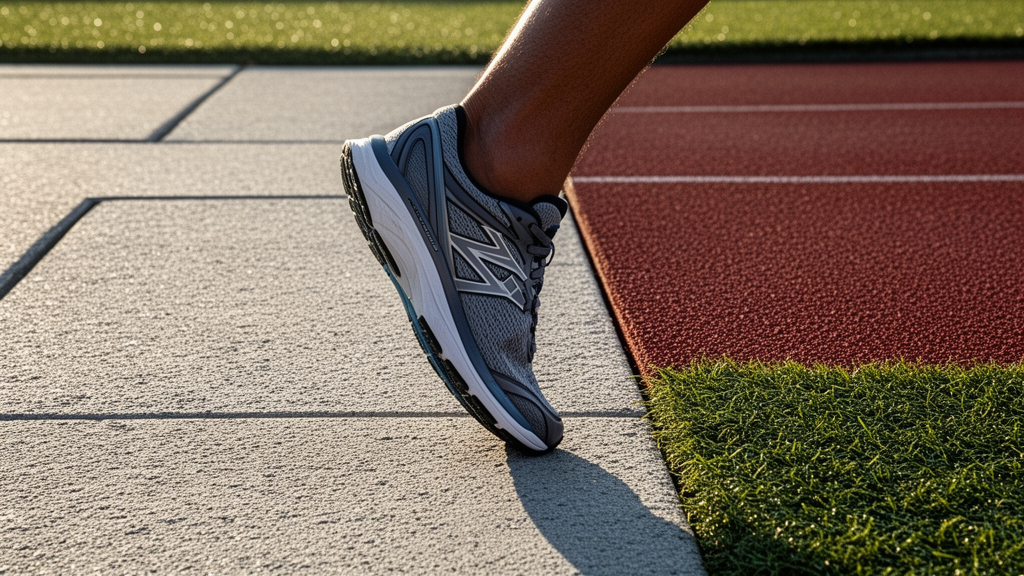
Outdoor running surfaces exert a substantial influence on impact dynamics during locomotion, with concrete pavements generating significantly higher vertical average loading rates than synthetic rubber tracks or artificial turf during running trials. Investigating how outdoor running environments alter both impact forces and lower-limb biomechanics, the study evaluated twenty-two healthy male recreational runners to determine how common outdoor running surfaces shape vertical loading rates alongside lower-limb sagittal-plane kinematics across the continuous gait cycle.
The physical characteristics of running surfaces have long been understood to potentially influence both loading rate and lower-limb biomechanics during running. However, empirical scientific evidence regarding the specific biomechanical effects of outdoor running surfaces has remained limited in the published literature. To address this limitation, the authors investigated the distinct effects of three common outdoor running surface types on vertical average loading rate, abbreviated as VALR, as well as lower-limb sagittal-plane kinematics during running.
The experimental protocol recruited a sample of twenty-two healthy male recreational runners who successfully completed running trials across three distinct outdoor surfaces: concrete pavement, a rubber track, and artificial turf.
Vertical average loading rate was recorded using Loadsol in-shoe pressure sensors, while lower-limb kinematics were assessed using wearable inertial sensors manufactured by Xsens. To evaluate the resulting biomechanical data, repeated measures analysis of variance was conducted to examine differences in vertical average loading rate across the three outdoor surface conditions, while statistical parametric mapping was employed to assess continuous sagittal-plane kinematics throughout the entire gait cycle.
The repeated measures analysis of variance revealed that outdoor surface type significantly affected the vertical average loading rate, demonstrating a statistically significant main effect with F(1.31, 27.43) equal to 10.86, a p-value of .001, and a partial eta squared of 0.34. Specifically, the vertical average loading rate was greatest on the concrete surface at 67.95 ± 19.72 body weights per second, followed by the rubber track at 60.77 ± 18.23 body weights per second, and was lowest on artificial turf at 58.00 ± 17.15 body weights per second. Post hoc statistical analysis demonstrated that the loading rate on concrete was significantly greater than on both the rubber track and artificial turf, and that the loading rate on the rubber track was significantly greater than on artificial turf.
Continuous kinematic analysis through statistical parametric mapping identified a statistically significant surface effect specifically for hip kinematics during running. Runners exhibited a significantly greater hip angle on concrete compared with the rubber track between 45.6% and 60.3% of the gait cycle, which was identified as a significant cluster with p equal to .004 occurring during the swing phase of gait. In contrast to the hip adaptations observed between concrete and rubber track conditions, the researchers identified no statistically significant surface effects across the three outdoor running surfaces for either knee kinematics or ankle kinematics.
In summarizing their conclusions, the investigators reported that among the three tested outdoor surface types, running on concrete was associated with a higher vertical average loading rate than running on either the rubber track or artificial turf. Furthermore, while sagittal-plane hip kinematics differed between concrete and rubber track during the swing phase, knee and ankle kinematics did not differ significantly between the three outdoor surfaces. Given that a large proportion of recreational running in Saudi Arabia is routinely performed on concrete pavements, the researchers noted that these findings provide critical surface-specific loading data directly relevant to recreational runners in this setting.
Subject of Research: Outdoor running surface effects on vertical loading rates and lower-limb kinematics
Article Title: Influence of outdoor running surface type on loading rate and lower-limb kinematics
Article References: Aljohani, M. M. A., Mashabi, A. S., Alqahtani, S. Z., Alshehri, Y. S., Alfayyadh, A., & Aljehani, M. S. (2026). Influence of outdoor running surface type on loading rate and lower-limb kinematics. BMC Sports Science, Medicine and Rehabilitation. https://doi.org/10.1186/s13102-026-02151-4
Image Credits: AI Generated
DOI: 10.1186/s13102-026-02151-4
Keywords: vertical average loading rate, lower-limb kinematics, concrete running surface, rubber track, artificial turf, recreational runners, Loadsol sensors, wearable inertial sensors, Xsens, sagittal-plane kinematics, gait cycle, statistical parametric mapping, hip kinematics, swing phase, self-selected running speed, Saudi Arabia, repeated measures ANOVA
News Source: Ophelia Keating. (November 11, 2026). Concrete Surfaces Produce Higher Vertical Loading Rates Than Rubber or Turf. Scienmag.