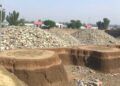
In a groundbreaking study led by researchers at Concordia University, iron-rich slag—traditionally considered a daunting waste product in the mining industry—has been identified as a promising material for capturing and storing carbon dioxide (CO₂). This innovative research marks a significant step forward in exploring practical and sustainable methods for reducing atmospheric greenhouse gases, which are pivotal in combating climate change.
Slag, the by-product of metal smelting and refining, often accumulates in vast quantities at mining sites, posing ecological and logistical challenges. Historically overlooked as a mere waste product, iron-rich slag contains minerals capable of reacting with CO₂ and converting it into solid carbonate minerals—a process known as mineral carbonation. However, most previous investigations into this phenomenon have relied on laboratory conditions saturated with water, leaving uncertainty about slag’s performance in more naturally occurring, variable moisture environments.
Addressing this gap, the Concordia-led team conducted an experimental study focusing on the carbon sequestration capabilities of slag under moisture conditions closer to those found in real-world scenarios, including low-to-moderate humidity levels. Samples sourced from a Quebec-based smelter were sealed in controlled containers, injected with CO₂ gas, and subjected to varied moisture settings. After 24 hours, researchers meticulously measured the residual CO₂ concentration in the air to determine how much gas had been absorbed by the slag.
Remarkably, the results revealed that slag could remove up to 99.5 percent of CO₂ under these conditions, underscoring its significant potential as a carbon capture medium. However, even more intriguing was the discovery that mineral formation was not the primary mechanism of CO₂ storage as conventionally assumed. Rather, most of the CO₂ was captured via a surface adsorption process, wherein CO₂ molecules adhere to the slag’s surface rather than transforming into solid carbonate minerals.
This novel insight challenges existing paradigms in carbon sequestration, which have traditionally emphasized mineral carbonation as the main avenue for permanent CO₂ storage in industrial waste materials. The predominance of adsorption over mineral formation implies that slag’s carbon capture capabilities can be effective even in environments with limited moisture, broadening the operational settings in which slag-based sequestration can be deployed.
The chemistry behind this adsorption is complex, involving interactions between CO₂ molecules and reactive sites on the slag’s surface, which is rich in iron oxides and other metal compounds. These surface sites act as active centers where CO₂ molecules can be retained, potentially offering a rapid and reversible carbon trapping mechanism. This mechanism circumvents the need for significant water content to facilitate carbonate mineral growth, making it highly applicable to dry or semi-arid locations.
Beyond laboratory validation, the practical implications of this work are profound. Mining operations worldwide generate millions of tons of slag annually, usually stockpiled with limited economic use. The study proposes that these waste piles could be repurposed as large-scale carbon sinks by injecting captured CO₂ from nearby industrial sources directly into the slag heaps. Such an integration could convert mining waste management from an environmental challenge into an innovative carbon mitigation strategy.
Because slag stockpiles often exist in remote locations where conventional carbon capture infrastructures are cost-prohibitive, this approach offers a low-maintenance, passive solution requiring minimal processing of the waste material. Harnessing the existing slag infrastructure could drastically lower costs and logistical barriers related to carbon capture and storage (CCS), making it a scalable and attractive option for industries seeking to reduce their carbon footprint.
While mineral carbonation offers permanent CO₂ sequestration by locking carbon into stable solid forms, adsorption-based CO₂ capture identified in this study represents a complementary mechanism. It allows for substantial CO₂ uptake under a wider range of environmental conditions. Nevertheless, further studies are needed to understand the long-term stability of adsorbed CO₂, potential considerations for slag reactivity over time, and the best operational parameters for maximizing carbon storage efficacy.
The research team, including lead author Samantha Wilcox and co-supervisors Professors Catherine Mulligan and Carmen Mihaela Neculita, emphasize that their findings open new frontiers in carbon capture research. They highlight how the interplay of chemical and physical processes within slag materials can be harnessed more effectively, promising more versatile and accessible options for industries aiming to contribute to carbon neutrality goals.
Published in the prestigious Chemical Engineering Journal, this study not only enhances our scientific understanding of carbon capture dynamics in mining residues but also bridges the gap between laboratory research and real-world application. The reported research received support from the Natural Sciences and Engineering Research Council of Canada, underlining the importance of national investment in sustainable engineering solutions.
In an era where climate action is of utmost urgency, this work symbolizes a convergence of waste valorization, green chemistry, and industrial ecology. By transforming an abundant waste material into a potent carbon sink, the mining sector could achieve new environmental milestones, turning one of its biggest liabilities into a strategic asset for global decarbonization efforts.
As the world grapples with escalating climate challenges, discoveries like this illuminate the path forward, showcasing how innovative science can unlock unexpected solutions hidden within existing industrial by-products. Continued exploration and scaling of such novel technologies could be instrumental in reducing overall greenhouse gas emissions and achieving a more sustainable industrial future.
Subject of Research: Not applicable
Article Title: Evaluation of carbon sequestration by iron-rich slag materials
News Publication Date: 11-Mar-2026
Web References:
https://www.sciencedirect.com/science/article/pii/S1385894726023624
References:
Wilcox, S., Mulligan, C., Neculita, C. M., “Evaluation of carbon sequestration by iron-rich slag materials,” Chemical Engineering Journal, DOI: 10.1016/j.cej.2026.174903.
Keywords
– Chemical engineering
– Carbon capture
– Carbon sequestration
– Carbon sinks
Tags: carbon capture using mining wastecarbon dioxide mineralization in slagConcordia University carbon capture studyenvironmental benefits of slag recyclingindustrial waste for climate change mitigationiron-rich slag carbon sequestrationlow-to-moderate humidity effects on CO2 storagemineral carbonation in mining by-productsmining slag for atmospheric CO2 reductionreal-world moisture impact on carbonationreducing greenhouse gases with slagsustainable CO2 storage methods