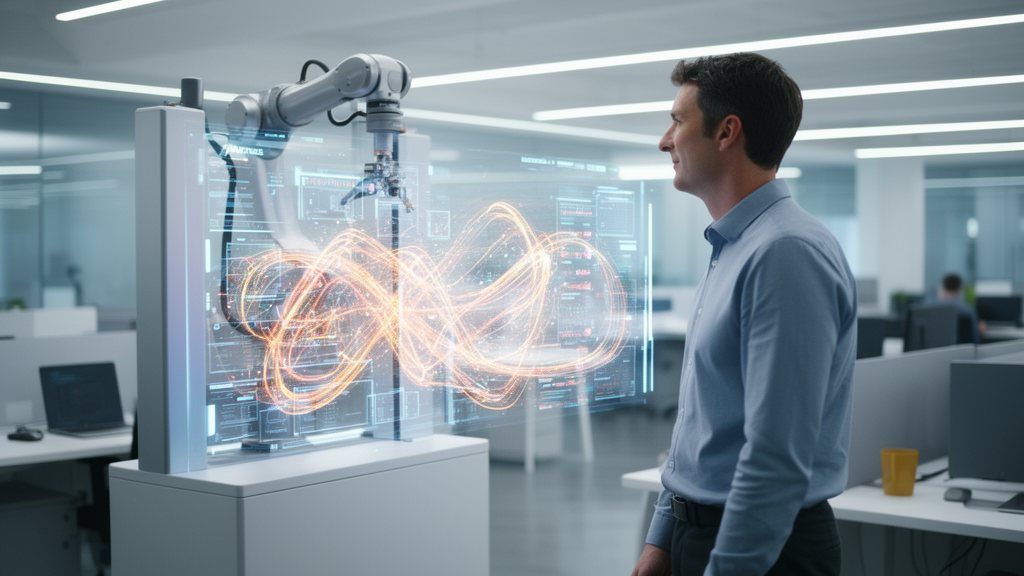
A collaborative research team representing business process management and human-centered artificial intelligence has formulated a conceptual framework to explain how human trust operates when employees interact with software robots in robotic process automation. Published as a research notes vision paper in Business & Information Systems Engineering, the study addresses a critical operational breakdown observed across modern enterprises known as re-manualization, where automated workflows revert to costly manual human execution because workers mistrust automated systems. Unlike physical or social robots, software robots operate as abstract, non-anthropomorphic lines of code that execute rule-based tasks through user interfaces by emulating human mouse movements and keystrokes. Because these bots lack social presence and moral agency, standard interpersonal trust evaluations based on perceived benevolence and moral integrity fail to capture how human workers evaluate them. The authors propose that trust in software automation must be understood through the structural interaction between the human trustor, the software robot trustee, and the specific task assigned as the trust subject.
The conceptual framework emerged from structured group discussions held during a Dagstuhl Seminar focused on improving trust between humans and software robots, utilizing a consensus-driven interpretive research methodology to synthesize literature from organizational behavior, human-computer interaction, and automation science. The authors highlight that while robotic process automation has been adopted across sectors such as banking and financial services to free workers from repetitive tasks, real-world deployments frequently stumble over misaligned expectations. When software bots exhibit unpredictable behaviors or encounter unforeseen exceptions, human operators face heightened uncertainty regarding task outcomes. Traditional models of technology adoption and interpersonal trust, including the generic trust model and classical technology acceptance paradigms, fail to account for the transactional proximity of robotic process automation. Because software robots directly execute operational workflows rather than merely providing strategic analytics, software malfunctions immediately jeopardize data integrity and institutional performance, making trust calibration an acute operational imperative.
Within the proposed architecture, the researchers distinguish key properties belonging to the user, the robot, and the delegated task, showing how their intersection governs workplace collaboration. User properties encompass an individual’s general inclination toward adopting automated technologies and their formal organizational role, contrasting the perspectives of process managers with frontline employees. Process managers must evaluate high-level systemic capabilities and determine whether autonomous processing of structured or unstructured data is strategically viable, whereas operational employees directly witness routine task outcomes and shoulder the practical burdens of software failures. Robot properties center on operational autonomy, technical controllability, and communication interfaces spanning conversational chatbots, graphical windows, and code-level application programming interfaces. Meanwhile, task properties encompass perceived uncertainty and expected negative consequences, where the severity of potential operational errors directly dictates the amount of control an operator demands before agreeing to delegate business activities to software bots.
To transition trust research from qualitative observations into verifiable operational metrics, the authors propose a novel behavioral construct termed Willingness to Give Up Control, which directly captures whether a user genuinely trusts an automated system. In routine enterprise environments, employees frequently claim to use automated bots while continuously scrutinizing intermediate results, performing redundant manual checks that effectively negate automation benefits. The researchers demonstrate that genuine trust exists only when a human worker actively accepts perceived uncertainty by relinquishing operational oversight to the robot. Willingness to Give Up Control provides a measurable behavioral index governed by worker familiarity, previous automation interactions, robot interpretability, and task stakes. Developing quantitative instruments capable of tracking this construct across varying organizational settings represents the foundational research priority outlined by the authors, offering engineering teams an empirical indicator to replace informal assumptions regarding employee confidence.
Building on behavioral measurement, the paper articulates a second major research challenge centered on calibrating human trust against the objective trustworthiness of software robots. Trustworthiness represents an intrinsic engineering property encompassing technical robustness, regulatory compliance, functional accuracy, and adherence to operational standards, whereas trust reflects the human perception of that competence. Conventional automation research conceptualizes calibration through a categorical matrix distinguishing justified trust from misplaced trust, such as automation bias or unjustified disuse. However, the authors argue that this four-quadrant binary classification is too coarse to guide industrial robotic process automation implementations. Instead, they call for the construction of a continuous gradient trust scale grounded in empirical survey data and expert interviews. This gradient scale will enable organizations to compare pre-implementation expectations against post-implementation operational realities, systematically isolating perception gaps among managers and staff before latent mistrust causes workflow abandonment.
To mitigate adoption friction, the authors construct a five-tiered trust signal framework modeled on hierarchical psychological needs, outlining communication and design interventions across progressive phases of technology integration. At the foundational level, organizations must address acute employee concerns regarding job security through transparent managerial communication, institutional reskilling commitments, and predictable user interfaces that present automation as supportive assistance rather than human replacement. As workers stabilize their employment expectations, subsequent levels address personal effectiveness through hands-on training, interactive demonstrations, and system explainability that clarify why specific automated decisions occur. Higher tiers address organizational belonging through peer mentoring, protect professional identity by showcasing employee value within hybrid teams, and facilitate personal development by providing concrete pathways for staff to acquire complementary technical proficiencies as repetitive burdens diminish.
A critical technical dimension examined in the vision paper concerns the trade-off between robot autonomy and human trust across four distinct evolutionary categories of automation architectures. Traditional robotic process automation handles purely structured data through rigid, hard-coded rules, requiring manual human reprogramming whenever data mappings shift or input paths change. Enhanced robotic process automation incorporates tools like optical character recognition to ingest unstructured sources into structured workflows while retaining rule-based execution. Intelligent robotic process automation introduces machine learning to support probabilistic, data-driven decisions that necessitate human validation, such as complex customer complaint handling. At the highest level, autonomous robotic process automation monitors operating environments via continuous feedback loops, adjusting resource allocation and execution parameters in real time without human intervention.
To regulate these escalating autonomy levels, the authors formulate a granular continuum of human-robot interaction that replaces binary attended and unattended automation paradigms with explicit operational oversight configurations. Spanning agency and supervision roles, this continuum defines seven interaction structures: Machine-out-of-the-loop, where humans perform tasks and bots conduct retrospective audits; Machine-on-the-loop, featuring concurrent robot guidance; and Machine-in-the-loop, where humans operate under upfront robot authorization. At the center lies hybrid intelligence, where operational responsibilities are balanced dynamically. Moving toward automation, the framework incorporates Human-in-the-loop requiring human authorization, Human-on-the-loop involving human intervention during execution, and Human-out-of-the-loop where tasks execute autonomously with optional ex-post notifications.
The authors establish that software robots cannot maintain human trust without exposing interpretable explanations detailing how specific conclusions were computed, providing structured notifications covering action outcomes and error exceptions, and generating calibrated numerical confidence scores for nondeterministic machine learning tasks. Furthermore, systems must preserve data transparency by revealing raw input streams alongside simplified visual representations to prevent cognitive overload during supervisory reviews. Supplying these observability mechanisms prevents the formation of black-box operational disconnects, equipping human operators with the contextual clarity needed to decide whether an automated recommendation warrants immediate approval or manual intervention.
The authors acknowledge notable conceptual boundaries within their study, specifically emphasizing that their proposed model represents a static analytical snapshot that does not yet capture the dynamic fluctuations of trust over prolonged operational lifecycles. Trust within enterprise workflows evolves dynamically in response to software patches, process drifts, environmental variations, and changing organizational cultures. By establishing an empirical roadmap encompassing measurement scales, psychological trust signals, autonomy classifications, and bidirectional interaction structures, the conceptual framework provides an essential theoretical baseline for designing next-generation automation that sustains productive human-technology collaboration.
Subject of Research: Human trust dynamics and conceptual modeling in robotic process automation systems
Article Title: Exploring Human Trust in Software Robots for Robotic Process Automation
Article References: Agostinelli, S., Bisconti, P., Casciani, A., Marrella, A., Rehse, J. R., Angelini, M., Asatiani, A., Axmann, B., Czarnecki, C., del Río Ortega, A., Delgado, A., Enríquez, J. G., Hannibal, G., Janiesch, C., Jiménez-Ramírez, A., Khan, F. A., Martínez-Rojas, A., Modlinski, A., Plattfaut, R., … Wilde, A. (2026). Exploring Human Trust in Software Robots for Robotic Process Automation. Business & Information Systems Engineering. https://doi.org/10.1007/s12599-026-01007-y
Image Credits: AI Generated
DOI: 10.1007/s12599-026-01007-y
Keywords: Robotic Process Automation, Human-Robot Interaction, Trust in Technology, Conceptual Modeling, Re-manualization, Software Robots, Willingness to Give Up Control, Hybrid Intelligence, Trust Calibration, Human-in-the-Loop, Observability, Explainable AI, Business Process Management, Automation Governance, Task Uncertainty, Decision-Making Autonomy
News Source: Denise Maddox. (November 26, 2026). Conceptual Framework Identifies Human Trust Dynamics in Robotic Process Automation. Scienmag.