Credit: G. Baranov
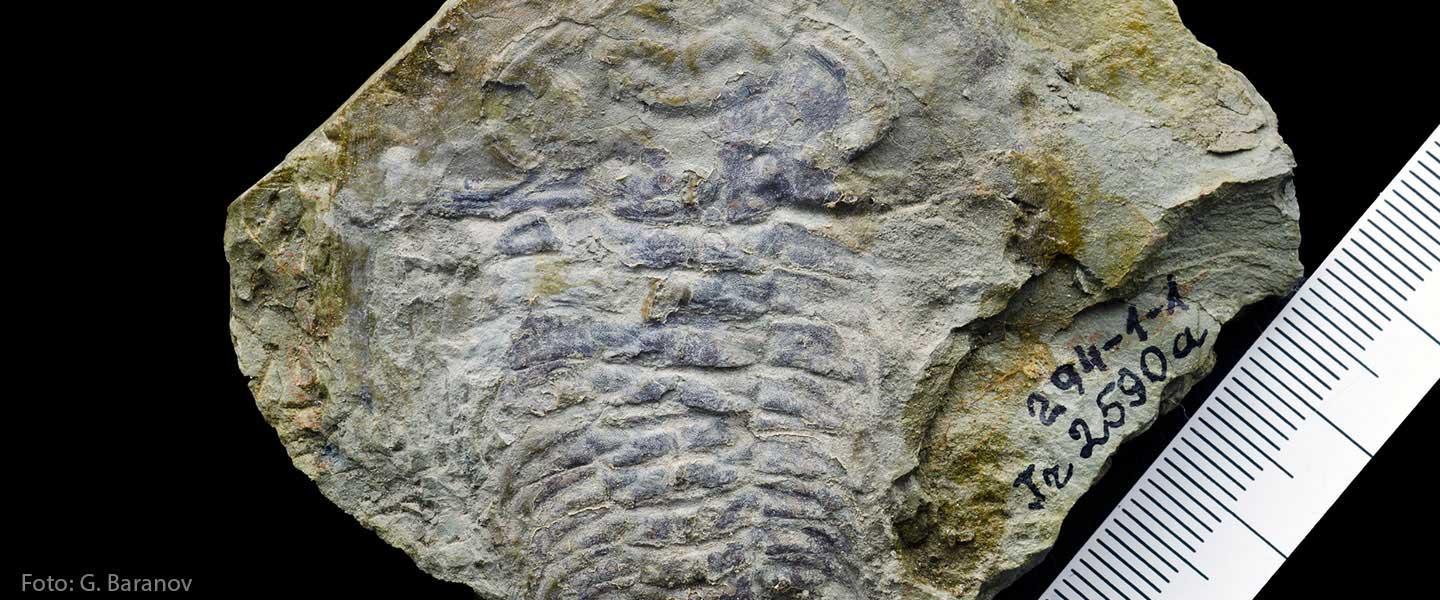
Dr Brigitte Schoenemann (University of Cologne) and her colleagues Helje Pärnaste (Tallinn, Estonia), and Euan Clarkson (Edinburgh, Scotland) have succeeded in unraveling the structure and functioning of the oldest known compound eye. The researchers used an exceptionally well-preserved fossil trilobite (Schmidtiellus reetae), which is over half a billion years old, showing the cellular structure of a compound eye. It not only shows how this eye was constructed, but also its functioning, its performance, and how it differs from contemporary compound eyes. The results show that modern compound eyes work in ways strikingly similar to those of half a billion years ago. They are very conservative in their structure – and quite successfully so. 'The principle of the modern compound eye most likely goes back to before the times of our first fossil records. Half a billion years ago, it was in the early stage of its development, and with our work we have succeeded in uncovering the first visible steps of this extremely successful visual principle', says Schoenemann.
The eye belongs to a trilobite found in Estonia, an extinct anthropod that lived in the oceans of the Palaeozoic. The findings from this geological layer have brought to light the very first fossils of complex animals. The right eye of the trilobite is slightly abraded, allowing for a view into its interior. It is a typical compound eye consisting of approximately 100 subunits placed relatively far apart compared to modern forms. The authors were able to show that each of these subunits (ommatidia) consists of about eight sensory cells – just like modern compound eyes – grouped around a central rhabdom, a light-guiding receptive structure. The latter contains the visual pigments and conveys the brightness of the surrounding environment to the animal's central nervous system. 'However, in contrast to the modern compound eyes of bees, dragonflies, and many crabs, this very old compound eye does not have a lens', Schoenemann explains. 'This is likely due to the fact that these rather soft-shelled anthropods lacked the necessary layer in their shell responsible for lens formation.' The physical features of the central rhabdom ensures that each element of the compound eye has a limited field of vision and that the animal's overall visual impression already has the mosaic-like character of a modern compound eye. The precision of such an eye can be determined by the number of its elements – just like the number of pixels determines the precision of a computer graphic. 'With approximately 100 "pixels", the performance of this eye dating back more than half a billion years is certainly not outstanding. But it was sufficient to provide the trilobite with information on movement in its field of vision, for example approaching predators. It could roughly discern the distribution of light in its surroundings or avoid obstacles in its path', says Schoenemann.
The biologist and her team were also able to show that only a few million years after Schmidtiellus, new and improved compound eyes with higher resolution developed in another trilobite from the Baltic region: Holmia kjerulfi. The performance of this species' eyes even approximated that of modern dragonflies. A physical analysis of the compound eyes of both trilobites showed that the organism inhabited bright waters, most likely costal shelf regions of a Palaeozoic ocean.
###
Media Contact
Dr. Brigitte Schoenemann
[email protected]
49-221-470-7732
@UniCologne
http://www.uni-koeln.de
Original Source
http://www.pnas.org/content/early/2017/11/28/1716824114.full http://dx.doi.org/10.1073/pnas.1716824114