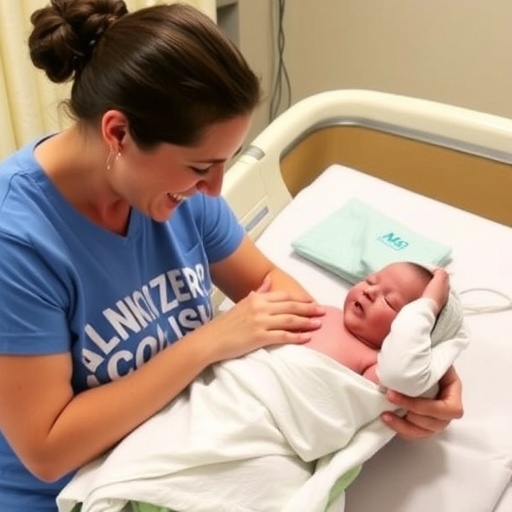
In a profound advancement for neonatal care, a comprehensive systematic review published in the Cochrane Database of Systematic Reviews presents compelling evidence in favor of immediate skin-to-skin contact between healthy newborns and their mothers. This practice, which entails placing the undressed infant upon the mother’s bare chest immediately following birth, emerges as a vital intervention with a spectrum of physiological and developmental benefits for the neonate.
Skin-to-skin contact serves as an intrinsic facilitator of neonatal adaptation to extrauterine life. By establishing a direct thermal and tactile interface, it promotes the maintenance of optimal body temperature through thermal regulation processes, effectively minimizing the risks associated with hypothermia—a significant threat in the immediate postnatal period. This thermoregulatory function is critical in stabilizing the neonate’s metabolic equilibrium and conserving energy essential for growth and development.
Moreover, the intervention conveys notable enhancements in the stabilization of the newborn’s cardiorespiratory status. By promoting synchronous breathing and an optimal heart rate, skin-to-skin contact supports vital physiological parameters during a period characterized by transition from placental to pulmonary gas exchange. The reduction of neonatal stress and crying observed with this contact implies modulation of neuroendocrine responses, potentially influencing long-term neurodevelopmental trajectories.
A paramount finding of this review is the association between immediate skin-to-skin contact and increased rates of exclusive breastfeeding during the first six months of life. The intimate exposure of the newborn to maternal skin facilitates early latch-on success and sustained feeding behaviors, thereby optimizing nutritional intake and enhancing immunological protection conferred through breast milk. This effect on breastfeeding exclusivity holds profound implications for infant health outcomes and maternal-infant bonding.
The evidence synthesized within the review is robust, encompassing 69 randomized controlled trials and involving over 7,000 mother-infant dyads predominantly from high-resource settings. Such a meta-analytical consolidation strengthens the generalizability of the findings, although the absence of studies conducted in low-income regions signals a research gap requiring attention. Nonetheless, the physiological underpinnings and observed benefits suggest universal applicability.
Historically, conventional maternity care protocols frequently mandated immediate postnatal separation of mother and infant for routine newborn assessments, weighing, and hygiene procedures—practices now shown to inadvertently disrupt critical early contact. The updated evidence advocates for a paradigm shift to uninterrupted skin-to-skin initiation, underscoring its feasibility and urgent necessity in modern healthcare frameworks.
In addition to neonatal benefits, the review explored potential maternal outcomes such as blood loss and placental delivery timing, though findings in these domains remain inconclusive or insufficiently powered for definitive conclusions. Future investigative efforts might explore mechanistic insights into maternal physiological responses engendered by early skin-to-skin contact to elucidate broader peripartum health consequences.
Ethical considerations emerge prominently from the review’s conclusions, with the authors explicitly cautioning against the continuation of randomized controlled trials that withhold skin-to-skin contact in control groups. Given the accumulating evidence of improved newborn health parameters and possible survival benefits in vulnerable populations, such trial designs now present ethical dilemmas conflicting with current best practices.
Notably, parallel research conducted in resource-limited settings has underscored the life-saving potential of skin-to-skin contact, particularly for low birth weight infants prone to high mortality rates. This intervention acts as a low-cost, high-impact strategy that complements neonatal intensive care measures, reinforcing global health calls for widespread adoption in diverse contexts.
The review also emphasizes transitioning future research priorities from efficacy trials toward studies focusing on implementation science and optimizing protocol integration within varied healthcare systems. Addressing barriers to adoption, cultural considerations, and healthcare personnel training will be paramount to ensuring widespread compliance with skin-to-skin contact guidelines.
In the broader landscape of neonatal care, the findings serve as a clarion call to align clinical practices with robust scientific data, shifting policy frameworks and institutional protocols to embed immediate mother-infant skin-to-skin contact as standard care. This integration promises to elevate neonatal outcomes, breastfeeding success, and mother-infant dyadic interactions, ultimately contributing to improved public health metrics.
As we unravel the mechanisms by which this simple, low-technology intervention mediates complex physiological responses, we are reminded of the profound biological design optimized through evolution. Immediate skin-to-skin contact emerges not only as a clinical recommendation but as a fundamental human right for every newborn to commence life with the best possible start.
Subject of Research: People
Article Title: Immediate or early skin-to-skin contact for mothers and their healthy newborn infants
News Publication Date: 21-Oct-2025
Web References: http://dx.doi.org/10.1002/14651858.CD003519.pub5
Keywords: Neonatology, Skin, Parenting, Body weight, Human physiology, Breast feeding, Pregnancy, Blood glucose, Body temperature, Body temperature regulation, Family, Mothers
Tags: cardiorespiratory stabilization in infantsCochrane systematic review findingsevidence-based neonatal carehypothermia prevention in newbornsimmediate postnatal interventionslong-term neurodevelopmental outcomesmaternal-infant bondingneonatal care practicesphysiological effects of skin-to-skin contactreducing neonatal stressskin-to-skin contact benefitsthermoregulation in newborns