• HOME
  • NEWS
  • EXPLORE
    • CAREER
      • Companies
      • Jobs
    • EVENTS
    • iGEM
      • News
      • Team
    • PHOTOS
    • VIDEO
    • WIKI
  • BLOG
  • COMMUNITY
    • FACEBOOK
    • INSTAGRAM
    • TWITTER
Sunday, August 9, 2026
BIOENGINEER.ORG
No Result
View All Result
  • Login
  • HOME
  • NEWS
  • EXPLORE
    • CAREER
      • Companies
      • Jobs
        • Lecturer
        • PhD Studentship
        • Postdoc
        • Research Assistant
    • EVENTS
    • iGEM
      • News
      • Team
    • PHOTOS
    • VIDEO
    • WIKI
  • BLOG
  • COMMUNITY
    • FACEBOOK
    • INSTAGRAM
    • TWITTER
  • HOME
  • NEWS
  • EXPLORE
    • CAREER
      • Companies
      • Jobs
        • Lecturer
        • PhD Studentship
        • Postdoc
        • Research Assistant
    • EVENTS
    • iGEM
      • News
      • Team
    • PHOTOS
    • VIDEO
    • WIKI
  • BLOG
  • COMMUNITY
    • FACEBOOK
    • INSTAGRAM
    • TWITTER
No Result
View All Result
Bioengineer.org
No Result
View All Result
Home NEWS Science News Chemistry

Compact quantum computer for server centers

Bioengineer by Bioengineer
September 6, 2025
in Chemistry
Reading Time: 2 mins read
0
IMAGE
Share on FacebookShare on TwitterShare on LinkedinShare on RedditShare on Telegram

Researchers build smallest quantum computer yet based on industry standards

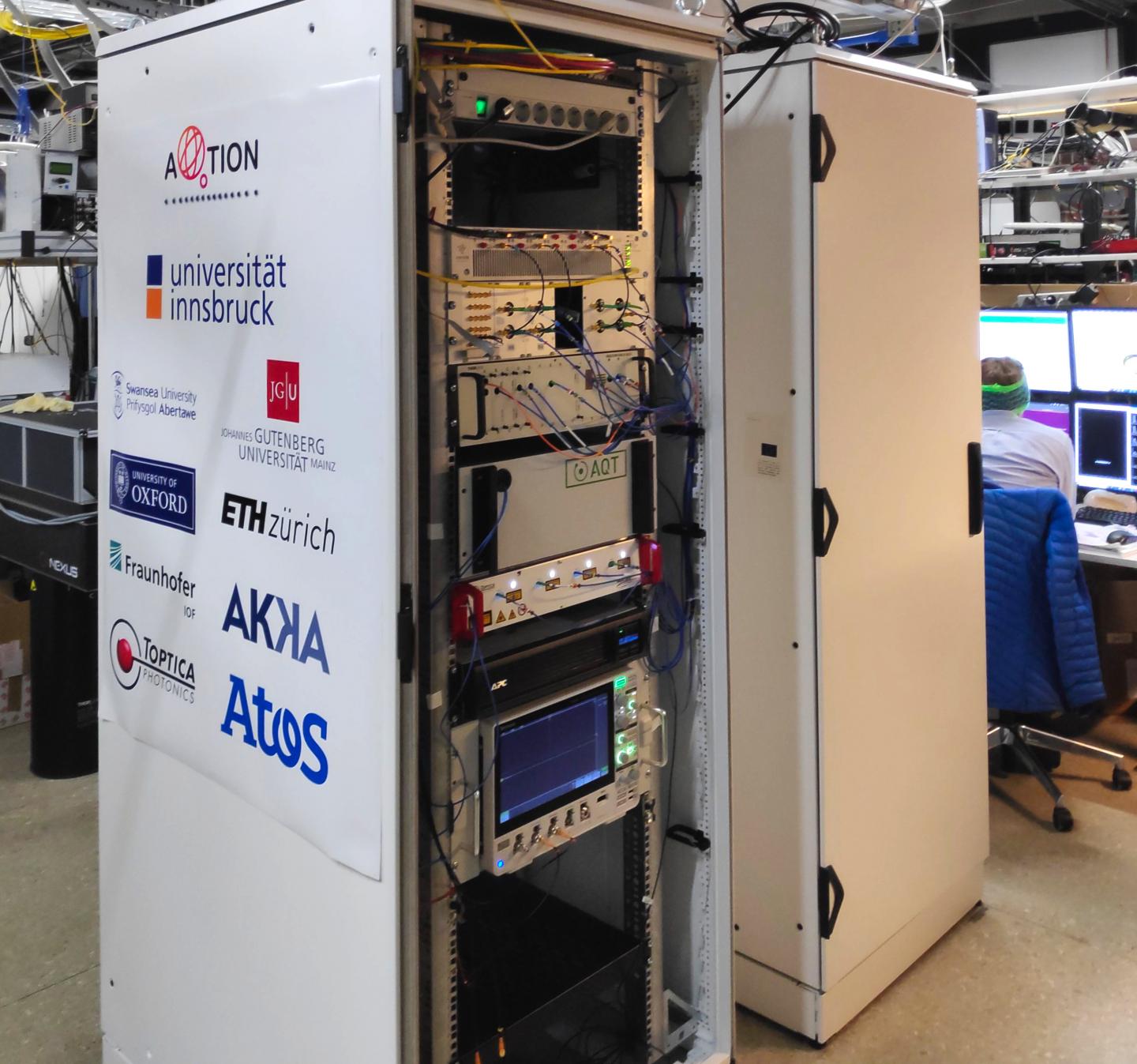
Over the past three decades, fundamental groundwork for building quantum computers has been pioneered at the University of Innsbruck, Austria. As part of the EU Flagship Quantum Technologies, researchers at the Department of Experimental Physics in Innsbruck have now built a demonstrator for a compact ion trap quantum computer. “Our quantum computing experiments usually fill 30- to 50-square-meter laboratories,” says Thomas Monz of the University of Innsbruck. “We were now looking to fit the technologies developed here in Innsbruck into the smallest possible space while meeting standards commonly used in industry.” The new device aims to show that quantum computers will soon be ready for use in data centers. “We were able to show that compactness does not have to come at the expense of functionality,” adds Christian Marciniak from the Innsbruck team.

The individual building blocks of the world’s first compact quantum computer had to be significantly reduced in size. For example, the centerpiece of the quantum computer, the ion trap installed in a vacuum chamber, takes up only a fraction of the space previously required. It was provided to the researchers by Alpine Quantum Technologies (AQT), a spin-off of the University of Innsbruck and the Austrian Academy of Sciences which aims to build a commercial quantum computer. Other components were contributed by the Fraunhofer Institute for Applied Optics and Precision Engineering in Jena and laser specialist TOPTICA Photonics in Munich, Germany.

Up to 50 quantum bits

The compact quantum computer can be operated autonomously and will soon be programmable online. A particular challenge was to ensure the stability of the quantum computer. Quantum devices are very sensitive and in the laboratory they are protected from external disturbances with the help of elaborate measures. Amazingly, the Innsbruck team succeeded in applying this quality standard to the compact device as well, thus ensuring safe and uninterrupted operation.

In addition to stability, a decisive factor for the industrial use of a quantum computer is the number of available quantum bits. Thus, in its recent funding campaign, the German government has set the goal of initially building demonstration quantum computers that have 24 fully functional qubits. The Innsbruck quantum physicists have already achieved this goal. They were able to individually control and successfully entangle up to 24 ions with the new device. “By next year, we want to be able to provide a device with up to 50 individually controllable quantum bits,” says Thomas Monz, already looking to the future.

The project is financially supported by the Austrian Science Fund FWF, the Research Funding Agency FFG, the European Union, and the Federation of Austrian Industries Tyrol, among others.

###

Publication: Compact Ion-Trap Quantum Computing Demonstrator. I. Pogorelov, T. Feldker, Ch. D. Marciniak, L. Postler, G. Jacob, O. Krieglsteiner, V. Podlesnic, M. Meth, V. Negnevitsky, M. Stadler, B. Höfer, C. Wächter, K. Lakhmanskiy, R. Blatt, P. Schindler, and T. Monz
PRX Quantum 2, 020343 – Published 17 June 2021
https://doi.org/10.1103/PRXQuantum.2.020343

Media Contact
Thomas Monz
[email protected]

Related Journal Article

http://dx.doi.org/10.1103/PRXQuantum.2.020343

Tags: Chemistry/Physics/Materials Sciencescompact technologydata centersion trapquantum bitsquantum computingTechnology/Engineering/Computer Science
Share12Tweet8Share2ShareShareShare2

Related Posts

Hebrew University Congratulates Haim Sompolinsky on Receiving 2026 Dirac Medal

Hebrew University Congratulates Haim Sompolinsky on Receiving 2026 Dirac Medal

August 8, 2026
New brain model reveals how regional chemistry shapes large-scale neural activity

New brain model reveals how regional chemistry shapes large-scale neural activity

August 8, 2026

Topological coupler breaks bandwidth tradeoff in broadband coupled resonator waveguides

August 8, 2026

Radical Chemistry Selectively Cleaves Strong Bonds While Preserving Weaker Ones

August 7, 2026
Please login to join discussion

POPULAR NEWS

  • UVA-Induced Hyperploidization Causes Fibrosis in Post-Mitotic Fuchs Dystrophy Corneal Cells

    29 shares
    Share 12 Tweet 7
  • Study Explores PDLIM2 as Prognostic Biomarker and Treatment Target in Lung Adenocarcinoma

    29 shares
    Share 12 Tweet 7
  • Healthy Vaccinee Effect Shapes Evaluation of Updated COVID-19 Vaccines in Older Adults

    29 shares
    Share 12 Tweet 7
  • Nanoparticle pan-Ebolavirus vaccine protects rodents against lethal Zaire and Sudan virus infections

    29 shares
    Share 12 Tweet 7

About

We bring you the latest biotechnology news from best research centers and universities around the world. Check our website.

Follow us

Recent News

UVA-Induced Hyperploidization Causes Fibrosis in Post-Mitotic Fuchs Dystrophy Corneal Cells

Study Explores PDLIM2 as Prognostic Biomarker and Treatment Target in Lung Adenocarcinoma

Healthy Vaccinee Effect Shapes Evaluation of Updated COVID-19 Vaccines in Older Adults

Subscribe to Blog via Email

Enter your email address to subscribe to this blog and receive notifications of new posts by email.

Join 86 other subscribers
  • Contact Us

Bioengineer.org © Copyright 2023 All Rights Reserved.

Welcome Back!

Login to your account below

Forgotten Password?

Retrieve your password

Please enter your username or email address to reset your password.

Log In
No Result
View All Result
  • Homepages
    • Home Page 1
    • Home Page 2
  • News
  • National
  • Business
  • Health
  • Lifestyle
  • Science

Bioengineer.org © Copyright 2023 All Rights Reserved.