• HOME
  • NEWS
  • EXPLORE
    • CAREER
      • Companies
      • Jobs
    • EVENTS
    • iGEM
      • News
      • Team
    • PHOTOS
    • VIDEO
    • WIKI
  • BLOG
  • COMMUNITY
    • FACEBOOK
    • INSTAGRAM
    • TWITTER
Thursday, June 25, 2026
BIOENGINEER.ORG
No Result
View All Result
  • Login
  • HOME
  • NEWS
  • EXPLORE
    • CAREER
      • Companies
      • Jobs
        • Lecturer
        • PhD Studentship
        • Postdoc
        • Research Assistant
    • EVENTS
    • iGEM
      • News
      • Team
    • PHOTOS
    • VIDEO
    • WIKI
  • BLOG
  • COMMUNITY
    • FACEBOOK
    • INSTAGRAM
    • TWITTER
  • HOME
  • NEWS
  • EXPLORE
    • CAREER
      • Companies
      • Jobs
        • Lecturer
        • PhD Studentship
        • Postdoc
        • Research Assistant
    • EVENTS
    • iGEM
      • News
      • Team
    • PHOTOS
    • VIDEO
    • WIKI
  • BLOG
  • COMMUNITY
    • FACEBOOK
    • INSTAGRAM
    • TWITTER
No Result
View All Result
Bioengineer.org
No Result
View All Result
Home NEWS Science News Chemistry

Compact broadband acoustic absorber with coherently coupled weak resonances

Bioengineer by Bioengineer
January 16, 2020
in Chemistry
Reading Time: 2 mins read
0
IMAGE
Share on FacebookShare on TwitterShare on LinkedinShare on RedditShare on Telegram

IMAGE

Credit: ©Science China Press


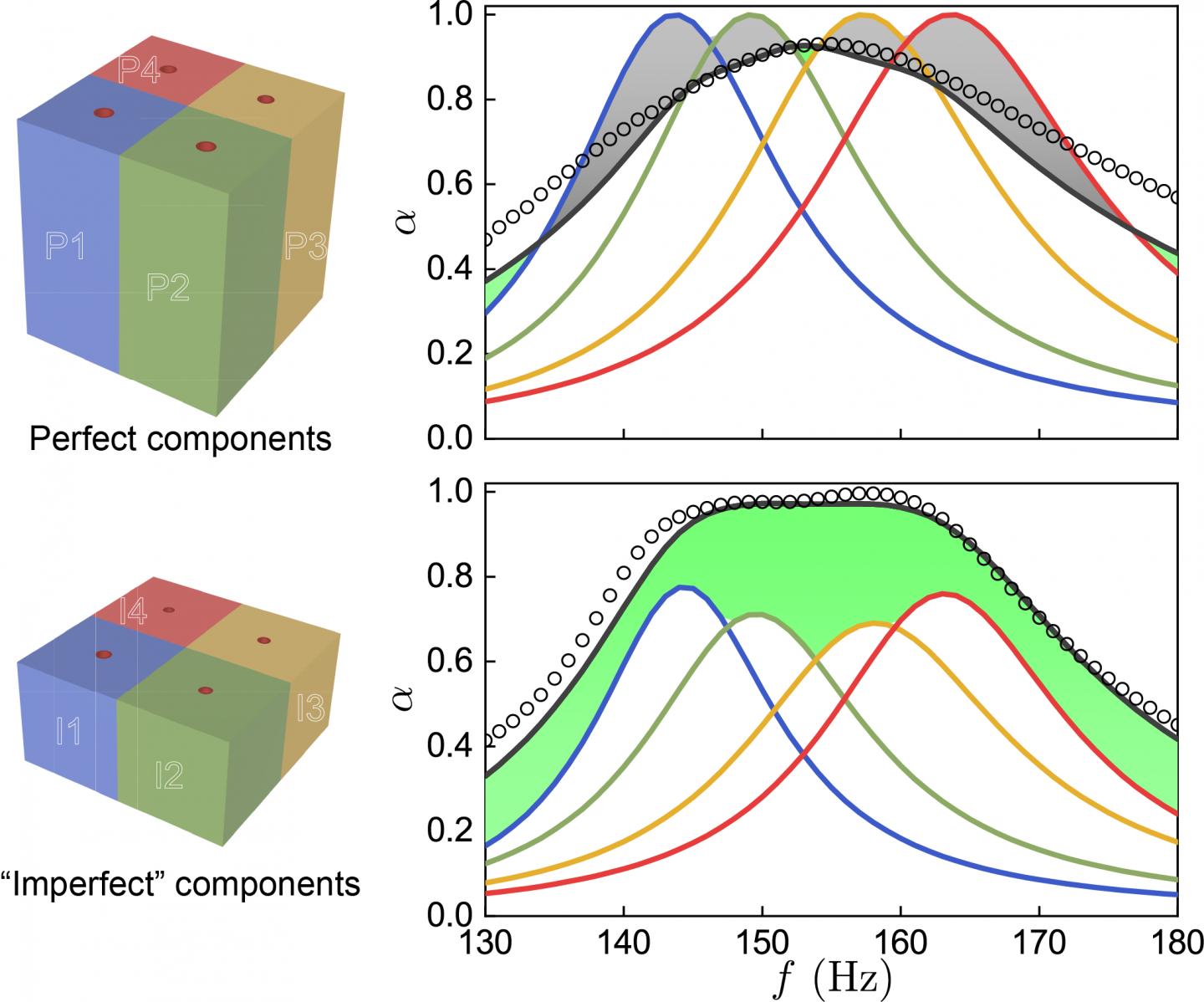
Deep-subwavelength acoustic absorbers have received great attention due to their scientific and application values. Porous materials and micro-perforated absorbers, as the most conventional solutions, generally possess a structural thickness comparable to working wavelength, which hinders their potentials in the low frequency region. The recent advance in acoustic metamaterial/metasurface brings forward perfect absorbers (resonators) that possess ultra-thin thickness but relatively narrow working frequency bandwidth. Then these perfect resonators with quasi-perfect absorption are combined to piece together a broad absorbing band. However, the requirement of quasi-perfect absorption substantially places a very strict restriction on the impedance and thickness of the resonators.

Recently, the research teams from Tongji University and The Hong Kong Polytechnic University go a counter-intuitive way — coupling imperfect components that possess low absorption peaks to achieve a compact broadband acoustic absorber. Their work opens a new pathway for this challenging goal by exerting the coherent coupling effect among the imperfect components to an unprecedentedly dominant role. This lifts the major restrictions on each component and frees the manipulation of coherent coupling effect. Results show that although each of the components exhibits rather low absorption peak individually, by suitably modulating the coherent coupling effect among the imperfect components, they work collectively to provide a broadband (870 – 3224 Hz) quasi-perfect absorption (average coefficient reaches 0.957). This work explores compact broadband acoustic absorbers with coherently coupled weak resonances and provides deep insight into the fundamental characteristics of these coupling systems, which may pave the way for developing novel acoustic devices against low frequency noise, and pave a way to modulate the surface acoustic impedance arbitrarily in broadband.

###

See the article: Sibo Huang, Zhiling Zhou, Dongting Li, Tuo Liu, Xu Wang, Jie Zhu, Yong Li. Compact broadband acoustic sink with coherently coupled weak resonances. Science Bulletin, doi: 10.1016/j.scib.2019.11.008

https://www.sciencedirect.com/science/article/pii/S2095927319306401

Media Contact
Yong Li
[email protected]

Related Journal Article

http://dx.doi.org/10.1016/j.scib.2019.11.008

Tags: Chemistry/Physics/Materials Sciences
Share13Tweet8Share2ShareShareShare2

Related Posts

AI and Physics Collaborate to Design Advanced Hydrogen Storage Materials

June 25, 2026

International Team Including Dresden Scientists Develops Novel Designer Proteins for Advanced Study of Living Tissue

June 25, 2026

New Study Uncovers Key Factors Driving Water Chemistry in Nanoscale Environments

June 25, 2026

Plasma Technology Extends Catalyst Lifespan in Hydrogen Production

June 24, 2026
Please login to join discussion

POPULAR NEWS

  • Saying Goodbye to PGY-6: Pediatric Fellowship Realities

    103 shares
    Share 41 Tweet 26
  • Multi-Hospital Study Reveals Long Covid Burden Is Twice as High as Current Estimates

    92 shares
    Share 36 Tweet 23
  • Detection of EDCs in Breast Milk and Infant Urine Up to Six Months Highlights Early Exposure Risks

    77 shares
    Share 31 Tweet 19
  • New Drug Candidate Developed at McMaster Shows Potential for Treating Brain Cancer

    58 shares
    Share 23 Tweet 15

About

We bring you the latest biotechnology news from best research centers and universities around the world. Check our website.

Follow us

Recent News

Tracking Lanthanide-Labeled Microplastics in Plants

POSTECH Researchers Slash Cost of Reconstituted Cell-Free Systems by 95%

AI and Physics Collaborate to Design Advanced Hydrogen Storage Materials

Subscribe to Blog via Email

Success! An email was just sent to confirm your subscription. Please find the email now and click 'Confirm' to start subscribing.

Join 82 other subscribers
  • Contact Us

Bioengineer.org © Copyright 2023 All Rights Reserved.

Welcome Back!

Login to your account below

Forgotten Password?

Retrieve your password

Please enter your username or email address to reset your password.

Log In
No Result
View All Result
  • Homepages
    • Home Page 1
    • Home Page 2
  • News
  • National
  • Business
  • Health
  • Lifestyle
  • Science

Bioengineer.org © Copyright 2023 All Rights Reserved.