


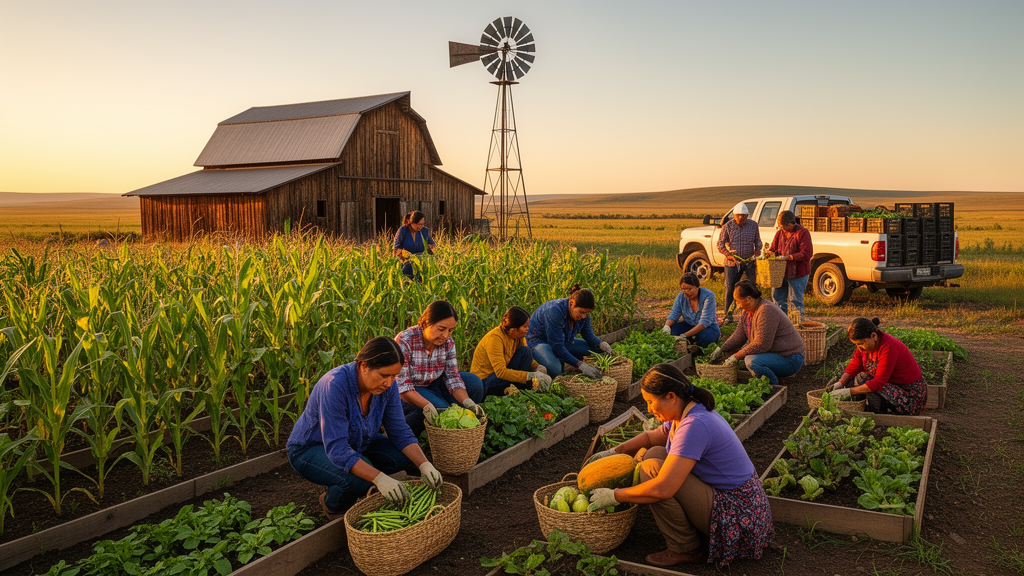
A 16-week community-supported agriculture (CSA) program tailored for American Indians in Oklahoma was not only effective at improving glycemic control in a randomized controlled trial but also economically worthwhile, according to an economic evaluation of the Go Healthy study published in Archives of Public Health.
The underlying trial randomly assigned participants to a multi-component CSA intervention or a control group. In balanced panel data comparing 193 people who received the intervention with 203 controls, the program produced meaningful reductions in HbA1c.
The base-case estimate, deliberately conservative, credited the intervention with at least 8.88 QALYs gained from HbA1c reductions. Under less conservative assumptions about converting life-year gains, the figure rose to between 15.33 and 16.02 QALYs. The incremental cost-utility ratio came to $16,326.97 per QALY, with sensitivity analyses ranging from $9,050.16 to $17,405.24 and a probabilistic 95% simulation interval of $6,139.28 to $20,154.54. All of these values fall well below the willingness-to-pay threshold of $50,000 to $150,000 per QALY used in the study.
Uncertainty was addressed in several ways. Deterministic sensitivity analyses varied the cost of produce boxes, wage rates, the life-year conversion factor, and the discount rate, and tested alternative methods for converting HbA1c changes into life-years. A Monte Carlo probabilistic sensitivity analysis with 20,000 iterations was run for both the cost-effectiveness and cost-utility ratios, producing the reported simulation intervals.
Beyond health gains, the cost-benefit analysis tallied non-health benefits. Using the willingness-to-pay range and a conservative, age-specific excess-cost approach for estimating healthcare savings from potentially averted diabetes cases, the intervention would generate $444,000 to $1,332,000 worth of QALYs, $79,183.13 in productivity gains, and $145,218.10 in healthcare costs saved, for a total net benefit of $524,008.40 to $1,412,008.40.
Longer-horizon projections amplify the picture. Assuming a 3% discount rate, the authors estimate net benefits of $13.10 to $35.83 million with continuous intervention, or $16.95 to $39.67 million without it, over a decade. Over a lifetime, the corresponding figures rise to $25.26 to $69.06 million and $32.82 to $76.62 million. These are model-based projections that assume the observed effects persist, not observed long-term outcomes.
The trial was registered at ClinicalTrials.gov as NCT05773833 on March 17, 2023.
The authors are careful about the limits of their work. The conclusion states that the indigenous CSA dietary intervention improved glycemic control and demonstrated short- and long-term cost-effectiveness relative to accepted willingness-to-pay thresholds, suggesting it may be a worthwhile investment for the American Indian population, subject to the limitations discussed and confirmation in larger and longer-term studies. In other words, the economic case is strong on the trial’s own terms, but scaling the model will depend on whether the glycemic benefits and cost profile hold up in bigger populations and over longer follow-up periods.
Subject of Research: Economic evaluation of a community-supported agriculture dietary intervention to improve glycemic control among American Indians
Article Title: Economic evaluation of a randomized controlled trial of a community-supported agriculture intervention for American Indians: the Go Healthy study
Article References: Zhao, J., Taniguchi, T., Clyma, K. R., Reese, J. A., Zhang, Y., Sheikh, E., Sisson, S. B., Haymann, J., & Jernigan, V. B. B. (2026). Economic evaluation of a randomized controlled trial of a community-supported agriculture intervention for American Indians: the Go Healthy study. Archives of Public Health. https://doi.org/10.1186/s13690-026-02085-w
Image Credits: AI Generated
DOI: 10.1186/s13690-026-02085-w
Keywords: community-supported agriculture, American Indians, cost-effectiveness, HbA1c, QALY, randomized controlled trial, diabetes prevention, economic evaluation, Go Healthy study, cost-benefit analysis, public health nutrition, Oklahoma
News Source: Alan Morgan. (October 27, 2026). Community farm program for American Indians shows strong cost-effectiveness in trial. Scienmag.



