


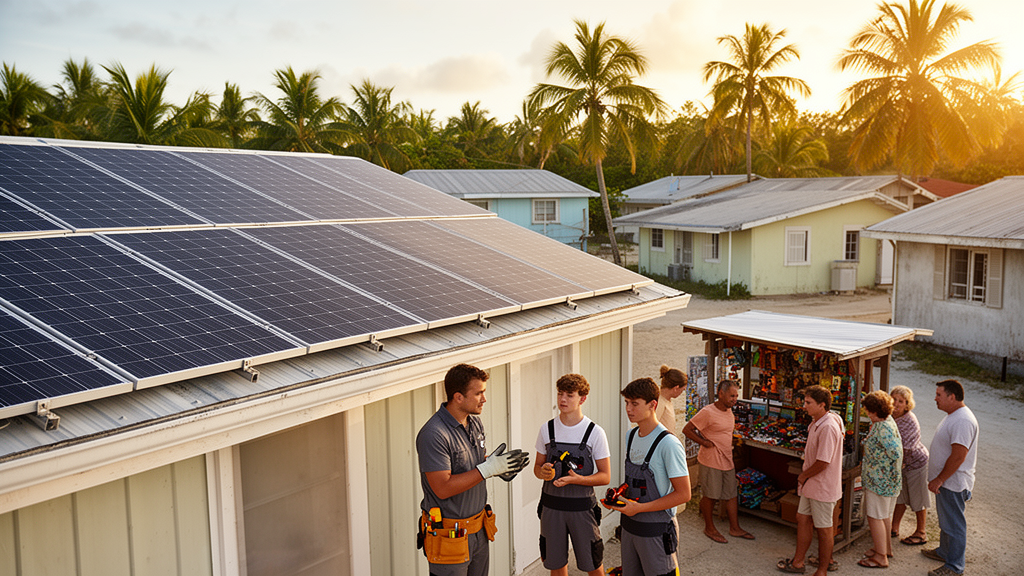
Four small, community-run energy projects on the French overseas department of Mayotte appear to have done more than deliver electricity or cleaner transport. According to a qualitative study published in Energy, Sustainability and Society, interviews with eleven key informants involved in the interventions revealed multiple perceived positive spillover effects reaching into education, innovation, inequality reduction, sustainable communities and international partnerships, while only a handful of negative impacts were reported. The researchers used the United Nations Sustainable Development Goals as an organizing framework to map these wider effects, and concluded that the goals proved useful for structuring diverse impacts, even though applying them at the scale of a single community exposed real methodological challenges.
The interventions were designed and implemented as part of MAESHA, a European Union-funded project aimed at decarbonizing energy systems on islands through increased use of renewable sources. Mayotte, an island of roughly 329,000 inhabitants located between Madagascar and Mozambique, was chosen as the pilot island. Its electricity system is largely dependent on imported fossil fuels because of geographic isolation and a lack of interconnection with neighboring grids, producing high energy costs and significant socio-economic disparities. Those constraints, the authors argue, make the island a relevant case for examining decentralized and community-based energy interventions within a tightly bounded energy system, and the findings particularly relevant for other islands facing similar structural conditions.
The four case studies differed sharply in design. The Solar Mama intervention introduced solar home systems and small solar devices to households lacking electricity access, built by four women who completed certified training in installing and maintaining solar technologies and now deliver energy-related services through an energy kiosk and repair workshop. The Solar Housing intervention, embedded in a broader resettlement program led by the local association SOLIHA Mayotte, equipped six of thirty low-cost social housing units with photovoltaic panels that serve as demonstration sites and a revenue source for community activities and maintenance. The Clean Mobility intervention deployed 150 emission-free e-bikes to reduce carbon dioxide emissions, air pollution and traffic congestion in a territory where public transport is largely absent, with four young people from disadvantaged backgrounds trained as the island’s first certified e-bike mechanics. Finally, the Student Awareness initiative had university students act as facilitators of Climate Fresk workshops for peers, high-school classes and the broader public.
The assessment rested on eleven semi-structured, in-person interviews with key informants, most of them directly involved in implementing and operating the interventions. Interviews were audio-recorded with consent, transcribed, and analyzed in MAXQDA using a predominantly deductive coding approach in which the Sustainable Development Goals served as predefined analytical categories. Respondents’ statements were coded according to their perceived positive, negative or neutral contribution to each selected goal. For each intervention, three goals deemed unrelated to the local context or technology were excluded, leaving fourteen goal-linked guiding questions per questionnaire. The authors stress that this sampling deliberately captured implementers and facilitators rather than a representative slice of end users, a limitation they flag explicitly.
The Social Housing case produced some of the most concrete perceived economic effects. Access to solar-generated electricity enabled income generation for all participating households, who earned revenue by feeding electricity into the grid, which respondents linked directly to poverty reduction under SDG 1. Because community members had lacked energy access before the intervention, panel installation was also seen to decrease structural inequalities under SDG 10, and becoming prosumers was described as a notable innovation in the Mayotte context under SDG 9. Interviewees further reported improved social inclusion following relocation from informal settlements, and effective communication among all partners, consistent with SDG 17. Environmentally, the panels supported renewable energy adoption and lowered greenhouse gas emissions, but respondents also raised a negative impact under SDG 12, since no framework exists for managing end-of-life disposal of installed equipment, and a vulnerability under SDG 13, because panels remain exposed to destruction by recurrent cyclones despite a resilience-focused feasibility study.
The Solar Mamas intervention generated strong perceived gains in education and gender equality. The four participants, who previously had no technical background, received substantial training and skills development, and their inclusion in traditionally male-dominated technical roles was seen to advance women’s participation in the community. Yet economic outcomes remained limited during the study period: equipment delivery delays meant practical implementation had only just begun, and professional installation activity was hindered by regulatory requirements, most importantly an additional certification permitting rooftop work that had not been obtained within the project timeframe. Respondents nonetheless noted modest positive contributions to SDG 7 through promoting access to clean energy technologies, and notable progress on innovation under SDG 9, as the energy kiosk model sparked considerable community interest in renewable technologies. The single reported negative impact concerned SDG 12, again because broken solar appliances currently lack any disposal strategy.
The Clean Mobility case illustrated how net environmental benefits depend on context. Interviewees described a clear positive impact from shifting from cars to electric bicycles, particularly when charging occurred via solar panels at the office of the local partner. However, most users charge their bikes at home, where electricity comes from a coal-based grid, diminishing the environmental benefit, and some users switched from walking to e-bikes, increasing electricity consumption and emissions. The authors therefore characterize the intervention’s net climate impact as ranging from positive to slightly negative depending on electricity sources and previous transport mode. On the socio-economic side, the four trained technicians secured permanent contracts, bike rentals previously unavailable on the island became visible across Petite Terre and Mamoudzou, affordable transport improved time efficiency for residents who cannot afford cars or taxis, and the local partner Mob’helios became Mayotte’s first co-operative society of collective interest, fostering relationships among employees, users, associations and institutions.
The Student Awareness intervention was the only one of the four with no reported negative impacts. All three interviewees underscored the workshops’ practical approach to understanding climate change and sustainability, with one describing how the sessions filled a gap by explaining how to act, why to act and in what circumstances to act. Promoting clean energy knowledge was confirmed in all interviews as a positive influence on SDG 7, and raising awareness of environmental challenges produced a considerable positive impact on SDG 13.
Across the cases, the authors identify capacity building, locally embedded partnerships and participatory processes as enabling conditions behind the perceived gains, while cautioning that positive outcomes are not automatic. The Solar Mamas experience shows that community-based approaches alone do not overcome structural or regulatory barriers, and the study explicitly cannot establish a causal relationship between community engagement and broader sustainability impacts, because it did not compare community-based with non-community-based interventions. The authors also note trade-offs requiring proactive governance, especially end-of-life equipment management and infrastructure vulnerability to cyclones.
The study’s limitations are substantial and acknowledged in detail. The sample was small and dominated by people close to the projects, potentially introducing perspective bias and missing end-user experiences or unintended negative impacts. The deductive SDG framing may have prioritized impacts fitting predefined sustainability categories while overlooking effects outside that structure. The interventions were initiated within an EU-funded project and shaped by institutional and funding constraints, and Mayotte’s unique status as a French overseas department limits direct transferability. The authors position the findings as exploratory insights for contextually adapted applications rather than one-size-fits-all recommendations, while suggesting that islands, with their small-scale systems and distinct socio-spatial characteristics, may offer valuable testing grounds for socially innovative energy transitions provided evaluation remains attentive to local complexity, equity and long-term sustainability.
Subject of Research: Perceived sustainability impacts of four community-based energy interventions on Mayotte assessed with the Sustainable Development Goals
Article Title: How does community energy impact life from an SDG perspective?
Article References: Baslik, P., Schöne, N., Britton, T. R., Otte, L., Fevret, E., & Heinz, B. (2026). How does community energy impact life from an SDG perspective?. Energy, Sustainability and Society, 16(1), Article 41. https://doi.org/10.1186/s13705-026-00598-4
Image Credits: AI Generated
DOI: 10.1186/s13705-026-00598-4
Keywords: community energy, Mayotte, SDGs, social innovation, island energy transition, solar housing, e-bikes, qualitative interviews, renewable energy, spillover effects, capacity building, decarbonization
News Source: Sloane Callahan. (October 29, 2026). Community energy projects on Mayotte ripple beyond electricity into jobs, learning and equity. Scienmag.



