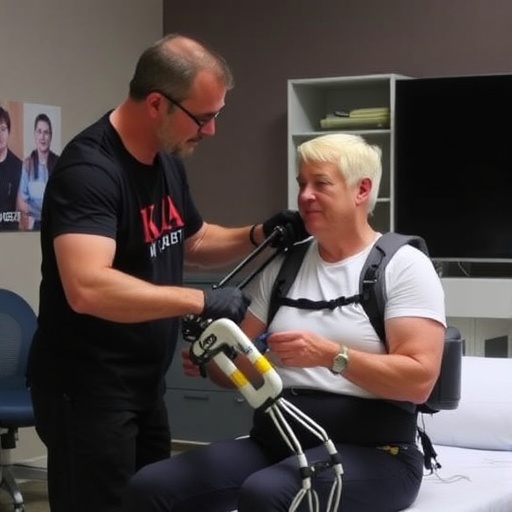
Each year, nearly 800,000 Americans survive a stroke, embarking on a challenging journey toward recovery marked by relearning foundational motor skills such as walking. The aftermath of a stroke often results in muscle weakness, impaired coordination, and compromised leg control, making even the simplest of movements daunting. Traditional rehabilitation protocols heavily depend on intensive, therapist-led sessions where patients progressively regain mobility, independence, and confidence. However, the physical demands on therapists and the limitations of conventional methods necessitate innovative approaches that can enhance therapy effectiveness while mitigating therapist fatigue.
A groundbreaking study led by researchers from Shirley Ryan AbilityLab and Northwestern University introduces a novel paradigm that integrates lower-limb exoskeletons to enhance therapist-patient interaction during functional gait training. Published in the prestigious journal Science Robotics, the study unveils a transformative approach termed Therapist-Exoskeleton-Patient Interaction (TEPI). This system connects a therapist and a stroke survivor physically via complementary lower-limb exoskeletons, linked through virtual spring-damper elements at the hips and knees. This design facilitates real-time bidirectional physical interaction, where the therapist’s movements dynamically guide and respond to the patient’s gait by modulating forces through the exoskeleton interface.
Conventional physical therapy for gait rehabilitation involves therapists providing hands-on corrective assistance to patients, focusing typically on isolated aspects of walking mechanics due to their ability to assist only a limited number of joints or movements simultaneously. Complex, whole-body retraining often demands multiple therapists, posing logistical and physical constraints. While robotic rehabilitation devices can increase therapy intensity by enabling prolonged walking practice, most systems operate on preprogrammed, fixed movement trajectories that lack the flexibility to adapt instantaneously to patient performance or allow meaningful therapist input. This gap limits personalized care and the nuanced adaptability essential in neurorehabilitation.
TEPI fundamentally redefines this intervention landscape by leveraging the dexterous control capabilities of therapists in conjunction with robotic consistency and scalability. Through the exoskeleton-mediated connection, therapists can impose finely tuned guidance, resistance, or assistance, tailored in real time to the patient’s biomechanical status and response patterns. This synergy allows the therapy to encompass intricate whole-body dynamics within a single therapeutic session, eliminating the need for multiple practitioners in many cases. Moreover, the system’s responsiveness facilitates continuous adjustment throughout the gait cycle, enhancing motor learning through immediate feedback.
During the pilot evaluation involving eight stroke survivors, TEPI was contrasted with conventional therapist-guided treadmill walking sessions. Quantitative motion analysis revealed that TEPI training elicited significantly greater joint range of motion, augmented step length, and increased step height compared to standard therapy. Electromyographic assessments indicated comparable muscle activation patterns between the two modalities, affirming that TEPI does not compromise neuromuscular engagement while augmenting kinematic outcomes. Subjective evaluations reflected high patient motivation and enjoyment, underscoring the system’s potential to enhance adherence and therapeutic enthusiasm.
The TEPI framework also addresses a critical occupational health issue: therapist fatigue and injury risk associated with manual gait rehabilitation. By externalizing some physical effort to the exoskeleton-mediated interaction, therapists can guide patient movements more sustainably and ergonomically. This innovative method not only preserves the expertise of hands-on care but also reduces the biomechanical strain on providers, potentially extending the longevity and well-being of rehabilitation professionals.
From an engineering perspective, the system employs a sophisticated control architecture that harmonizes the exoskeleton’s stiffness and damping properties with the therapist’s voluntary movements. The virtual spring-damper coupling dynamically modulates mechanical impedance at key lower-limb joints, enabling a naturalistic yet controlled interaction paradigm. This technical advancement permits the system to act almost like an intelligent mechanical extension of the therapist’s own legs, enabling seamless transfer of movement intent and corrective forces.
Looking ahead, the researchers plan to expand the TEPI model beyond treadmill walking to include overground ambulation, stair navigation, and sit-to-stand transitions—functional tasks that more holistically represent daily living activities. The capacity to apply this approach across varied locomotor challenges promises to broaden its clinical applicability and deepen its therapeutic impact. Furthermore, scaling the technology into more accessible and user-friendly configurations could facilitate home-based rehabilitation, supporting remote care delivery and extending therapeutic supervision beyond clinical settings.
Such remote rehabilitation capability aligns with emerging trends in teletherapy and digital health, addressing barriers to access and continuity of care, especially for patients in underserved regions or with mobility limitations. By integrating sensor networks, adaptive control algorithms, and connectivity protocols, future iterations of TEPI could enable therapists to remotely guide patients through personalized gait training regimens with real-time haptic feedback and data monitoring.
This pioneering work symbolizes a major step forward in merging human expertise and robotic technology to optimize post-stroke rehabilitation. By synergizing the adaptability and intuitive understanding of therapists with the precision and endurance of robotic exoskeletons, TEPI opens a new frontier for restoring functional mobility—ultimately enhancing quality of life for millions of stroke survivors.
The collaborative research team behind this innovative study includes José L. Pons, PhD, scientific chair at Shirley Ryan AbilityLab and professor at Northwestern University; postdoctoral researchers Lorenzo Vianello, PhD, and Matthew R. Short, PhD; and co-first author Emek Barış Küçüktabak, PhD. Their collective expertise spans neurorehabilitation, robotics, and biomechanical engineering, driving the development of this cutting-edge, translational technology.
As the field advances, the TEPI approach may serve as a blueprint for next-generation rehabilitation robotics, where human-robot collaboration is optimized to support recovery from complex neurological impairments. The blend of immersive therapist control, real-time adaptability, and patient-centered design embodied by TEPI heralds a new era in rehabilitation science—one poised to transform care standards and patient outcomes.
Subject of Research: People
Article Title: Therapist-exoskeleton-patient interaction for gait therapy
News Publication Date: 17-Jun-2026
Web References: DOI link
Image Credits: Shirley Ryan AbilityLab
Keywords: Health care, Diseases and disorders, Biomedical engineering
Tags: bidirectional physical interaction therapyenhancing mobility after strokefunctional gait training innovationimproving post-stroke coordinationlower-limb exoskeleton therapyNorthwestern University rehabilitation researchovercoming muscle weakness post-strokerobotic-assisted stroke recoverystroke rehabilitation technologytherapist fatigue reduction methodstherapist-exoskeleton-patient interactionvirtual spring-damper exoskeleton design