


The catch is a striking one: the same drug pairing that lifted the performance of rodents struggling on the tasks actually impaired the animals that were already doing well. The work, led by Luke Bransom, Ava P. Bassett, Mi Zhou, Richard B. Mailman and Yang Yang at Penn State College of Medicine, suggests that the future of cognitive pharmacotherapy may lie not in broad-acting stimulants but in selective receptor cocktails tuned to an individual’s baseline brain state.
Methylphenidate, sold as Ritalin, works indirectly. By blocking the reuptake of dopamine and norepinephrine, it floods the synaptic cleft and stimulates a wide range of dopaminergic and adrenergic receptors at once. That non-selectivity is precisely why its effectiveness varies so much from patient to patient and why it carries undesired side effects and a risk of abuse. The Penn State team started from a specific hypothesis: if the cognitive benefits of stimulants flow mainly through two particular receptor systems in the prefrontal cortex, then activating those two receptors directly and selectively might work better, with fewer collateral effects, than the shotgun approach.
The two targets were chosen for good reason. The α2A adrenergic receptor is known to enhance prefrontal cortical function and network connectivity, and dysfunction of this system is common in ADHD; indeed, the α2A full agonist guanfacine, marketed as Intuniv ER, is already approved for clinical use in the disorder. The D1 dopamine receptor plays a complementary role, finely tuning the signal-to-noise ratio of prefrontal circuits by regulating the balance of excitatory and inhibitory activity. Both systems obey an inverted-U-shaped dose-response curve: too little or too much signaling produces suboptimal cognition. The researchers reasoned that hitting both receptors simultaneously, each with a selective agonist, might push the prefrontal cortex toward its optimal operating point more effectively than raising catecholamine levels indiscriminately.
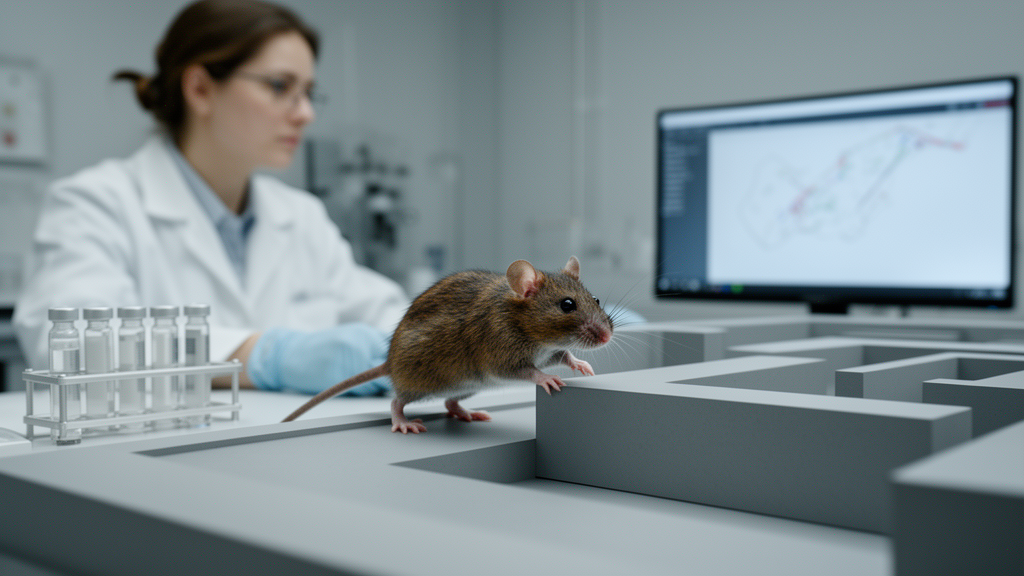
To test this, the team compared methylphenidate against three compounds: the selective D1/5 dopamine agonist 2-methyldihydrexidine, the selective α2A agonist guanfacine, and cannabigerol, a cannabinoid compound that happens to act as an α2A agonist with very little activity at CB1 or CB2 receptors. Cannabigerol was included because recreational cannabis use is rising among people with ADHD, making its cognitive profile a question of practical urgency. Each agent was given alone and in combination, and acute effects were measured with two well-established rodent behavioral tasks: temporal-order object recognition in an open field, which probes memory for the sequence in which objects were encountered, and delayed alternation response in a T-maze, which probes spatial working memory. Both tasks depend critically on prefrontal cortex function, and both map onto cognitive domains, temporal order memory and spatial working memory, that are measurably reduced in patients with ADHD.
The experimental design was rigorous for a behavioral pharmacology study. Thirty-one male Fischer rats were used in total, twenty-two for the temporal-order task and nine for the T-maze, with a within-subject design in which every animal served as its own control. A vehicle test day always immediately preceded each drug test day, and at least five washout days separated successive drug sessions. Doses were chosen for translational relevance: methylphenidate was given orally at 1.5 milligrams per kilogram mixed into Nutella, matching the allometric human equivalent, while guanfacine was injected intraperitoneally at 0.1 milligrams per kilogram, a dose known to improve working memory in rats without causing hypotension. The D1 agonist was given subcutaneously at 3 micrograms per kilogram based on prior efficacy studies.
The headline result emerged only when the researchers looked below the group average. Across all drug conditions, temporal-order recognition showed no overall significant difference, but the spread of baseline performance under vehicle was enormous, ranging from zero to one with a coefficient of variation as high as 78 percent. Splitting the rats at an a priori cutoff of 0.7, a boundary confirmed by k-means clustering, revealed the hidden signal. In rats with poor baseline temporal-order memory, co-administration of the D1 agonist with the α2A agonist cannabigerol significantly raised the recognition index, from 0.256 under vehicle to 0.526, a large effect with a Cohen’s d of 1.004. Neither compound achieved this when given alone. Methylphenidate, by contrast, did not significantly improve temporal order memory, spatial working memory, or cognitive flexibility in any subgroup, though it showed a non-significant trend toward reducing rigidity.
The flexibility findings told a parallel story with a different cast. In rats with rigid baseline performance, meaning a strong side bias indicating poor cognitive flexibility, the D1 agonist alone and the D1 agonist paired with guanfacine both significantly reduced the rigidity index, with effect sizes around 1.1. Notably, the D1 agonist alone could deliver this benefit while neither α2A agonist could, pointing to D1 receptors as the more critical lever for flexibility. The authors propose that α2A receptors may require optimal D1 function to exert their full cognitive influence, which would explain why only the combination rescued temporal-order memory while neither single agent did.
The mirror-image penalty for high performers is the study’s most sobering finding. In rats that already excelled at temporal-order recognition, the same D1-plus-cannabigerol combination significantly worsened performance, dropping the index from 0.898 to 0.340. In flexible performers, the D1 agonist alone, guanfacine alone, and both combinations all significantly increased rigidity, with guanfacine producing the largest impairment. The authors attribute this to the inverted-U curve: animals already at their cognitive peak were likely pushed past it into overactivation territory. Intriguingly, methylphenidate was the only treatment that never significantly harmed the good performers, supporting the idea that normally functioning prefrontal circuits are more vulnerable to disruption by selective agents than by diffuse catecholamine elevation. The authors note that off-target effects cannot be entirely ruled out, but consider them unlikely as the primary mechanism given the low doses and the confinement of adverse effects to the high-performing group.
The comparison between the two α2A agonists added a further layer of nuance. Cannabigerol had the more profound effects on temporal-order memory, rescuing poor performers and impairing strong ones, while guanfacine was more effective at modulating cognitive flexibility. Since both compounds share α2A agonist activity but cannabigerol is also a 5HT1A antagonist whose full pharmacological profile remains incompletely defined, actions at other receptors may underlie the divergence. On the motor side, total exploration time in the open field, an index of motor function, was unchanged across all drug conditions, and in the T-maze the alternation rate itself, the direct measure of spatial working memory, was not significantly altered by any treatment; only a trend toward increased side bias with the D1 agonist alone appeared there, and it did not survive Bonferroni correction.
The authors are candid about the limits: subgroup sizes were small, some rats dropped out for health reasons unrelated to the study, and the complexity of the within-subject design precluded full dose-response experiments, so some impairments may reflect circuit overactivation. They also stress that this was a study in normal rats, not an ADHD disease model, so direct validation in such models is warranted before any translation. Still, the path toward human testing may soon be practical: the D1 agonist tavapadon, an orally available partial agonist with functional selectivity that recently completed four Phase-3 trials for Parkinson’s disease with positive primary and secondary endpoints in TEMPO-1 and TEMPO-3, could serve as a clinical tool for well-controlled cognition studies. For now, the message is that selective co-activation of D1 and α2A receptors can outperform the standard stimulant, but only for brains that need help, and that precision, not potency, may be the real frontier of cognitive pharmacology.
Subject of Research: Selective D1 dopamine and α2A adrenergic receptor co-activation versus methylphenidate for cognition in rats
Article Title: Concomitant activation of D1 dopamine and α2A adrenergic receptors improves cognition better than methylphenidate in two rodent behavioral tests
Article References: Bransom, L., Bassett, A. P., Zhou, M., Mailman, R. B., & Yang, Y. (2026). Concomitant activation of D1 dopamine and α2A adrenergic receptors improves cognition better than methylphenidate in two rodent behavioral tests. Discover Pharmaceutical Sciences, 2(1), Article 11. https://doi.org/10.1007/s44395-026-00047-3
Image Credits: AI Generated
DOI: 10.1007/s44395-026-00047-3
Keywords: ADHD, methylphenidate, D1 dopamine receptor, α2A adrenergic receptor, guanfacine, cannabigerol, prefrontal cortex, working memory, temporal order memory, cognitive flexibility, rodent behavior, 2-methyldihydrexidine
News Source: Glenn Wilkins. (October 29, 2026). Combining D1 dopamine and α2A adrenergic receptor activation beat methylphenidate in rat cognition tests. Scienmag.



