


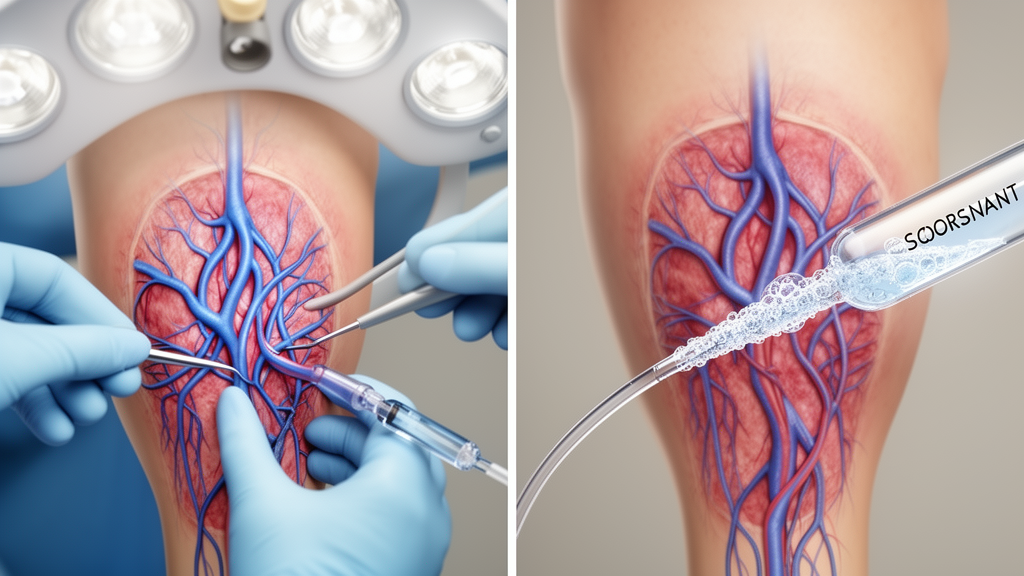
A randomized prospective study from Kasr Al-Ainy hospital in Cairo reports that three different ways of surgically treating varicocele all improved semen parameters in infertile men, but a combined technique that merges microsurgical varicocelectomy with antegrade sclerotherapy produced the fewest complications, including a complete absence of postoperative testicular pain. The work, published in Basic and Clinical Andrology, randomized 68 male patients into three treatment arms and followed them for six months after surgery, tracking sperm count, motility, morphology, ultrasound findings, operative times, pregnancy rates and complications.
Varicocele is an abnormal dilation and tortuosity of the internal spermatic veins and the pampiniform plexus, the network of veins that drains the testis. Retrograde blood flow through the internal spermatic vein is considered central to the impaired sperm production that varicocele can cause, and the condition shows a distinct correlation with infertility and testicular growth arrest. It is found in 19 to 41 percent of men with primary infertility and 45 to 80 percent of men with secondary infertility, making it the most prevalent correctable cause of male infertility. The dilated veins raise testicular temperature and create hypoxia and oxidative stress, all of which negatively influence sperm function.
Several operative strategies exist. Subinguinal microsurgical varicocelectomy is widely regarded as the gold standard because of its low recurrence and complication rates, although it demands microsurgical expertise and longer operative time. Antegrade sclerotherapy, in contrast, is minimally invasive, technically straightforward and associated with faster recovery, but carries a risk of incomplete occlusion or recurrence. A combined approach incorporating both techniques has recently been suggested, aiming to merge the precision of microsurgery with the efficacy of sclerotherapy, and early evidence indicated it might offer superior semen outcomes compared with either technique alone.
The new trial is, according to its authors, the first prospective randomized study to evaluate subinguinal microsurgical varicocelectomy or subinguinal antegrade sclerotherapy separately against the combined approach in infertile patients with primary varicocele. The primary outcome was improvement in sperm count, motility and morphology at baseline and at three and six months. Secondary outcomes included pregnancy rate, operative time, recurrence rate, complication rate, patient satisfaction and postoperative recovery. Participants were men aged 18 to 45 with infertility lasting more than one year, suboptimal semen parameters according to the WHO 2010 guidelines, and varicocele confirmed by scrotal duplex ultrasound. Men with genitourinary infections, erectile dysfunction, diminished sexual desire, inhibited orgasm, uncontrolled systemic illness, alcohol or drug abuse, hormonal disturbance or azoospermia were excluded.
Randomization used sealed opaque envelopes with simple numbering. Group A comprised 27 patients who underwent subinguinal microsurgical varicocelectomy under a surgical microscope at 6x to 25x magnification, sparing the artery and lymphatics while ligating all visible veins with silk sutures. Group B included 21 patients treated with antegrade sclerotherapy, in which bulldog clamps occluded the cord proximally and distally before injection of 3 percent aetoxisclerol into the largest spermatic vein, followed by ligation of the punctured vein and a saline wash. Group C received the combined approach: microscopic dissection and ligation of the largest visible veins, plus sclerosant injection into a selected periarterial vein. All procedures used a subinguinal incision of 1.5 to 2.5 centimeters along Langer’s lines.
The semen results showed substantial within-group gains. Median sperm count rose from 13.0 at baseline to 35.0 at three months and 40.0 at six months. Median motility increased from 37.0 to 50.0 and then 55.0 over the same intervals. Intra-group comparisons demonstrated significant improvement in median total sperm motility and in median progressive motility across the follow-up period, while median abnormal forms significantly declined in all three groups. On ultrasound, highly significant postoperative reductions in left and right vein diameters were recorded within each group, and postoperative reflux in the left and right veins was no longer visualized. Right-sided reflux, present in all cases before surgery, was absent in all cases afterward.
Operative times differed by technique. For left-sided procedures, the median operative times were 29.5 minutes, 20 minutes and 25 minutes in groups A, B and C respectively. For bilateral procedures, the mean operative time was significantly longer in the microsurgery group, at 57.86 plus or minus 5.2 minutes, compared with 36.93 plus or minus 4.3 minutes for the sclerotherapy group and 44.17 plus or minus 3.45 minutes for the combined group. The authors attribute the shorter bilateral times of the combined approach to ligating fewer veins microsurgically, since the sclerosant occludes the remainder.
Complications revealed the clearest separation between the techniques. Orchialgia, or testicular pain, occurred in 19 percent of the sclerotherapy group, 3.7 percent of the microsurgery group and none of the combined group, a difference the authors considered significant and plausibly explained by the smaller amount of sclerosant used in the combined procedure. Hydrocele occurred in 3.7 percent of the microsurgery group with no significant difference among groups, recurrence was reported only in the microsurgery group at 3.7 percent, scrotal edema appeared only in the sclerotherapy group at 4.8 percent, and mild scrotal swelling with bluish discoloration was insignificantly noted in 10 percent of the combined group. Pregnancy rates of 22.2, 19 and 25 percent in groups A, B and C did not differ significantly, which the authors attribute to the short six-month follow-up. A regression analysis identified six-month progressive motility as a significant predictor of pregnancy, with an odds ratio of 1.039, while age, infertility type and earlier semen parameters were not significant.
The authors conclude that both subinguinal microsurgical varicocelectomy and antegrade sclerotherapy produced significant postoperative improvement in semen parameters, but recommend the combined approach because it was associated with the lowest incidence of complications. They also caution that the study had important limitations: the sample size was relatively small, the six-month follow-up was too short to properly assess pregnancy rates or the role of time in easing testicular pain, exclusion of hormonal imbalance cases prevented evaluating reproductive hormones as pregnancy predictors, and the analysis relied on the fifth rather than the sixth edition of the WHO semen guidelines. Larger studies, they write, are needed to confirm the current results.
Subject of Research: Comparing subinguinal microsurgical varicocelectomy, antegrade sclerotherapy and a combined approach for semen parameters in infertile men with varicocele
Article Title: Evaluation of the efficacy of subinguinal antegrade sclerotherapy and subinguinal micro varicocelectomy versus a combined approach on the semen parameters in infertile patients: a randomized prospective comparative study
Article References: Elahwany, A., GamalEl Din, S. F., Torad, H., ELsisi, I., Hashem, A. R., & Aburahma, A. A. (2026). Evaluation of the efficacy of subinguinal antegrade sclerotherapy and subinguinal micro varicocelectomy versus a combined approach on the semen parameters in infertile patients: a randomized prospective comparative study. Basic and Clinical Andrology, 36(1), Article 16. https://doi.org/10.1186/s12610-026-00314-4
Image Credits: AI Generated
DOI: 10.1186/s12610-026-00314-4
Keywords: varicocele, male infertility, varicocelectomy, antegrade sclerotherapy, semen parameters, randomized trial, microsurgery, orchialgia, sperm motility, pregnancy rate, scrotal duplex ultrasound, surgical complications
News Source: Ophelia Keating. (October 29, 2026). Combined Surgery and Sclerotherapy Shows Lowest Complications for Varicocele Infertility. Scienmag.



