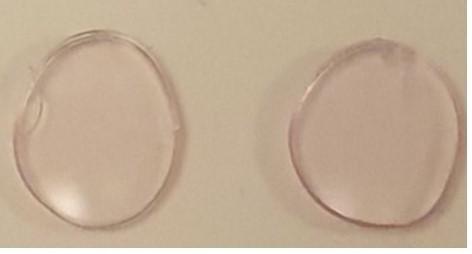
Credit: Adapted from ACS Nano 2021, DOI: 10.1021/acsnano.0c09657
Imagine seeing the world in muted shades — gray sky, gray grass. Some people with color blindness see everything this way, though most can’t see specific colors. Tinted glasses can help, but they can’t be used to correct blurry vision. And dyed contact lenses currently in development for the condition are potentially harmful and unstable. Now, in ACS Nano, researchers report infusing contact lenses with gold nanoparticles to create a safer way to see colors.
Some daily activities, such as determining if a banana is ripe, selecting matching clothes or stopping at a red light, can be difficult for those with color blindness. Most people with this genetic disorder have trouble discriminating red and green shades, and red-tinted glasses can make those colors more prominent and easier to see. However, these lenses are bulky and the lens material cannot be made to fix vision problems. Thus, researchers have shifted to the development of special tinted contact lenses. Although the prototype hot-pink dyed lenses improved red-green color perception in clinical trials, they leached dye, which led to concerns about their safety. Gold nanocomposites are nontoxic and have been used for centuries to produce “cranberry glass” because of the way they scatter light. So, Ahmed Salih, Haider Butt and colleagues wanted to see whether incorporating gold nanoparticles into contact lens material instead of dye could improve red-green contrast safely and effectively.
To make the contact lenses, the researchers evenly mixed gold nanoparticles into a hydrogel polymer, producing rose-tinted gels that filtered light within 520-580 nm, the wavelengths where red and green overlap. The most effective contact lenses were those with 40 nm-wide gold nanoparticles, because in tests, these particles did not clump or filter more color than necessary. In addition, these lenses had water-retention properties similar to those of commercial ones and were not toxic to cells growing in petri dishes in the lab. Finally, the researchers directly compared their new material to two commercially available pairs of tinted glasses, and their previously developed hot-pink dyed contact lens. The gold nanocomposite lenses were more selective in the wavelengths they blocked than the glasses. The new lenses matched the wavelength range of the dyed contact lenses, suggesting the gold nanocomposite ones would be suitable for people with red-green color issues without the potential safety concerns. The researchers say that the next step is to conduct clinical trials with human patients to assess comfort.
###
The authors acknowledge funding from Khalifa University, Khalifa University – Korean Advanced Institute of Science and Technology Joint Research Center, Sandooq Al Watan LLC, Aldar Properties and the Engineering and Physical Sciences Research Council for a New Investigator Award (U.K.).
The paper is freely available as an ACS AuthorChoice article
here.
For more of the latest research news, register for our upcoming meeting,
ACS Spring 2021.
Journalists and public information officers are encouraged to apply for complimentary press registration by emailing us at [email protected].
The American Chemical Society (ACS) is a nonprofit organization chartered by the U.S. Congress. ACS’ mission is to advance the broader chemistry enterprise and its practitioners for the benefit of Earth and its people. The Society is a global leader in providing access to chemistry-related information and research through its multiple research solutions, peer-reviewed journals, scientific conferences, eBooks and weekly news periodical Chemical & Engineering News. ACS journals are among the most cited, most trusted and most read within the scientific literature; however, ACS itself does not conduct chemical research. As a specialist in scientific information solutions (including SciFinder® and STN®), its CAS division powers global research, discovery and innovation. ACS’ main offices are in Washington, D.C., and Columbus, Ohio.
To automatically receive news releases from the American Chemical Society, contact [email protected].
Follow us:
Twitter | Facebook
Media Contact
Katie Cottingham
[email protected]