


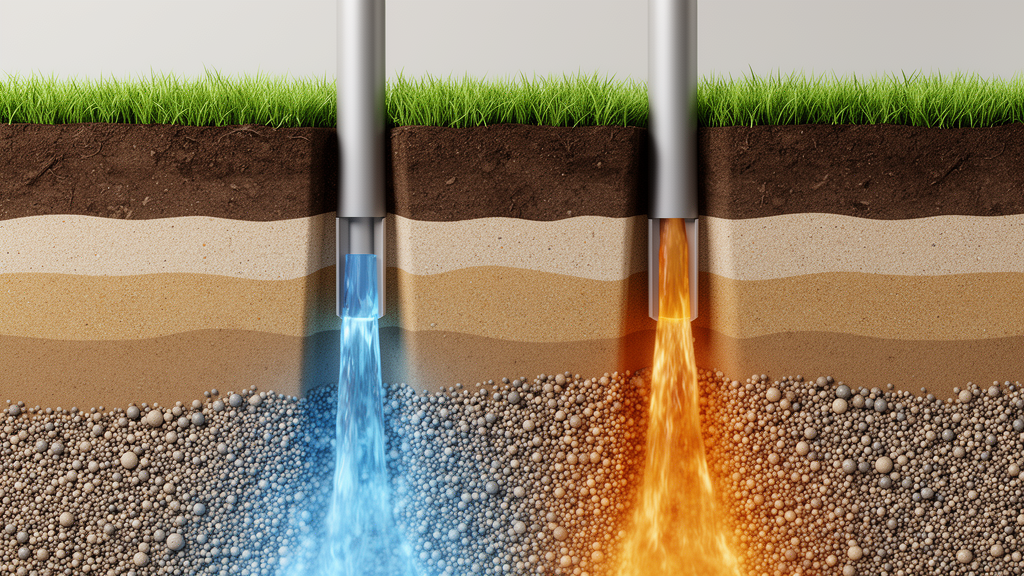
Aquifer thermal energy storage promises to stash summer heat underground and pull it back out in winter, but a new modeling study shows that the reliability of such systems may hinge on a component that designers often overlook: the cold well. Using a stochastic simulation framework built on 50 randomly generated aquifer configurations, researchers found that while the warm well of a low-temperature storage doublet performed steadily across a wide range of injection temperatures, the cold well’s worst-case thermal recovery collapsed dramatically as the warm-well injection temperature rose.
The study, published in the journal Geothermal Energy, simulated a confined aquifer hosting one warm well and one cold well, each screened across the full 20-meter thickness of the aquifer. The researchers generated 50 statistically independent three-dimensional hydraulic-conductivity fields with a lognormal distribution, ran ten consecutive storage and recovery cycles for each configuration, and repeated the exercise under four different treatments of fluid density and viscosity. Warm-well injection temperatures ranged from 14 to 30 degrees Celsius, while the cold well was always injected at 6 degrees, against an ambient aquifer temperature of 10 degrees Celsius. In total, the no-flow baseline comprised 1,000 stochastic simulations performed with the finite-element software FEFLOW.
The headline result concerns the 10th percentile of thermal recovery, a conservative estimate of how the least favorable aquifer realizations behave. Under the simplest scheme, in which both density and viscosity were held constant, the cold well’s 10th-percentile recovery fell from about 61 percent at 14 degrees Celsius injection to 24.4 percent at 30 degrees. When both density and viscosity were treated as temperature dependent, that figure dropped below 25 percent overall and reached as low as 4.2 percent. Meanwhile, the 90th percentile stayed above 61 percent in every scheme, revealing an enormous spread of possible outcomes: at 30 degrees Celsius, the uncertainty range of cold-well recovery widened to between roughly 40 and 57 percentage points, five to seven times larger than at the warm well.
The warm well told a very different story. Its median thermal recovery crept only from about 69.8 to 70.2 percent at 14 degrees up to 72.6 to 73.5 percent at 30 degrees, and differences among the four density-viscosity schemes never exceeded about 1.3 percentage points even at the highest temperature. The asymmetry stems from the operational setup: because the cold-well injection temperature was fixed, raising the warm-well temperature mainly increased the heat stored on the warm side, while the cold well absorbed the growing thermal interference. The researchers caution that this asymmetry reflects the specific temperature configuration tested, not a general warm-versus-cold property of all storage systems.
To understand why some aquifer realizations failed so badly, the team examined the conductivity structures behind the best and worst cold-well outcomes under the most demanding scenario. The unfavorable realization featured a broad, continuous zone of above-average hydraulic conductivity spanning the region between the wells, with a length-weighted mean log-conductivity of 3.71 along the direct inter-well profile and a minimum of 3.59, never dipping below the global mean of 3.2. The favorable realization, by contrast, contained a low-conductivity bottleneck around the cold well, with log-conductivity remaining below the global mean over a continuous stretch of about 44 meters from the cold well. Notably, the peak conductivity values were nearly identical in both cases, showing that isolated high-conductivity spots matter far less than whether high-conductivity material forms an unbroken bridge between the wells.
Such continuous pathways enable preferential advective heat transport from the warm-well storage zone toward the cold-storage zone, a phenomenon the authors describe as thermal short-circuiting. When temperature-dependent viscosity was included, warmer groundwater became less viscous and more mobile, amplifying this transport along connected high-conductivity zones and pushing the worst-case recovery even lower. At 30 degrees Celsius, switching from constant to temperature-dependent viscosity lowered the cold-well median recovery by about 10 percentage points and the 10th percentile by about 17.5 percentage points. A supplementary analysis showed this viscosity effect grows with heterogeneity: under homogeneous conditions the viscosity-related difference in cold-well recovery was about 3.7 percentage points, rising to 17.5 percentage points at the 10th percentile when the log-conductivity standard deviation reached 1.0.
Density effects, by contrast, proved minor. Differences between constant-density and temperature-dependent-density cases stayed below 1 percentage point for medians and 90th percentiles, reaching only about 2.5 to 2.7 percentage points for the cold-well 10th percentile at 30 degrees. The authors supported this with a Darcy-Rayleigh number analysis: using vertical hydraulic conductivity and a maximum temperature contrast of 20 degrees Celsius, the estimated Rayleigh number was about 0.9, and even with horizontal conductivity as an upper bound it reached only about 9.0, well below the critical value of roughly 39.5 for the onset of free convection. Within the investigated low-temperature range, with warm-well injection not exceeding 30 degrees Celsius and a maximum warm-cold contrast of 24 degrees, buoyancy-driven flow simply is not strong enough to matter much.
Beyond percentile statistics, the study introduced a robustness index that combines mean performance, variability, and a minimum acceptable recovery threshold of 0.60, inspired by probabilistic variation mode and effect analysis. For the warm well, this index climbed slightly from about 0.82 to 0.96 across the temperature range. For the cold well, it fell monotonically from approximately 0.8 at 14 degrees to between 0.28 and 0.34 at 30 degrees, already dropping to about 0.39 to 0.46 at 22 degrees. A threshold-sensitivity analysis using thresholds of 0.55, 0.60, and 0.65 confirmed that the qualitative conclusion, that the cold well becomes the reliability-limiting component at higher injection temperatures, holds regardless of the exact threshold chosen. A Monte Carlo convergence check with an enlarged ensemble of 100 realizations confirmed that the extreme low-percentile results were stable, with the 10th percentile varying only between 3.33 and 4.69 percent.
Two additional factors reshaped the picture. Regional groundwater flow reduced recovery at both wells: at a moderate velocity of 50 meters per year, median thermal recovery fell to roughly 54 to 57 percent, and at 200 meters per year it collapsed to between 6.2 and 17.5 percent, with all cases converging toward similarly poor outcomes dominated by advective heat displacement. The authors suggest groundwater flow should serve as a first-order feasibility screening criterion, noting that 200 meters per year would likely render a conventional doublet unviable without substantial design modification. Increasing the well distance from two to three thermal radii, meanwhile, mainly rescued the cold well: at 30 degrees Celsius, the cold-well 10th-percentile recovery rose from about 24.4 percent under constant viscosity to about 63.8 percent at the larger spacing, with most of the benefit already achieved by three thermal radii.
The practical message is that median recovery alone can mask serious risk. Under the most demanding scenario, the cold-well median thermal recovery was still about 41 percent, yet the 10th percentile had fallen to 4.2 percent, meaning an assessment based on average performance would dramatically underestimate the chance of failure. The authors recommend that low-percentile metrics and robustness indices complement conventional averages in system design, and that pre-operational site characterization, including pumping tests and inter-well tracer tests, be used to detect strongly connected well configurations before wells are placed. They also stress the limits of their findings: the quantitative results apply to the specific model geometry, heterogeneity statistics, injection temperatures, and freshwater viscosity formulation considered, and the simplified density treatment should not be extrapolated to high-temperature storage or contrasts of 40 degrees Celsius or more, where buoyancy may become significant.
Subject of Research: Numerical simulation of density- and viscosity-dependent heat transport in heterogeneous low-temperature aquifer thermal energy storage systems
Article Title: Coupled density–viscosity controls in low-temperature aquifer thermal energy storage under heterogeneous conditions
Article References: Yuan, G., & Bayer, P. (2026). Coupled density–viscosity controls in low-temperature aquifer thermal energy storage under heterogeneous conditions. Geothermal Energy, 14(1), Article 26. https://doi.org/10.1186/s40517-026-00404-6
Image Credits: AI Generated
DOI: 10.1186/s40517-026-00404-6
Keywords: aquifer thermal energy storage, geothermal energy, hydraulic conductivity heterogeneity, thermal recovery, temperature-dependent viscosity, buoyancy flow, Monte Carlo simulation, groundwater flow, robustness index, cold well, FEFLOW, preferential flow paths
News Source: Denise Maddox. (October 29, 2026). Cold Wells Limit Reliability in Low-Temperature Aquifer Heat Storage Simulations. Scienmag.



