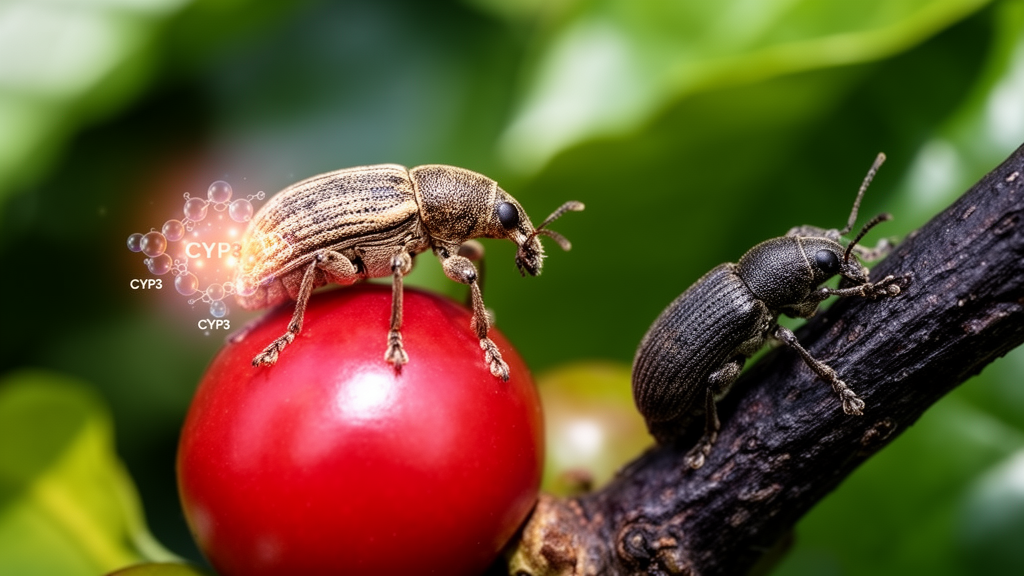
A genome-wide comparative investigation utilizing chromosome-level genome assemblies has identified 78 high-confidence cytochrome P450 genes in the coffee berry borer, Hypothenemus hampei, and 69 in the black twig borer, Xylosandrus compactus. Conducted to examine the genomic organization and evolution of this enzyme superfamily, the study assigned all detected cytochrome P450 genes into four primary lineages: the CYP2, CYP3, CYP4, and mitochondrial clans. The resulting gene repertoires establish a high-confidence genomic baseline for both economically important scolytine pests, detailing the count, structural distribution, and evolutionary properties of gene families that play vital roles in insect physiology and environmental interactions.
In insect biology, the cytochrome P450 superfamily is central to xenobiotic detoxification, hormone metabolism, and environmental adaptation.
A comparative analysis of gene clan sizes revealed contrasting repertoire compositions between the two insects, most visibly within the CYP3 and mitochondrial clans. The coffee berry borer possessed a substantially larger CYP3 complement than the black twig borer, harboring 41 CYP3 genes compared with 24 in Xylosandrus compactus. Conversely, the black twig borer contained a larger mitochondrial clan complement, encoding 16 mitochondrial cytochrome P450 genes compared with 8 in Hypothenemus hampei. The study authors explicitly noted that while these numbers illustrate contrasting CYP repertoire compositions between the two pest species, the differences do not by themselves establish lineage-specific gene expansion or gene loss.
The chromosomal mapping of the identified cytochrome P450 genes revealed that they are distributed both individually and in clusters throughout the genome assemblies. In addition to occurring as isolated loci and clustered groups, the genes displayed marked enrichment on specific chromosomes in each insect. In the coffee berry borer, cytochrome P450 genes were enriched prominently on chromosome 6, whereas in the black twig borer, a corresponding enrichment was localized to chromosome 1. These distinct genomic distributions show how each species organizes its respective complement of detoxification and metabolic genes across its chromosome architecture.
Synteny analysis comparing the two assemblies demonstrated that extensive chromosomal rearrangements occurred following the divergence of the two species from their common ancestor. However, this macro-level chromosomal reshuffling stood in stark contrast to the preservation observed at the gene level. Detailed gene structure and motif analyses revealed strong conservation within individual phylogenetic groups. These findings show that while broad genomic architecture underwent significant rearrangement over evolutionary time, the structural characteristics and conserved motifs of the cytochrome P450 genes remained closely preserved within their respective phylogenetic lineages.
To determine the origins of gene repertoire organization, the researchers classified duplication events, identifying dispersed duplication and tandem duplication as the major components shaping cytochrome P450 organization in both species. Furthermore, evolutionary selection analysis revealed that most examined duplicated gene pairs exhibited Ka/Ks ratios well below 1, indicating that predominant purifying selection has acted on these loci. The authors concluded that their comparative analysis provides an essential genomic and evolutionary framework for future functional characterization of cytochrome P450 genes associated with detoxification and metabolism in both pest species.
Subject of Research: Comparative analysis of cytochrome P450 gene families in scolytine pests
Article Title: Genome-wide identification and comparative analysis of cytochrome P450 gene families in the coffee berry borer Hypothenemus hampei and the black twig borer Xylosandrus compactus
Article References: Zhang, R., Liu, S., Gao, S., Xu, X., Zhang, X., Gou, Y., Zhao, Q., Tian, T., & Sun, S. (2026). Genome-wide identification and comparative analysis of cytochrome P450 gene families in the coffee berry borer Hypothenemus hampei and the black twig borer Xylosandrus compactus. BMC Genomics. https://doi.org/10.1186/s12864-026-13568-z
Image Credits: AI Generated
DOI: 10.1186/s12864-026-13568-z
Keywords: Hypothenemus hampei, Xylosandrus compactus, coffee berry borer, black twig borer, cytochrome P450, CYP gene families, scolytine pests, chromosome-level genome assemblies, CYP2 clan, CYP3 clan, CYP4 clan, mitochondrial CYP clan, xenobiotic detoxification, hormone metabolism, chromosomal synteny, tandem duplication, dispersed duplication, purifying selection
News Source: Juliet Wilcox. (November 16, 2026). Coffee Berry Borers Possess Larger CYP3 Complement Than Black Twig Borers. Scienmag.