Agricultural waste derived from coconut shells can be processed into epoxy-based composite substrates capable of storing electrical energy across microwave frequencies, according to an experimental investigation published in the Journal of King Saud University – Engineering Sciences. Researchers examined how incorporating ground coconut shell particles into an epoxy polymer matrix alters the material’s real permittivity at five gigahertz, an operating range relevant to high-frequency communication circuits and radio-frequency identification hardware. By combining chemical extraction procedures with a structured statistical evaluation, the research team established that ambient curing and elevated filler loadings produce composites with predictable increases in electrical polarization. The work demonstrates how discarded botanical residues might provide renewable functional alternatives to synthetic, non-biodegradable dielectric compounds currently used in printed circuitry and energy storage components.
The study sought to resolve a persistent gap in the scientific literature regarding how the organic constituents of coconut shells directly govern high-frequency dielectric behavior. While earlier investigations had evaluated coconut shell activated carbons and ground powders, previous researchers primarily linked variations in permittivity to carbonization pathways, morphological shifts, or general filler-to-matrix ratios without quantifying the direct role played by isolated lignocellulosic fractions. Coconut shell tissue naturally possesses a dense lignocellulosic architecture composed of cellulose, hemicellulose, and lignin functionalized with polar chemical groups. The researchers hypothesized that systematically tracking this cellulose-dominant fraction under controlled chemical and physical processing conditions would clarify how organic constituents regulate polarization mechanisms under alternating electromagnetic fields.
To rigorously test these parameters without relying on unstructured trial-and-error formulations, the authors implemented a two-level factorial design coupled with two-level factorial analysis using Design-Expert software. This design framework evaluated four specific processing variables across low and high operational levels: filler particle size, filler loading percentage, mechanical stirring time, and curing conditions. Particle sizes were classified via test sieving into nominal categories of 0.3 millimeters and 1.18 millimeters, representing finer reaction profiles and coarser structural distributions, respectively. Filler concentrations were fixed at 20 weight percent and 40 weight percent relative to the polymer system. Stirring times were controlled at 5 minutes and 10 or 15 minutes, while curing regimes contrasted ambient curing at room temperature for 24 hours against thermal curing at 100 degrees Celsius for 2 hours.
Raw coconut shells obtained from a local market in Kuantan, Pahang, Malaysia, served as the primary bio-filler feedstock after thorough water washing, mechanical grinding, and sieving. To isolate and quantify the cellulose-dominant lignocellulosic content present in the pulverized shells, the authors applied the classical Kurschner-Hanack analytical digestion method across sequential chemical treatments. Pre-weighed shell samples were initially introduced into a heated aqueous sodium hydroxide solution at 100 degrees Celsius to initiate alkaline pulping, disrupting protective lignin barriers and exposing embedded cellulosic fibers. The dewatered and oven-dried pulp was subsequently subjected to acid digestion in an eighty-percent acetic acid and concentrated nitric acid mixture held at 100 degrees Celsius for 20 minutes to dissolve residual non-cellulosic matter.
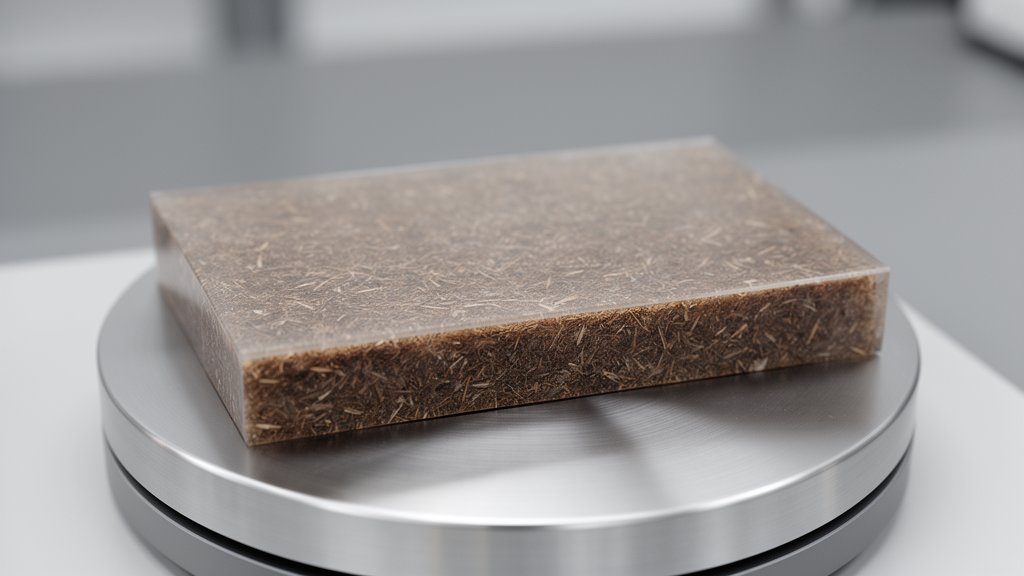
The insoluble cellulosic residue resulting from this acid digestion was filtered through a Buchner funnel, washed repeatedly with distilled water until reaching a neutral pH, and dried at 105 degrees Celsius for 24 hours to determine dry mass recovery. The authors noted that while the Kurschner-Hanack protocol effectively isolates a cellulose-dominant residue through chemical resistance, it does not achieve complete chemical separation of all lignin and hemicellulose fragments, functioning instead as a standardized metric of cellulose-rich content. Composite test specimens were subsequently synthesized by combining the processed shell powders with Epoxy Resin SM828 and Polyamide Resin 651 hardener at a stoichiometric ratio of 19.5 grams of resin to 5.5 grams of hardener, mixing the formulations mechanically before casting into rectangular molds.
Electromagnetic evaluation of the cured composite blocks was conducted across a standardized G-band WR-187 waveguide setup connected to a Rohde & Schwarz signal and spectrum analyzer operating within the 4 to 6 gigahertz range. Each test specimen was machined to dimensions of 2.2 centimeters by 2.5 centimeters by 2.5 centimeters to ensure accurate transverse electric TE10 mode propagation and calibrated using a two-port short-open-load-thru procedure. Across the sixteen experimental configurations tested in the factorial matrix, the real part of permittivity at five gigahertz ranged from a baseline of 3.7473 up to 4.1058. In comparison, neat epoxy resin exhibited an unreinforced baseline permittivity of 2.8613, confirming that introducing coconut shell particles uniformly raised charge-storage capability across all formulated processing combinations.
Statistical evaluation via analysis of variance revealed that curing condition was the single most dominant factor influencing microwave permittivity, demonstrating a statistically significant impact with a p-value of 0.0027 and exceeding critical Bonferroni significance limits. Samples cured under non-heated ambient conditions consistently attained higher permittivity values than those subjected to two hours of oven heating at 100 degrees Celsius. The authors attributed this reduction under thermal curing to heightened polymeric cross-linking density within the cured polyamide-epoxy network, which physically restricts the rotational mobility of molecular dipoles under rapid five-gigahertz field oscillations, coupled with minor thermal modifications of organic functional groups that suppress dipolar response.
Filler loading percentage represented the second most significant main factor affecting permittivity, yielding a p-value of 0.0303, followed closely by particle size with a p-value of 0.0473. Increasing filler incorporation from 20 to 40 weight percent expanded the network of polar hydroxyl and ether functional groups supplied by cellulose and hemicellulose, while establishing continuous filler-to-filler pathways that enhanced interfacial polarization across phase boundaries. Furthermore, analysis of variance identified a significant two-factor interaction between filler weight percentage and curing condition, registering a p-value of 0.0458. This interaction demonstrated that the dielectric enhancement gained by packing high concentrations of bio-filler into the resin is maximized when the polymer network remains unconstrained by thermal cross-linking.
The maximum permittivity measurement of 4.1058 was recorded in composite specimens prepared with 40 weight percent filler loading, coarse 1.18-millimeter particle size, and 5 minutes of mechanical stirring under non-heated curing conditions. Conversely, the lowest permittivity of 3.7473 occurred in specimens prepared with 20 weight percent loading of fine 0.3-millimeter particles stirred for 15 minutes and cured under elevated heat. Supplementary elemental analysis using energy-dispersive X-ray spectroscopy on the highest-performing composite revealed a chemical composition dominated by 71.36 percent carbon and 28.64 percent oxygen by mass. Scanning electron microscopy confirmed an irregular, compact microstructure characterized by particle agglomerations spanning 0.39 to 2.75 micrometers, which generate extensive interfacial phase boundaries that foster Maxwell-Wagner-Sillars interfacial polarization.
Parallel factorial analysis of the extracted lignocellulosic content demonstrated that measured values ranged between 54.00 percent and 59.50 percent across the experimental runs. Unlike permittivity, lignocellulosic retention was governed almost entirely by filler loading percentage, which proved highly significant with a p-value below 0.0001, whereas particle size variations between 0.3 and 1.18 millimeters showed no statistically significant influence, yielding a p-value of 0.4062. Regression modeling of lignocellulosic retention demonstrated exceptional stability, accounting for 94.74 percent of observed experimental variation. Higher filler concentrations improved preservation of the cellulose-rich phase against matrix dilution effects, ensuring that abundant polar groups remained present within the composite core.
When evaluating the direct correlation between lignocellulosic fraction and permittivity, the authors observed a modest positive trend that exhibited substantial data scatter and a low coefficient of determination of 0.1006. While factorial analysis confirmed that lignocellulosic content is an active contributor to electrical polarization (p = 0.0173), chemical composition alone could not reliably forecast absolute dielectric permittivity without factoring in processing conditions. The authors highlighted that their derived first-order regression model for permittivity, despite achieving an overall coefficient of determination of 0.9060, exhibited a predicted R-squared value of 0.3316. This limitation indicates that unmodeled physical factors, including microscopic void distribution, uneven particle dispersion, and localized interfacial adhesion, continue to affect high-frequency dielectric performance.
The researchers contextualized their findings against earlier investigations into bio-based dielectric fillers, noting that the observed permittivity values between 3.74 and 4.11 align with the moderate permittivity threshold required for high-frequency circuit boards, antenna substrates, and electromagnetic interference shielding. Unlike previous studies on cassava cortex, jute, or activated coconut carbon that primarily focused on carbonization or qualitative fiber types, this study provides an empirical framework linking specific chemical isolation metrics to microwave performance. The authors concluded that future research must incorporate dielectric loss tangent measurements, dynamic temperature profiles, moisture sensitivity evaluations, and nanoscale surface modifications to refine the predictive design of agricultural-waste composites for sustainable electronics.
Subject of Research: Factorial evaluation of lignocellulosic content and dielectric permittivity in coconut-shell epoxy composites
Article Title: Factorial analysis of lignocellulosic content influence on the permittivity of coconut-shell epoxy dielectric composites
Article References: Mekha, K. B., Aprianto, N. S. I. D., Sudhakar, K., Zainol, N., Hasan, N., Karim, M. S. A., & Yusof, N. A. T. (2026). Factorial analysis of lignocellulosic content influence on the permittivity of coconut-shell epoxy dielectric composites. Journal of King Saud University – Engineering Sciences, 38(2), Article 17. https://doi.org/10.1007/s44444-026-00097-z
Image Credits: AI Generated
DOI: 10.1007/s44444-026-00097-z
Keywords: dielectric materials, coconut shell composites, epoxy composites, permittivity, microwave electronics, two-level factorial design, Kurschner-Hanack method, lignocellulosic materials, curing conditions, dipolar polarization, interfacial polarization, vector network analyzer, waveguide measurements, agricultural waste valorization, radio-frequency substrates, sustainable electronics
News Source: Denise Maddox. (November 21, 2026). Coconut Shell Epoxy Composites Show Tunable Microwave Permittivity in Factorial Testing. Scienmag.