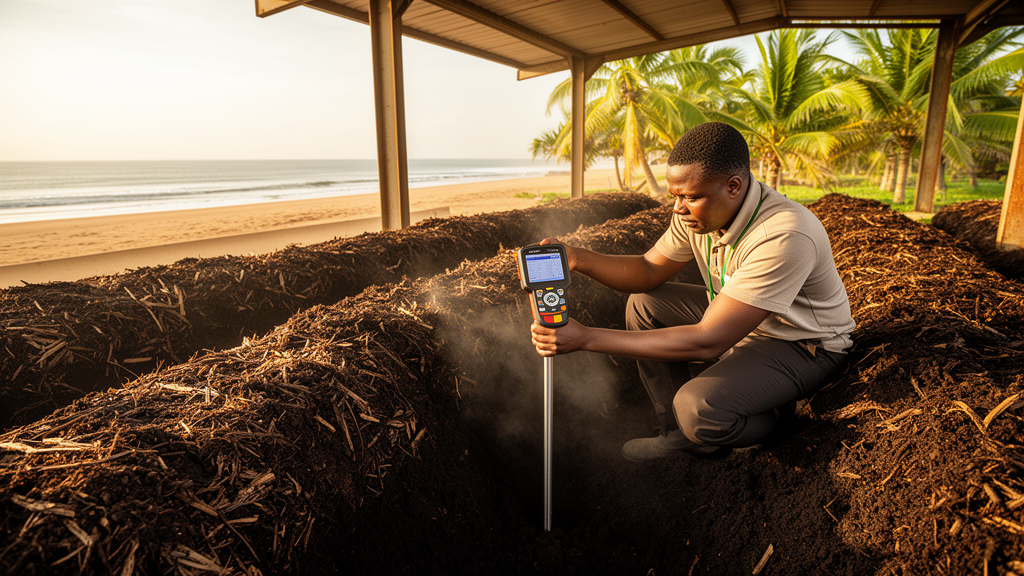
A comparative field and laboratory investigation across four coastal communities in Ghana has demonstrated that community-specific feedstock composition shapes organic waste composting outcomes far more reliably than aggregate waste volumes, while exploratory machine-learning tools showed significant limitations when predicting compost maturity. Conducted in the Komenda–Edina–Eguafo–Abirem (KEEA) Municipality within Ghana’s Central Region, the research evaluated organic waste generation, raw waste preparation, aerobic degradation dynamics, biological phytotoxicity, microbial and chemical safety, and the performance of supervised and unsupervised analytical models. Across the sampled settlements of Elmina, Ankwanda, Bantuma, and Brenu Akyinim, waste characteristics diverged markedly, establishing that municipal circular-bioeconomy initiatives require source-tailored composting recipes rather than uniform treatment strategies. Crucially, the diagnostic evaluation revealed that while standard machine-learning algorithms could help organise multivariate process data, they achieved very modest predictive performance, with random forest regression explaining less than eight percent of the observed variance in seed germination response.
The study was situated against the severe solid waste management pressures confronting urban and peri-urban coastal settlements across sub-Saharan Africa. The broader subcontinental region generates an estimated 230 million tonnes of food waste annually, with biodegradable organic fractions comprising between 50 and 80 percent of municipal solid waste streams. In Ghana, aggregate daily municipal waste generation exceeds 12,000 tonnes, roughly 60 percent of which is organic. In coastal municipalities such as KEEA, which generates approximately 72 tonnes of organic refuse daily, underdeveloped collection infrastructure, a deficiency of skip trucks, erratic haulage schedules, and minimal domestic source segregation frequently lead to unmanaged open dumping into marine waters, coastal lagoons, and drainage networks. Such uncontrolled disposal produces foul odours, toxic leachate, and substantial methane emissions, degrading sensitive aquatic ecosystems and threatening community health. Aerobic composting represents an accessible circular intervention to divert organic matter from dumpsites into agricultural soil conditioners, yet community-scale systems often struggle with unstable process conditions and inconsistent end-product maturity.
To rigorously investigate waste flows and transformation pathways under real-world conditions, the research team deployed a quasi-controlled comparative design combining quantitative household sampling with standardised laboratory protocols. Household selection along the coastal belt employed a mixture of purposive and convenience sampling based on settlement access, waste availability, and communal permissions. Using regional population statistics accounting for 4,453 households across the four target communities, the authors applied Yamane’s formula at an 11 percent precision level to calculate a baseline requirement of 81 households. Field teams surveyed 85 households across the study zone between January 17 and February 28, 2025, distributing coverage among Elmina with 45 households, Bantuma with 21, Ankwanda with 10, and Brenu Akyinim with 9. This non-probability sampling framework balanced operational feasibility against analytical rigor, enabling detailed characterisation of local waste-handling patterns while preserving authentic environmental variability across distinct coastal settings.
Weekly waste monitoring carried out over four consecutive weeks revealed stark disparities in both cumulative volume and week-to-week delivery stability among the settlements. Elmina generated the greatest cumulative mass of recoverable organic waste at 316.0 kilogrammes, followed by Ankwanda with 285.9 kilogrammes, Bantuma with 234.1 kilogrammes, and Brenu Akyinim with 104.6 kilogrammes. Despite producing the largest aggregate volume, Elmina exhibited pronounced weekly generation fluctuations, whereas Ankwanda supplied a considerably more stable volume each week. The physical makeup of the waste stream also differed considerably between locations: Bantuma’s organic residue was heavily dominated by starchy cassava residues, Elmina featured a heterogeneous profile of mixed household food leftovers, and Ankwanda and Brenu Akyinim contained substantial proportions of discarded pineapple and plantain tissues alongside prepared staples such as corn dough and waakye. These compositional variations governed the biological behaviour of the substrates, illustrating why practical compost design must account for substrate stability, porosity, and specific moisture dynamics rather than relying strictly on total mass.
Bins were allocated according to community waste volume rather than household counts, establishing 18 bins in Elmina, 16 in Bantuma, 14 in Ankwanda, and 8 in Brenu Akyinim. Each community’s pooled weekly collection constituted an independent batch and temporal replicate, managed under intensive aerobic composting parameters with moisture adjusted to approximately 40 to 60 percent. Material was manually turned every three days during the first two weeks of vigorous microbial activity and turned weekly thereafter during a 21-day composting cycle, yielding an overall nine-week operational period across staggered batches. Sorted raw wastes originally entered the process under acidic, moisture-laden, and carbon-dense conditions, displaying mean initial pH levels spanning from 4.37 in Brenu Akyinim to 5.45 in Elmina, alongside fresh moisture contents ranging between 59.85 percent in Bantuma and 65.20 percent in Ankwanda.
Chemical tracking showed that aerobic decomposition successfully converted acidic raw feedstocks into alkaline, nutrient-bearing composts while substantially depressing carbon-to-nitrogen ratios across all four locales. Final compost nitrogen concentrations ranged between 1.58 and 2.49 percent, matching typical reference intervals for organic soil conditioners, with Bantuma producing the highest nitrogen concentrations. Potassium content remained largely consistent across communities, while total phosphorus remained comparatively low, spanning 0.27 to 0.49 percent. Strikingly, stabilization efficiency decoupled completely from initial waste volumes: Brenu Akyinim, which yielded the lowest raw waste mass, achieved the greatest proportional carbon-to-nitrogen ratio reduction at 80.35 percent, followed closely by Bantuma at 77.70 percent, Ankwanda at 69.84 percent, and Elmina at just 50.10 percent. The finding confirms that feedstock biochemistry, initial moisture, natural pile porosity, and substrate degradability dictate carbon consumption far more effectively than initial pile bulk.
Maturity and biological safety assessments underscored the importance of multi-indicator screening over reliance on single agronomic proxies. Biological maturity was assessed using dual-seed germination index bioassays with radish and lettuce seeds exposed to 1:10 aqueous compost extracts. While community mean germination index values generally cleared the 80 percent exploratory threshold commonly associated with phytotoxicity reduction, radish seeds systematically produced higher germination values than lettuce, demonstrating the profound influence of bioassay test species on maturity interpretation. Cassava-dominated Bantuma achieved the highest overall germination performance, aligned with its substantial carbon-to-nitrogen reduction and superior nitrogen retention. However, chemical and microbiological safety screenings revealed critical hazards that germination metrics alone failed to capture. Ankwanda compost exhibited the highest levels of coliform bacteria on selective agar, while Brenu Akyinim recorded the highest concentrations of polycyclic aromatic hydrocarbons, proving that compost capable of supporting vigorous seedling root elongation can nevertheless harbour biological pathogens or persistent organic contaminants.
The multi-parameter dataset, comprising physical, chemical, nutrient, bioassay, and safety indicators, was assembled into a structured analytical matrix to assess computational modeling options. Dimensionality reduction via two-dimensional principal component analysis captured 77.3 percent of total predictor variance across the first two axes, with the primary component accounting for 49.7 percent and the second accounting for 27.6 percent. This ordination demonstrated that variation was heavily structured by community origin and raw feedstock properties rather than arbitrary noise. Unsupervised K-means clustering grouped the feature space into three exploratory clusters with distinctive principal component score coordinates and germination profiles. However, observations belonging to acceptable and borderline maturity classes displayed partial overlap within the ordination plane, reflecting shared predictor values across repeated laboratory bioassay rows and demonstrating that the physical boundary between stable compost and unfinished material remains nuanced and gradational.
Supervised machine-learning evaluations undertaken in the study exposed severe constraints when predicting quantitative maturity metrics from small community datasets. In continuous germination index prediction, random forest regression achieved the lowest internal error metrics, recording a root mean square error of 16.19 and a mean absolute error of 13.34 germination index percentage points; however, its coefficient of determination reached only 0.077, meaning the model accounted for only 7.7 percent of the observed germination variation. When continuous Ridge regression predictions were evaluated as a ranking score against the 80 percent germination threshold, they yielded an apparent area under the receiver operating characteristic curve of 0.743, while direct binary classification using logistic regression yielded an area under the curve of 0.711. Direct classification confusion matrices revealed troubling false-acceptable classifications, where phytotoxic or insufficiently mature samples were erroneously categorized as acceptable, creating substantial risks for downstream crop production.
The authors emphasised critical methodological limitations regarding validation provenance and model structure that preclude operational deployment of these algorithms. Because the primary modelling matrix contained 64 rows derived from multiple bioassay replicates sharing material-level physicochemical predictors, simple random row splitting introduces potential data leakage. Furthermore, the archived analytical outputs preserved no audit log of grouped cross-validation, hyperparameter tuning grids, or fully held-out external test sets. Consequently, the reported metrics represent descriptive internal diagnostics of the archived runs rather than reliable indicators of out-of-sample predictive accuracy. In multi-class use-decision modeling spanning safe, borderline, and unsafe designations, the unsafe class contained too few physical observations to permit stable algorithmic calibration, resulting in an absence of correctly classified unsafe samples. Random forest feature importance metrics also highlighted heavy dependence on assay-level design factors, including seed species and replicate identifiers, confirming that the models were partially learning laboratory assay structures rather than pure compost chemistry.
Ultimately, the study establishes that while artificial intelligence techniques provide useful exploratory tools for mapping multidimensional interactions, they cannot replace standard laboratory certification or rigorous bioassays in community composting initiatives. Effective organic waste recycling across coastal sub-Saharan municipalities requires source-specific operational protocols that account for local dietary staples, moisture challenges, and bulking needs. Sustainable circular bioeconomy frameworks in settings like KEEA must prioritize robust multi-indicator quality assurance—integrating nutrient monitoring, dual-species phytotoxicity testing, coliform enumeration, and trace contaminant detection—before compost can be safely released for agricultural soil improvement, urban landscaping, or local food cultivation.
Subject of Research: Assessment of food waste composting quality and exploratory machine-learning evaluation in coastal Ghana
Article Title: AI-assisted decision-support framework for food waste compost quality assessment in coastal communities: A case study of KEEA municipality, Ghana
Article References: Kissi, S. K., Bryant, I. M., Eshun, A., Hayford, J. K., & Takase, M. (2026). AI-assisted decision-support framework for food waste compost quality assessment in coastal communities: A case study of KEEA municipality, Ghana. Cleaner and Circular Bioeconomy, 15, Article 100251. https://doi.org/10.1016/j.clcb.2026.100251
Image Credits: AI Generated
DOI: 10.1016/j.clcb.2026.100251
Keywords: composting, food waste, KEEA municipality, Ghana, circular bioeconomy, germination index, machine learning, organic waste management, physicochemical analysis, coliform screening, polycyclic aromatic hydrocarbons, principal component analysis, random forest, coastal communities, waste valorisation, phytotoxicity bioassay, soil amendments
News Source: Teresa Odom. (November 26, 2026). Coastal Ghana Composting Study Evaluates Machine Learning for Organic Waste Quality. Scienmag.