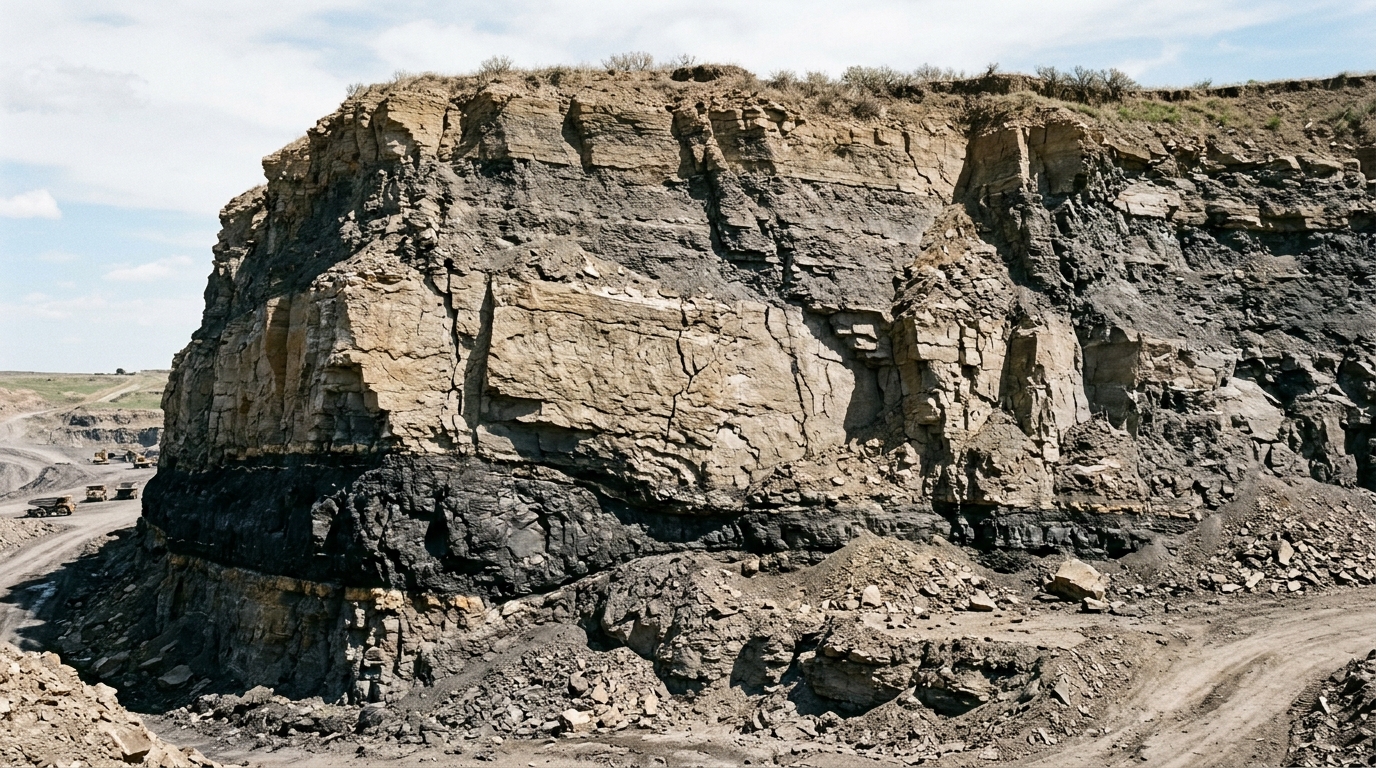
To clarify the complex mechanisms underlying differential overburden failure and non-uniform ground damage caused by variable coal seam thickness in shallow-buried, loess-covered western mining regions, an extensive geotechnical investigation was conducted at the 6106 working face in Ordos. The research team evaluated the subterranean site through an integrated approach combining direct field monitoring, theoretical mechanical analysis, physical similarity simulation, and three-dimensional distinct element numerical simulation using the 3DEC computational modeling platform.
The investigation demonstrated that natural variation in coal seam thickness fundamentally reconfigures both the pre-mining immediate-roof stress field and the overall stiffness structure of the surrounding coal-rock assemblage. By altering how stress is distributed prior to any excavation, this spatial variability in coal thickness establishes a coal-rock transition interface characterized by significant geometric and mechanical discontinuity across the geological formation before extraction begins.
In the mechanical analysis presented by the researchers, this coal-rock transition boundary is idealized as a potential weak structural plane within the overburden architecture. This structural vulnerability arises directly from the combined mechanical effects of seam-merging geometry, substantial stiffness contrast between the coal and adjacent rock layers, and the resulting deformation incompatibility that develops along the discontinuous contact boundary.
The research identified important differences in the baseline stress environment across distinct sections of the working face prior to extraction. Although the eastern thinning zone exhibits a greater burial depth, which naturally produces a larger burial-depth-controlled self-weight stress component before mining commences, the combined influence of seam-thickness variation and stiffness discontinuity induces localized stress redistribution specifically near the transition zone.
During active extraction of the coal seam, both the merging zone and the transition zone exhibit heightened vulnerability to key-stratum instability, upward fracture propagation, and non-uniform ground damage. This increased susceptibility occurs because the merging zone features a larger equivalent mining height and greater goaf free space, while the transition zone experiences pronounced deformation incompatibility directly linked to the presence of the weak structural plane.
Multiple observational techniques—including physical similarity simulations, 3DEC numerical modeling, surface GNSS monitoring, and in-situ field observations—yielded highly consistent results regarding the nature of surface disruption. Across all observation platforms, surface damage was dominated by step-like subsidence profiles, extensive boundary fissures, and localized surface collapse events, with ground damage documented as being notably most severe within the seam-merging zone.
The researchers also determined that the working face advance rate serves as a primary operational control over overburden behavior by regulating goaf compaction and overlying rock response. Through this regulatory mechanism, the face advance rate directly governs key-stratum subsidence, the upward development height of fractures, and the magnitude of bed separation occurring between stratified rock layers during the progression of mining.
To identify optimal operational parameters, the study evaluated four distinct face advance rates: 5, 10, 15, and 20 meters per day. Among these four investigated advance rates, 15 meters per day produced the smallest key-stratum subsidence before a subsidence rebound occurred at 20 meters per day, while simultaneously maintaining comparatively moderate fracture development and bed-separation growth throughout the rock mass.
Based on these mechanical findings, the researchers designated 15 meters per day as the preferred site-specific advance rate specifically for the 6106 working face, cautioning that it should not be treated as a universally optimal value for other operations. To address the documented geotechnical risks systematically, the authors proposed a comprehensive whole-process damage-mitigation strategy combining zonal advance-rate optimization, coordinated subsurface grouting, and subsequent post-mining ecological restoration.
Subject of Research: Overburden failure and surface damage mechanisms under variable coal seam thickness
Article Title: Mechanism and control of differential overburden failure and non-uniform surface damage induced by coal seam thickness variation in shallow-buried mining
Article References: Liu, B., Wang, Z., Wang, P., An, X., & Zhao, H. (2026). Mechanism and control of differential overburden failure and non-uniform surface damage induced by coal seam thickness variation in shallow-buried mining. Geomechanics and Geophysics for Geo-Energy and Geo-Resources. https://doi.org/10.1007/s40948-026-01273-w
Image Credits: AI Generated
DOI: 10.1007/s40948-026-01273-w
Keywords: coal seam thickness variation, shallow-buried mining, overburden failure, surface damage, 6106 working face, Ordos, key-stratum instability, weak structural plane, deformation incompatibility, step-like subsidence, boundary fissures, goaf compaction, face advance rate, bed separation, 3DEC numerical simulation, coordinated grouting, ecological restoration
News Source: Denise Maddox. (November 28, 2026). Coal Seam Thickness Variations Trigger Differential Overburden Failure in Shallow Mining. Scienmag.