


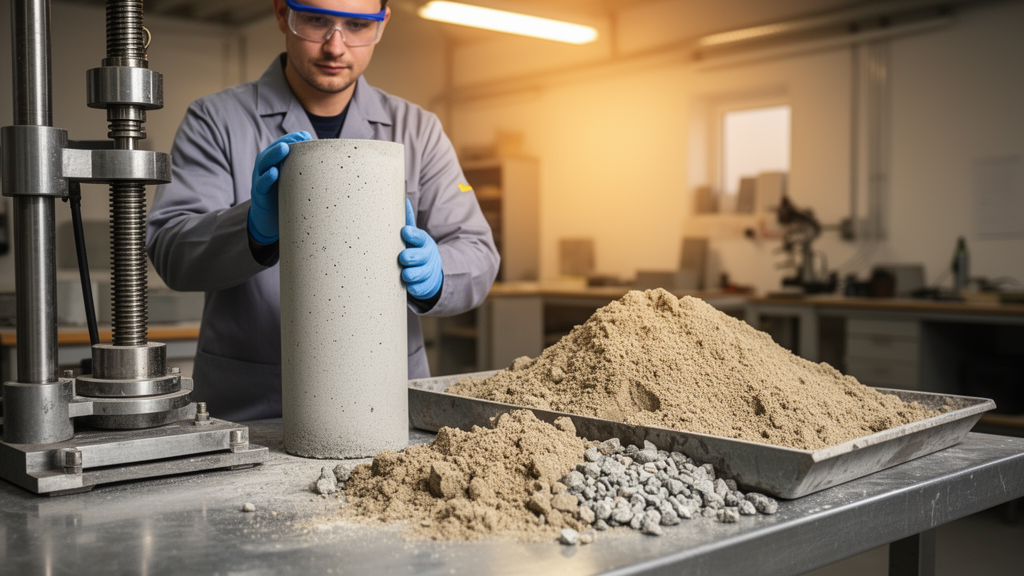
Concrete production depends heavily on sand, and in India that dependence has become a problem. River sand has grown scarce as rivers deteriorate and weather patterns shift, while stricter regulations on resource extraction and expanding infrastructure development have deepened the shortage. A new study explores whether waste dug out of coal mines could help fill the gap.
Their aim was to assess whether this processed overburden material could serve as a viable alternative aggregate in M20 grade concrete.
The team tested concrete in which natural sand was replaced with Processed Overburden Double Refined Material, or PODRM, a refined product manufactured from the mine waste. The manufacturing process matters, the authors note, because it is a significant factor in determining the costs that decide whether waste-based materials are economically feasible.
The experimental results showed that concrete with 100 percent replacement of natural sand by PODRM achieved the maximum strength among the processed overburden mixes tested. That fully replaced mix also exhibited performance comparable to conventional concrete made with natural sand, suggesting the mine waste could substitute entirely for the scarce material in this grade of concrete.
Strength properties improved with curing age across the mixes, a pattern the authors point to as evidence of the material’s potential over the lifespan of a structure. They describe processed overburden material as an eco-friendly and sustainable alternative to natural sand, particularly relevant for urban areas where construction demand is high and sand supply is under pressure.
The study is published as open access research in Discover Materials, with the article shared early to provide faster access to peer-reviewed, accepted research. The published version is subject to further edits and will be replaced by the final Version of Record, so some details may change before final publication.
The findings address a practical bottleneck for the construction industry. Cementitious products made from waste materials are considered a viable option in the abstract’s framing, and evaluating the strength properties of concrete made from waste materials over its lifespan is described as essential for such applications. By documenting that a fully replaced PODRM mix can match conventional concrete’s strength in M20 grade, the study adds a specific, tested data point to that broader case.
Because the reported results come from the abstract of an early-access article, the full experimental details — including the number of mixes, testing methods and statistical treatment — will be available in the complete paper. The authors’ comparison of riverbed sand with coal seam overburden sand, and the strength gains observed with curing age, form the core of what the published evidence currently supports.
Subject of Research: Using processed coal mine overburden sand as a replacement for natural sand in concrete
Article Title: Towards sustainable construction using processed overburden sand from coal mines as an alternative material for concrete
Article References: Devi, G. S. L., Teshome, H. M., & Prasad, C. V. S. R. (2026). Towards sustainable construction using processed overburden sand from coal mines as an alternative material for concrete. Discover Materials. https://doi.org/10.1007/s43939-026-01021-7
Image Credits: AI Generated
DOI: 10.1007/s43939-026-01021-7
Keywords: concrete, coal mine overburden, PODRM, natural sand shortage, M20 grade concrete, sustainable construction, construction materials, India, curing age, waste materials, Towards, sustainable
News Source: Denise Maddox. (October 28, 2026). Coal mine overburden sand matches conventional concrete performance in M20 mixes. Scienmag.



