High-throughput molecular dynamics simulations and machine learning models reveal that increasing carbon dioxide concentration in polycrystalline methane-carbon dioxide hydrates significantly reduces their thermal stability. The study, published in Carbon Neutrality, demonstrates that for every 20% increase in CO2 concentration, the melting point of these hydrate structures decreases by approximately 6 Kelvin. This finding provides a molecular-level explanation for the trade-offs involved in using CO2 injection for methane recovery and carbon sequestration in natural gas hydrate reservoirs. The research addresses a critical gap in understanding how the thermal stability of polycrystalline hydrates, which are common in real-world geological settings, changes when CO2 replaces methane as a guest molecule within the water cage framework.
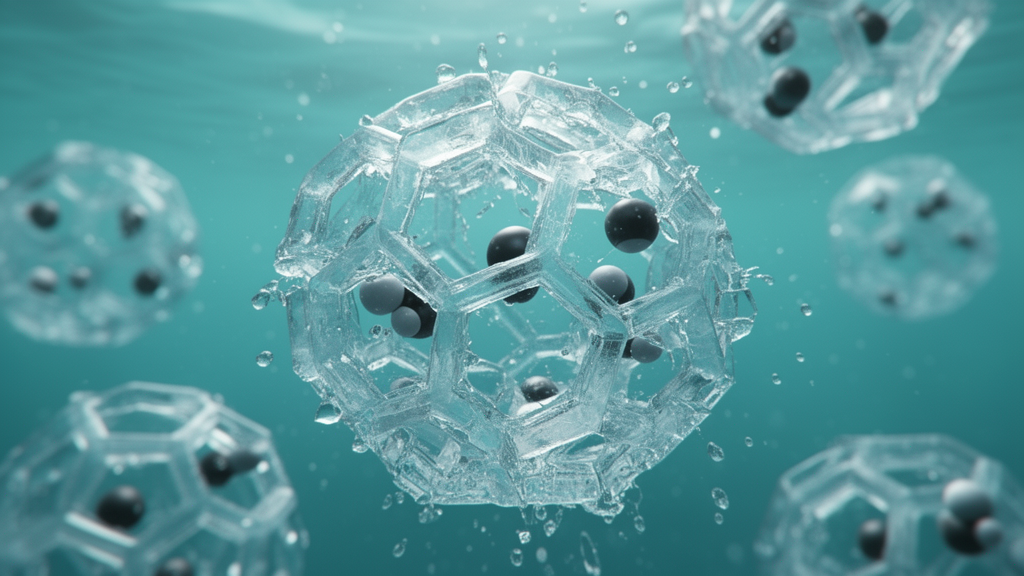
Natural gas hydrates are non-stoichiometric compounds formed under low-temperature and high-pressure conditions, consisting of a three-dimensional cage framework of hydrogen-bonded water molecules. Small guest molecules, such as methane and carbon dioxide, are trapped within these cages by van der Waals and coulombic forces. While methane hydrates are the primary target for energy recovery, carbon dioxide has attracted interest as a guest molecule because it can displace methane from deep-sea reservoirs. This replacement process not only facilitates natural gas recovery but also enables geological carbon storage, making it a promising strategy within carbon capture and storage technologies. However, the thermal stability of the resulting mixed hydrates, particularly in their polycrystalline forms, had remained poorly understood prior to this study.
To investigate these stability mechanisms, the researchers constructed 120 polycrystalline methane-carbon dioxide hydrate models using a cubic simulation box of 6 by 6 by 6 nanometers. These models were divided into six groups based on varying molar ratios of methane to carbon dioxide, ranging from 1:4 to 4:1. The simulations employed the TIP4P/2005 model for water molecules, the EPM2 forcefield for CO2, and the OPLS-UA forcefield for methane. The systems were equilibrated at 260 K and 10 MPa before being subjected to thermal heating from 260 K to 320 K over 60 nanoseconds. This heating process allowed the researchers to observe the dynamic dissociation features and structural transformations of the clathrate cages under conditions that mimic geological confinement.
The melting points of the hydrate samples were determined using the Lindemann index, a quantitative method that analyzes the variance of root-mean-square relative bond lengths to detect the loss of crystalline order. The results showed a clear linear relationship between CO2 concentration and melting point, with pure methane hydrates exhibiting the highest stability and pure CO2 hydrates the lowest. The average melting points ranged from approximately 310 K for pure methane hydrates to 274 K for pure CO2 hydrates. This systematic decrease in melting point with increasing CO2 concentration highlights the destabilizing effect of CO2 on the hydrate structure, a trend consistent with previous molecular dynamics simulations but now quantified for polycrystalline systems with greater precision.
Microstructural analysis revealed that the destabilization arises from CO2-induced distortion of the 512 cages and the formation of unconventional metastable cages at grain boundaries. In structure I hydrates, the 512 and 51262 cages are the primary components, but the presence of CO2 leads to a reduction in the number of 512 cages. CO2 molecules, due to their quadrupole moment and stronger electrostatic interactions with water, reorient water molecules within the 512 cages, causing distortion. In contrast, methane molecules, being spherical and non-polar, allow for more facile water mobility and lower transformation barriers. This difference in guest-host interactions explains why CO2-containing hydrates exhibit lower thermal stability and reduced frequency of cage transformations during heating.
The study also identified that thermal dissociation proceeds through complex cage transformations and dissociations, with 51262 and 4151062 cages acting as hubs for solid-solid restructuring pathways. Heatmaps of cage transformations showed that CO2 suppresses these transformations, with the frequency of 512 to 4151062 transformations decreasing by more than 400 as CO2 concentration increases from 0% to 100%. This suppression is attributed to the increased energy barrier for structural transitions caused by CO2’s stronger interactions with the water framework. The findings suggest that large-scale CO2 injection into natural gas hydrate reservoirs could weaken the thermal stability of hydrate-bearing sediments, potentially compromising reservoir integrity during methane recovery operations.
To predict melting points more efficiently, the researchers developed machine learning models, including Gradient Boosting Decision Tree, XGBoost, and Random Forest, trained on microstructural data from the simulations. The GBDT model achieved the best overall performance, with a coefficient of determination of 0.85 and a root mean square error of 4.75 K on the testing set. Feature importance analysis identified the 512, 51262, and 51263 cages as the most critical predictors of melting point. This predictive framework offers a practical tool for screening hydrate stability in carbon sequestration and natural gas recovery scenarios, where direct molecular dynamics simulation of every possible configuration is computationally prohibitive. The model’s ability to rapidly estimate melting points based on cage populations provides a valuable resource for optimizing injection strategies and ensuring safe operations.
The study acknowledges that the melting points obtained are defined as equilibrium states under specific molecular dynamics conditions, which are generally higher than experimental equilibrium dissociation temperatures. This discrepancy arises from the definition of melting in simulations as the loss of crystalline order, the nanoscale nature of the simulation boxes, and the much faster heating rates used in simulations compared to experiments. Despite these differences, the relative trend of CO2 hydrate stability being lower than mixed hydrates and methane hydrates is consistent with both experimental data and prior simulations. The researchers emphasize that while the absolute values may differ, the mechanistic insights into CO2-induced destabilization are robust and applicable to understanding real-world hydrate behavior.
The implications of these findings extend to the design of hydrate storage systems and the optimization of CO2 injection strategies for methane recovery. By understanding how CO2 concentration affects thermal stability and cage transformation pathways, engineers can better predict the long-term stability of stored CO2 and the efficiency of methane extraction. The study provides a multi-scale foundation for guiding site selection and operational design in marine settings, such as the South China Sea, where hydrate-based carbon sequestration is being explored. The integration of molecular dynamics and machine learning offers a robust framework for predicting hydrate behavior in complex geological environments, advancing the field of carbon capture and storage technologies.
Future research may expand the dataset to include more diverse microstructures and guest compositions to further enhance the predictive power of the machine learning models. The current study focuses on polycrystalline systems with specific molar ratios, but real-world reservoirs may exhibit greater heterogeneity. Additionally, the role of other guest molecules and the impact of mechanical stress on hydrate stability could be explored in subsequent studies. The findings of this research contribute to a deeper understanding of the molecular mechanisms governing hydrate stability, which is essential for the safe and efficient exploitation of natural gas hydrates and the effective sequestration of carbon dioxide in geological formations.
The molecular dynamics simulations were conducted using the GROMACS software package, with atomic motions integrated at a 2.0 femtosecond timestep. To maintain the systems at the target temperature and pressure during equilibration and heating, the researchers employed the Nose–Hoover thermostat and the Parrinello-Rahman barostat, respectively. Non-bonded van der Waals interactions were described using the standard 12–6 Lennard–Jones potential, while long-range electrostatic interactions were computed via the Particle Mesh Ewald method. Both the Lennard–Jones and real-space Coulombic interactions utilized a cut-off distance of 12.0 angstroms. These specific computational parameters ensure that the simulated interactions between water, methane, and carbon dioxide molecules align with established forcefield behaviors, providing a reliable baseline for observing structural changes in the polycrystalline hydrate models.
During the thermal heating phase, the Lindemann index curves for the hydrate samples exhibited a distinct three-stage progression. The initial stage involved a slow increase in the index as the hydrates underwent thermally induced volume expansions, accompanied by minor dissociations of the clathrate cages. This was followed by a second stage characterized by a steep rise in the index, indicating significant structural changes and the onset of major melting events. The final stage showed a decline in the index as the hydrates melted on a large scale, resulting in a loss of the crystalline order that the index measures. The critical temperature at which this abrupt increase occurred consistently decreased as the carbon dioxide concentration rose, confirming the destabilizing effect of the gas on the overall thermal stability of the polycrystalline structures.
The machine learning models were trained on a dataset comprising 120 polycrystalline hydrate samples, which was split into training and testing subsets to evaluate predictive performance. Five-fold cross-validation was employed during the training process to prevent overfitting and ensure the robustness of the models. The Gradient Boosting Decision Tree model demonstrated the highest accuracy, achieving a coefficient of determination of 0.85 and a root mean square error of 4.75 Kelvin on the testing set. The Random Forest and XGBoost models also performed well, with testing set coefficients of determination of 0.81 and 0.82, respectively. These results indicate that the initial microstructural information, specifically the populations of various clathrate cages, contains sufficient information to predict the melting points of the hydrates without requiring full-scale molecular dynamics simulations for every configuration.
The study notes that the melting points derived from the simulations are defined as equilibrium states under the specific nanoscale conditions of the models, which differ from macroscopic experimental dissociation temperatures. The simulation boxes, measuring approximately six nanometers in size, contain a high proportion of grain boundaries, which can lead to substantial nanoscale deviations in stability. Furthermore, the heating rate of 1 Kelvin per nanosecond is many orders of magnitude faster than typical experimental rates, potentially causing kinetic over- or under-estimation of transition temperatures. Despite these systematic differences in absolute values, the relative trend of stability, where carbon dioxide hydrates are less stable than mixed hydrates, which are in turn less stable than methane hydrates, remains consistent with both experimental data and previous molecular dynamics studies.
Subject of Research: Molecular dynamics and machine learning analysis of thermal stability in polycrystalline methane-carbon dioxide hydrates
Article Title: CO2 sequestration trade-offs in polycrystalline hydrate stability
Article References: Li, X., Huang, J., Xiong, K., Qu, Y., Shi, X., Li, Y., Zhang, Z., & Wu, J. (2025). CO2 sequestration trade-offs in polycrystalline hydrate stability. Carbon Neutrality, 4(1), Article 33. https://doi.org/10.1007/s43979-025-00151-w
Image Credits: AI Generated
DOI: 10.1007/s43979-025-00151-w
Keywords: carbon sequestration, gas hydrates, molecular dynamics, machine learning, thermal stability, methane recovery, clathrate cages, polycrystalline structures, CO2 injection, carbon capture and storage, sequestration, trade-offs
News Source: Sloane Callahan. (November 10, 2026). CO2 Reduces Polycrystalline Hydrate Stability by 6 K per 20% Increase. Scienmag.