In the red clay hills of rural Rwanda, a simple pair of rubber boots is doing more than keeping soil off farmers’ feet. A new study published in PLOS Global Public Health reports that a women-centered farming boot, co-designed with the very people who would wear it, encouraged consistent footwear use among rural farmers and fostered an unexpected sense of pride and empowerment among women, even as restrictive gender norms and community mockery persisted. The findings offer a rare, detailed look at how a neglected tropical disease can be fought not just with medicine or education, but with a product built around the daily realities of the people most at risk.
Podoconiosis, the disease at the heart of the research, is a non-infectious neglected tropical disease characterized by progressive swelling of the lower limbs, lesions, and nodular growths. It develops when irritant mineral particles in alkaline red clay soil penetrate bare skin over years of exposure, triggering chronic inflammation and non-filarial lymphoedema. The condition disproportionately affects subsistence farmers in low-income regions of Africa, Central and South America, and Southeast Asia who work barefoot with limited access to water. Beyond its physical toll, podoconiosis carries heavy social costs, including stigma, psychological distress, reduced economic productivity, and social exclusion that trap affected households in cycles of poverty. Across sub-Saharan Africa, the disease remains endemic in twelve countries, with the highest prevalences reported in Cameroon at 8.1 percent, Ethiopia at 7.5 percent, Uganda at 4.5 percent, and Kenya at 3.9 percent. Rwanda reports a national prevalence of 68.5 cases per 100,000 people, and women are twice as likely to be affected as men.
The scientific case for footwear as prevention is well established. Shoes and socks form a physical barrier that reduces contact with irritant soil particles, and to be effective the footwear must cover both the soles and the tops of the feet while withstanding labor that increases soil exposure. In Europe and North Africa, behavior change communication combined with increased shoe-wearing contributed to the elimination of podoconiosis decades ago. In Ethiopia, organizations such as Mossy Foot International have established workshops that manufacture and distribute more than 400 pairs of shoes monthly, improving shoe-wearing behavior and case management in endemic communities. Yet in Rwanda, national prevention strategies have primarily emphasized community education about the benefits of wearing shoes, an approach that earlier research suggested was insufficient on its own. Protective footwear at local markets is often expensive and unaffordable for high-risk populations, suitable options are scarce in village stores, and consistent shoe-wearing is constrained by a complex interplay of gender norms, power dynamics, and community backlash. Women’s limited control over household finances and decision-making further hinders rural female farmers from purchasing and wearing boots.
To address these barriers, a research team from the University of Global Health Equity partnered with Heart and Sole Africa, a community-based organization providing podoconiosis care in Rwanda, and DuHope, a Community Benefit Company that equips Rwandan women leaving sex work with job skills and employment. Guided by gender transformative approaches and a Target Product Profile framework, which outlines preferred product specifications before development based on the needs of the target population, the collaboration set out to test a culturally and ergonomically acceptable boot prototype built from previously identified farmer preferences. DuHope analyzed locally available raw materials, developed six prototypes, and subjected them to iterative testing and modification before a final design balancing functionality, design, and cost was approved for production by a local manufacturer.
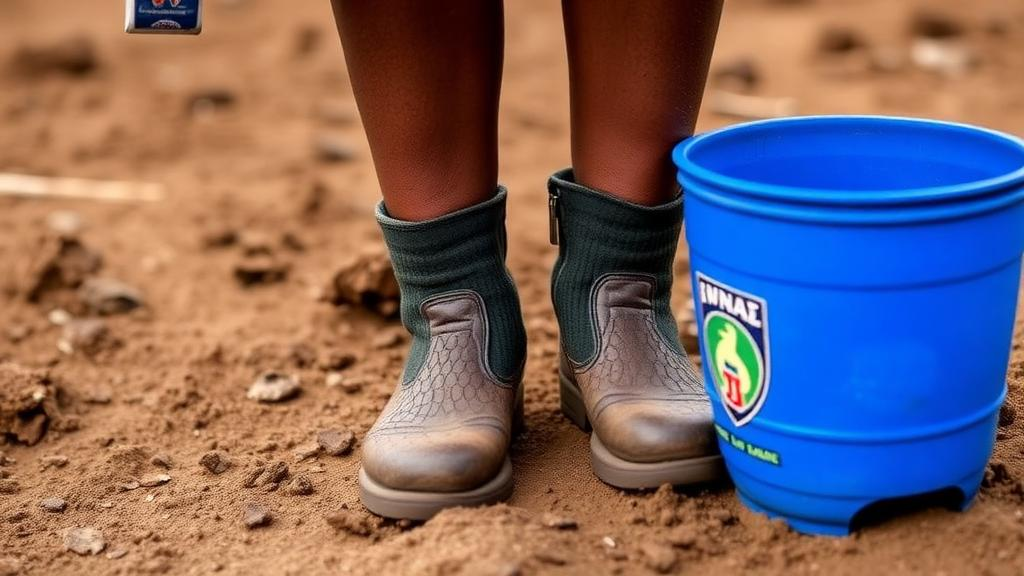
The resulting boot was a waterproof rubber design available in green, black, and blue. It stood mid-calf in height, featured grooved soles for traction, and included a soft padded inner sock that could be washed and dried within an hour. The top of the boot was open and laced, allowing wearers to adjust the fit to their preference. In a deliberate nod to aesthetics and identity, the top edge was lined with kitenge fabric matching the traditional and daily attire of rural women, covered with transparent plastic to ease cleaning and enhance durability. The design details mattered: women in earlier assessments had reported that boots felt like garments meant for men, and the team hoped a visibly women-centered product could begin to dismantle that perception.
Boots were distributed to 148 rural farmers, 110 women and 38 men, living in the four cells with the highest podoconiosis prevalence across Rwanda’s provinces, in the districts of Nyamasheke, Musanze, Nyagatare, and Nyaruguru. Participants were asked to wear the prototypes daily during farming, household chores, market trips, and other regular activities while noting their observations. The distribution was paired with community education campaigns covering the causes, management, and prevention of podoconiosis, as well as gender norms and myths associated with boots. Participants also received empowerment materials, including bracelets inscribed with the Kinyarwanda slogan “Ibirenge Bizima,” meaning Fit Feet, and a comic book narrating a female protagonist’s journey of learning about a mysterious disease that caused her friend’s feet to swell. After a one-month trial, the team conducted sixteen audio-recorded focus group discussions with the farmers to explore their experiences.
The results were striking. Farmers reported that receiving the boots and engaging with the education campaign encouraged more consistent shoe-wearing, and participants living with podoconiosis perceived meaningful improvements in their symptoms, including reduced swelling and itching and an improved ability to wear normal shoes. One woman in Nyagatare recounted visiting a clinic where staff exclaimed that her podoconiosis appeared cured, and replying that it was because of the boots. Mindsets shifted as well: women who had once believed boots were only for men came to see them as protective equipment for everyone, and some male participants testified that the change inspired other women in their communities to buy and wear boots without fear of judgment. The boots were perceived as comfortable and versatile, suitable for farming, rearing livestock, fetching water, and going to the market, although a few participants noted they remained inappropriate for social occasions such as weddings or church because of the outfits worn at those events. A long-standing fear that boots would damage crops also eroded under the weight of personal experience, though some farmers still removed them during certain harvesting tasks.
Yet the study does not shy away from the social friction the boots generated. Persistent stereotypes labeled women who wore boots as disrespectful, confused them with agronomists, or assumed they were rich simply because they owned a pair, and one woman reported that wearing the boots made it harder to find casual farming work. Some men initially viewed women in boots as overstepping gender boundaries, and older women in particular described feeling intimidated by the prospect of being seen in footwear that conflicted with dominant cultural norms. Some farmers who wore the boots in public were even labeled as diseased or disabled, a reaction the researchers attribute to the boots being distributed to a subset of the community and to their unfamiliar design. Crucially, however, most female farmers reported that these norms and reactions did not deter them from wearing the boots while farming, because they understood the protective value. Many turned mockery into an opportunity to educate their neighbors about podoconiosis prevention, reframing the footwear from a symbol of illness into one of protection. Support from husbands, local leaders, and peers reinforced their resolve, and one district official’s endorsement of women wearing boots as a sign of development validated female farmers and fostered positive community attitudes.
The authors argue that these findings carry important lessons for Rwanda’s 2030 goal of eliminating podoconiosis through scaled-up integrated clinical services and locally driven solutions. Combining education with boot distribution mirrors successful approaches elsewhere, such as western Uganda, where pairing footwear distribution with culturally tailored education increased shoe-wearing by 25 percent, and Ethiopia, where more than 77 percent of individuals with podoconiosis reported reduced swelling after consistent footwear use. The study also demonstrates that participatory, gender transformative design can foster empowerment and challenge power imbalances, but that such changes are gradual and require broader efforts to address structural and economic barriers. The researchers caution that footwear interventions can unintentionally reinforce disease-related labels when they target only a subset of the population, and they recommend pairing future scale-up with community-wide sensitization and distribution approaches that avoid singling out specific groups. Limitations include the short one-month trial period, the absence of clinical testing of the boots’ effectiveness against disease progression, the free distribution of the prototypes, and the potential influence of the Hawthorne effect, since farmers knew they would later evaluate the footwear. Even so, the study stands as a compelling demonstration that equitable access to protective footwear, treated as a public health priority and grounded in the lived experiences of at-risk communities, can transform both disease prevention and the social fabric of the villages where it is needed most.
Subject of Research: Testing a co-designed protective farming boot to prevent podoconiosis among rural female farmers in Rwanda
Article Title: “My feet are no longer swollen”: Testing a co-designed podoconiosis protective footwear among rural female farmers in Rwanda
Article References: Igihozo, G., Dusabe, L., Uwizeyimana, J., Boiles, J., Huston, T., & Schurer, J. M. (2026). “My feet are no longer swollen”: Testing a co-designed podoconiosis protective footwear among rural female farmers in Rwanda. PLOS Global Public Health, 6(10), e0007114. https://doi.org/10.1371/journal.pgph.0007114
Image Credits: AI Generated
DOI: 10.1371/journal.pgph.0007114
Keywords: podoconiosis, neglected tropical diseases, Rwanda, protective footwear, gender norms, community-based participatory research, women farmers, lymphoedema, soil exposure, public health, stigma, footwear design
News Source: Courtney Benton. (October 10, 2026). Co-Designed Boots Help Rwandan Women Farmers Fight a Disabling Soil Disease. Scienmag.