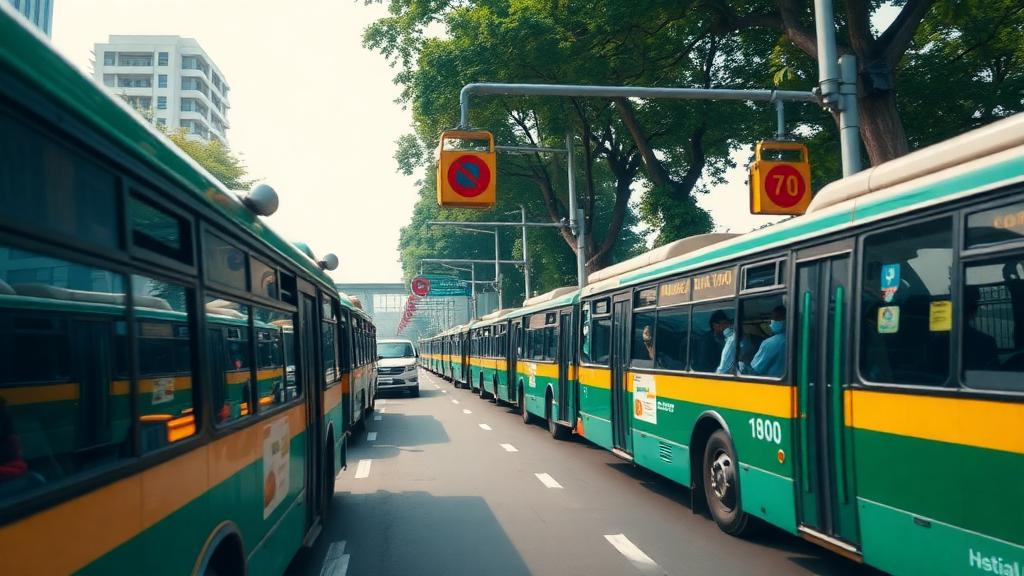
A study of bus services in Delhi, Mysore and Surat found that a cluster-aware deep-learning framework improved bus arrival-time predictions by reducing route heterogeneity and capturing localized patterns in travel time. The research compared three model families across cities with different traffic and operational conditions, suggesting that prediction performance depends not only on the algorithm but also on the features supplied and the environment in which it operates.
The researchers addressed two features of bus travel forecasting. First, they used temporal analysis to identify temporal input features rather than choosing them arbitrarily or solely according to data availability. Second, they applied deep embedded clustering to group road segments with similar spatio-temporal travel-time characteristics. This produced localized groups that could be modeled separately, allowing each prediction system to focus on a more internally consistent set of road-segment patterns than a single model fitted across the full route.
For each cluster, the team developed and compared three deep-learning models: long short-term memory, or LSTM; convolutional LSTM, or ConvLSTM; and ConvLSTM with an attention mechanism. The study then assessed the models under the different operational conditions represented by the three cities. Delhi and Mysore both had buses operating in mixed traffic, but Delhi had high travel-time variability and Mysore relatively low variability. Surat’s bus rapid transit system included dedicated bus lanes and therefore represented a distinct operating environment.
The results indicate that the proposed framework improved prediction accuracy within the tested settings by reducing route heterogeneity and more effectively capturing localized spatio-temporal patterns. The comparison also showed why a single preferred architecture may not be appropriate across all transit systems: the model’s suitability depended on the traffic and operational characteristics of the city. The authors describe the findings as practical guidance for choosing arrival-time prediction models according to city-specific traffic variability, with potential for supporting more scalable and reliable bus transit operations.
The study’s scope is limited to data and operating conditions from three Indian cities, so the reported improvement should not be interpreted as proof of performance in every transit network. Its framework also depends on the quality of the input data and on temporal and spatio-temporal patterns being represented adequately in those inputs. Within those boundaries, the research offers a data-driven approach to bus arrival-time prediction: identify relevant temporal information, group road sections according to similar travel behavior, and fit specialized models to those groups rather than treating every segment of a route as equivalent.
Subject of Research: Cluster-aware deep learning for bus arrival-time prediction in Delhi, Mysore and Surat
Article Title: Cluster-aware deep learning framework for bus arrival time prediction in Indian cities
Article References: Singh, R., Garg, M., & Kumar, B. A. (2026). Cluster-aware deep learning framework for bus arrival time prediction in Indian cities. Scientific Reports. https://doi.org/10.1038/s41598-026-76101-y
Image Credits: AI Generated
DOI: 10.1038/s41598-026-76101-y
Keywords: bus arrival prediction, deep learning, public transport, traffic variability, spatio-temporal modeling, LSTM, ConvLSTM, attention mechanism, Indian cities, transit operations, Cluster-aware, deep
News Source: Blake Davidson. (October 19, 2026). Cluster-aware deep learning framework for bus arrival time prediction in Indian cities. Scienmag.